Ben Felix
AI Audio Summaries
15 videos summarized
4 followers on BriefTube
Last summary: Apr 26, 2026
AI Audio Summaries
15 videos summarized
4 followers on BriefTube
Last summary: Apr 26, 2026
Read AI summary
YouTube
Upcoming mega IPOs from private companies like SpaceX, OpenAI, and Anthropic are poised to impact public stock markets and index fund investors. If these companies go public, their sheer size means they would rank among the largest firms, forcing index funds to buy their stock, whether investors like it or not. This raises questions because IPOs have historically been poor investments, and these particular ones present unique challenges. Index funds are generally excellent investments, aiming to deliver broad public stock market returns. To fulfill this role, many stock indices include new IPOs soon after a company lists. However, this practice is problematic for index fund investors because IPOs have a history of terrible returns. With trillions of dollars under their control, index funds' mandatory buying of newly listed stocks can significantly influence share prices. This creates a desirable scenario for the IPOing company and its early investors, providing liquidity and pushing up prices, but often leaves index fund investors "holding the bag" as prices tend to revert.
Read AI summary
YouTube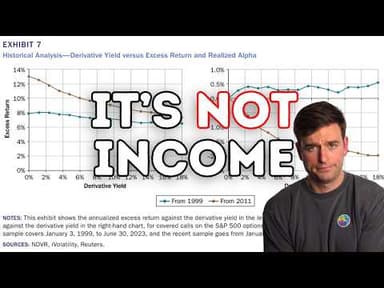
In this transcript, Ben Felix, the Chief Investment Officer at PWL Capital, presents a detailed critique of covered call strategies, labeling the promise of passive income from these vehicles as a "devil's bargain." He argues that while these strategies are marketed to exploit the common behavioral bias for high distribution yields, they are mechanically structured to underperform their underlying equities over the long term. Felix’s central thesis is that the yields provided by covered call funds are not equivalent to investment returns and that these strategies fundamentally alter the risk profile of an equity portfolio in a way that is detrimental to long-term investors. The mechanics of a covered call involve an investor owning an equity and selling a call option on that same asset. This sale generates an immediate premium, which funds typically distribute as cash to investors. However, this premium comes with a significant liability: the fund sells the right for the option holder to buy the stock at a predetermined "strike price." If the stock’s market value rises above this strike price, the fund is forced to sell the asset at the lower price, effectively capping the investor's upside. Felix explains this using the concept of "delta," which measures exposure to the underlying asset. Selling a call option creates a "short delta," reducing the investor's exposure to the equity risk premium. To achieve the high yields that attract retail investors, funds must sell options with lower strike prices, which increases the short delta and further reduces expected total returns.
Read AI summary
YouTube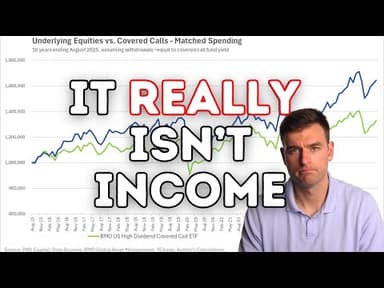
In this transcript, Ben Felix, the Chief Investment Officer at PWL Capital, provides a detailed critique of covered call funds. Despite their growing popularity among retail investors, Felix argues that these products are often detrimental to long-term wealth accumulation and even to those seeking consistent retirement income. He frames covered call funds as a "perfect storm" of financial innovation that benefits product providers more than consumers by exploiting common investor biases toward high-yield distributions. To understand why these funds can be problematic, Felix first explains the mechanics of a covered call. This strategy involves owning an underlying stock and selling a call option to another party. The buyer of the option pays a premium for the right to purchase the stock at a specific "strike price." If the stock price remains below the strike price plus the premium, the seller keeps the premium and the stock, technically performing better than if they had simply held the shares. However, if the stock price rises significantly above the strike price, the option is exercised, and the seller’s upside is capped. Crucially, on the downside, the investor remains almost fully exposed to losses; the small premium collected offers very little protection during a market crash.
Read AI summary
YouTube
In this transcript, Ben Felix, Chief Investment Officer at PWL Capital, provides a detailed critique of covered call ETFs, arguing that these increasingly popular financial products are fundamentally destructive to long-term wealth. Despite their marketing as high-yield "income" solutions, Felix asserts that they exploit investor biases and deliver inferior returns compared to simple index funds. The discussion begins by situating covered call funds within the broader history of the financial industry. Felix notes that for decades, high-fee, actively managed mutual funds siphoned wealth from investors. While the rise of low-cost index funds initially countered this trend, the industry has now "come full circle." A new wave of high-fee products—covered call ETFs—is being promoted by unlicensed content creators who sell "hope" and a "better future" without explaining the true costs. Felix references economist John Campbell to argue that the financial system often oversupplies products with hidden costs and exaggerated benefits because consumers are not always rational actors. In the case of covered calls, investors are psychologically attached to the idea of "income," and fund companies are eager to cater to this bias by charging high fees for a service that Felix views as detrimental.
Read AI summary
YouTube
This summary provides a foundational overview of investing as presented by Ben Felix, Chief Investment Officer at PWL Capital. It covers the necessity of investing, the mechanics of stocks and bonds, the debate between active and index management, and practical tools for implementation. ### The Necessity of Investing
Read AI summary
YouTube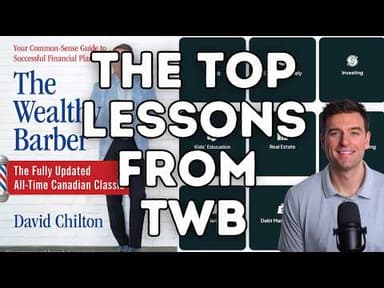
The 2025 edition of *The Wealthy Barber* by Dave Chilton remains a foundational guide to Canadian personal finance. Narrated through the story of a young couple, Matt and Maddie, who seek advice from Roy, a financially successful local barber, the book demystifies wealth building for those without high incomes. Roy’s central message is that financial success is not a mathematical feat but a matter of discipline and understanding a few straightforward concepts. He emphasizes that anyone is capable of managing their own money effectively once they grasp these core principles. **The Golden Rule: Pay Yourself First**
Read AI summary
YouTube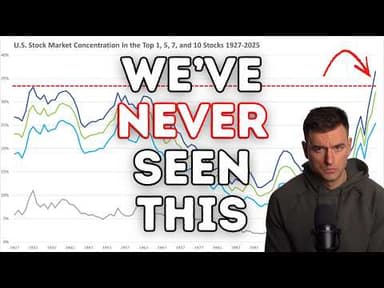
In this video, Ben Felix, the Chief Investment Officer at PWL Capital, examines the current state of index investing, specifically focusing on the unprecedented levels of market concentration and high valuations within the US stock market. Currently, just seven stocks account for 36% of the S&P 500 and 32% of the total US market. This represents the most extreme level of concentration in US market history, dating back to 1927. Furthermore, US stock market valuations are nearing their 1999 peaks, which were historically followed by a decade of stagnant returns. While these figures are concerning, Felix suggests that mitigating the risks associated with these conditions is achievable through historical perspective and disciplined strategy. Felix addresses the uncertainty surrounding a potential "AI bubble," noting that such phenomena are only identifiable in hindsight. However, current market behavior mirrors past technological revolutions, such as the rise of railroads in the 1840s and the internet in the late 1990s. These periods are characterized by massive infrastructure spending and skyrocketing asset prices, often followed by a painful correction. Felix describes these as "productive bubbles" because, despite the financial waste and investor losses, they facilitate the deployment of transformative technologies like fiber optic cables or railway tracks that pave the way for future economic growth. Since the launch of ChatGPT in November 2022, AI-related stocks have accounted for 75% of S&P 500 returns, 80% of earnings growth, and 90% of capital spending growth, indicating that the current price increases are backed by some economic substance rather than pure hype.
Read AI summary
YouTube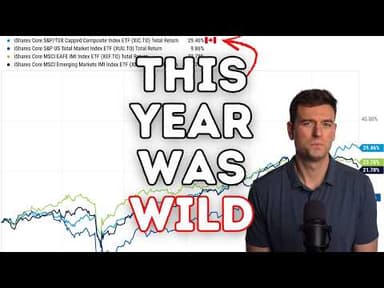
In this retrospective of 2025, Ben Felix, Chief Investment Officer at PWL Capital, reflects on a year defined by personal challenges, significant corporate shifts, and market outcomes that defied almost every expert prediction. For Felix, the year began with a personal battle against testicular cancer and a major transition for his firm, PWL Capital, which was acquired by the American firm One Digital. Despite these upheavals, the primary focus of his review is the series of surprising market lessons that unfolded throughout 2025, particularly regarding the resilience of the Canadian market and the enduring value of diversification. The dominant narrative at the end of 2024 was one of American exceptionalism. Investors were increasingly eager to abandon international diversification in favor of a US-only portfolio, spurred by years of US outperformance. At that time, the US market had beaten the Canadian market by nearly five percentage points annualized over five years. Compounding this was a sense of "doom and gloom" regarding Canada’s economy, fueled by a productivity crisis, proposed capital gains tax hikes, and the potential for damaging tariffs following the election of Donald Trump.
Read AI summary
YouTube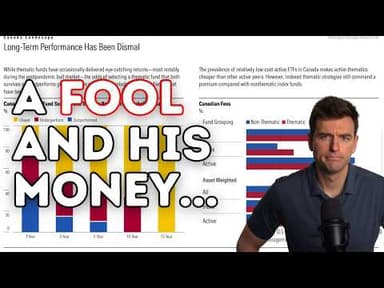
In this presentation, Ben Felix, Chief Investment Officer at PWL Capital, argues that the exchange-traded fund (ETF) market has entered a period of "ETF slop." This term describes a wave of low-quality, complex, and high-fee investment products engineered primarily to attract assets rather than improve investor outcomes. For the first time in U.S. history, there are more ETFs than individual stocks, and actively managed ETFs now outnumber index-tracking funds. This shift marks a departure from the low-cost, sensible investing principles that originally made ETFs successful. Felix highlights that 2025 was a record-breaking year for fund launches, with over 1,000 new ETFs in the U.S. and 300 in Canada, the majority of which are actively managed. While traditional index ETFs often feature fees below 0.1%, the average fee for these new launches exceeds 0.7%, with many topping 1%. This trend threatens to return investors to the "dark ages" of high-fee mutual funds. To help investors navigate this landscape, Felix identifies four specific categories of "ETF slop" that should generally be avoided: thematic ETFs, buffer ETFs, covered call ETFs, and single-stock ETFs.
Read AI summary
YouTube
In the world of index investing, market capitalization weighting is the standard approach. This method assigns weights to companies based on their total market value, meaning larger companies like Apple or Microsoft occupy a larger share of the index. However, a frequent question among investors is whether equal weight index funds—which assign the same percentage to every stock regardless of size—offer a superior alternative. In this transcript, Ben Felix, Chief Investment Officer at PWL Capital, explores why equal weighting may seem attractive on the surface but ultimately introduces inefficiencies that make it less desirable than other strategies. The current appeal of equal weight funds stems from two main concerns: high market concentration and high valuations. In the modern US market, a small handful of massive companies represent a significant portion of market-cap-weighted indexes. Equal weight funds naturally solve this by capping the influence of these giants. Furthermore, equal weight indexes have historically outperformed market-cap-weighted ones over several decades. For instance, the Invesco S&P 500 Equal Weight ETF has slightly outperformed the standard S&P 500 since its inception in 2003. However, Felix argues that these benefits come with significant trade-offs in terms of risk, cost, and strategy.
Read AI summary
YouTube
In the world of personal finance, many individuals focus heavily on factors outside their control, such as trying to predict winning investments, while neglecting the fundamental elements they can actually influence. Ben Felix, the Chief Investment Officer at PWL Capital, identifies the top ten biggest mistakes in personal finance that can determine whether someone lives paycheck to paycheck or enjoys a comfortable future. The first mistake is not earning enough money. While income is influenced by external factors like luck, family background, and geography, an individual’s "human capital"—their ability to earn through work—is often their most valuable asset. Investing in human capital through formal education, trades, or advanced certifications like the CFA charter significantly improves the distribution of potential lifetime earnings and makes income more resilient during economic downturns. Beyond wealth, higher education and income levels are statistically associated with increased happiness, longer lifespans, and better health. Felix emphasizes that while personal finance is personal and one should not choose a hated career for money, no amount of frugality can fully compensate for a fundamentally low income.
Read AI summary
YouTube
In the world of financial economics and portfolio management, few documents are as influential as the 1993 paper by Eugene Fama and Kenneth French. Titled "Common Risk Factors in the Returns on Stocks and Bonds," this research fundamentally altered how investors understand market returns. By identifying a specific group of factors that explain the vast majority of return differences across diversified portfolios, Fama and French moved the industry beyond the limitations of previous models and provided a systematic framework that remains the foundation for modern factor investing. To understand the significance of this paper, one must first look at what preceded it: the Capital Asset Pricing Model (CAPM), developed in the mid-1960s. For decades, the CAPM dominated finance by asserting that a stock’s expected return was tied solely to its "market beta"—the measure of how much a stock moves in relation to the overall market. Under this single-factor model, a higher beta meant higher risk and, consequently, higher expected returns. While the CAPM was groundbreaking enough to earn a Nobel Prize, it eventually faced challenges. Researchers began noticing "anomalies"—patterns where certain stocks delivered higher returns than their market beta could explain.
Read AI summary
YouTube
In this detailed analysis, Ben Felix, Chief Investment Officer at PWL Capital, dismantles the long-standing mystique surrounding private markets. For years, private equity, private credit, and private real estate have been marketed to investors—and increasingly to retail investors—on the premise that they offer superior returns with significantly lower risk than public markets. However, Felix argues that 2024 has served as a critical wake-up call, revealing that these assets are not nearly as "special" as fund managers claim. The central issue is the lack of transparency and liquidity. Because private assets do not trade on public exchanges, they are not subject to daily price discovery. This creates an illusion of stability, a phenomenon Felix describes as "volatility laundering." While the paper value of a fund might appear steady, the underlying economic risks are often identical to, or even greater than, those found in public stocks and bonds.
Read AI summary
YouTube
In this detailed analysis, Ben Felix, Chief Investment Officer at PWL Capital, explores the nuanced differences between two prominent investment vehicles: the Dimensional US Equity Market ETF (DFUS) and the Vanguard Total Stock Market ETF (VTI). While VTI is a traditional index fund tracking the CRSP US Total Market Index, DFUS is a total market fund that intentionally avoids following a rigid index. Felix acknowledges that while low-cost index funds are revolutionary tools for long-term wealth building, they are not flawless. By examining the performance of DFUS since its ETF launch in June 2021, he illustrates how a non-indexed approach can potentially offer structural advantages over traditional index tracking. A central theme of the discussion is the concept of "index drag" caused by rigid rebalancing rules. Traditional index funds like VTI must trade on specific schedules to match their underlying benchmarks. However, research suggests this creates a form of adverse selection. Corporations typically issue new shares or go public (IPOs) when they believe their stock is highly valued, and they execute buybacks when they perceive their stock to be undervalued. Because index funds rebalance quarterly to reflect these changes, they often find themselves buying high and selling low—essentially acting as "bad market timers." Felix cites a 2025 paper suggesting this imposes an implicit performance drag of approximately 60 basis points per year on total market indexes.
Read AI summary
YouTubeBriefTube monitors your YouTube channels, generates AI-powered audio summaries, and delivers them wherever you listen. Telegram, Discord, Slack, or your podcast app. Fully automated.
Start free trial