Was I Wrong About Covered Calls?
AI Summary
In this transcript, Ben Felix, the Chief Investment Officer at PWL Capital, provides a detailed critique of covered call funds. Despite their growing popularity among retail investors, Felix argues that these products are often detrimental to long-term wealth accumulation and even to those seeking consistent retirement income. He frames covered call funds as a "perfect storm" of financial innovation that benefits product providers more than consumers by exploiting common investor biases toward high-yield distributions.
To understand why these funds can be problematic, Felix first explains the mechanics of a covered call. This strategy involves owning an underlying stock and selling a call option to another party. The buyer of the option pays a premium for the right to purchase the stock at a specific "strike price." If the stock price remains below the strike price plus the premium, the seller keeps the premium and the stock, technically performing better than if they had simply held the shares. However, if the stock price rises significantly above the strike price, the option is exercised, and the seller’s upside is capped. Crucially, on the downside, the investor remains almost fully exposed to losses; the small premium collected offers very little protection during a market crash.
Felix highlights that the high distribution yields of these funds are often misleading. While they provide immediate cash, they do so by systematically reducing the portfolio's exposure to the upside while leaving the downside risk intact. This asymmetry prevents the fund from participating in the "mean reversion" or "bouncebacks" that typically follow market downturns, which are vital for long-term equity returns.
To support his claims, Felix presents data comparing several major covered call ETFs to their underlying equity benchmarks. For instance, the Global X S&P 500 covered call ETF trailed the standard S&P 500 ETF by an annualized 3.15 percentage points since 2014. Similar results were found in Canadian markets, where covered call versions of the TSX 60 and Canadian bank funds underperformed their simple equity counterparts by roughly 3.81 and 2.86 percentage points, respectively.
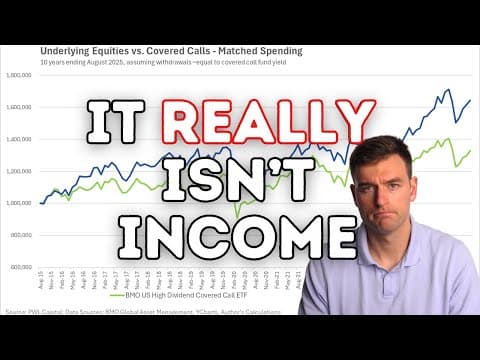
The most significant part of the analysis addresses the needs of income-oriented investors. Felix conducted a withdrawal study comparing five pairs of funds over a ten-year period. In this model, one investor held a covered call fund and spent its distributions, while another held the underlying equity fund and generated the exact same dollar amount of "income" by selling shares and collecting dividends. The results were striking: in every single case, the investor who held the underlying equities and created their own income ended up with more capital—on average, 26% more—after ten years. Felix notes that investors who believe they must receive a "dividend" rather than selling shares are often suffering from "mental accounting bias," which can be financially costly.
Felix further quantifies the "implied cost" of using a covered call strategy. He calculated that an investor would have to pay a non-tax-deductible fee of between 1.5% and 2.7% on a standard equity fund to end up with the same low wealth outcome as the covered call fund. Alternatively, he compared the strategy to holding a mix of stocks and cash. He found that an investor could hold between 19% and 36% of their portfolio in a high-interest savings account and the rest in stocks to match the returns of a covered call fund. However, the cash-and-stock approach is actually safer because the cash portion provides genuine downside protection, whereas the covered call strategy leaves the investor exposed to the full drop of the underlying stocks.
The analysis also covers "enhanced" or leveraged covered call funds. These products use leverage (typically around 125%) to boost yields and potential returns. While these funds can outperform standard covered call funds during bull markets, they still tend to underperform the underlying equities. Felix argues that if an investor is comfortable with the volatility of leverage, it makes more sense to leverage the underlying equity directly rather than leveraging a strategy that caps the upside.
Finally, Felix addresses the broader landscape of financial information. He warns that much of the content promoting covered call funds is sponsored by the very companies that sell them, creating a clear conflict of interest. While Felix acknowledges his own position as a wealth manager, he emphasizes that as a fiduciary, he could choose to use these funds if they were beneficial, but he chooses not to because the data suggests they are detrimental. He concludes that beyond providing a psychological sense of security through frequent distributions, covered call funds lack redeeming qualities for serious long-term investors. He urges investors to look past the "illusion of income" and understand the high long-term costs associated with these complex financial products.