The "AI Bubble"
AI Summary
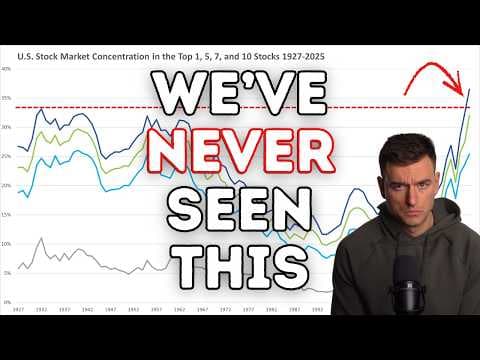
In this video, Ben Felix, the Chief Investment Officer at PWL Capital, examines the current state of index investing, specifically focusing on the unprecedented levels of market concentration and high valuations within the US stock market. Currently, just seven stocks account for 36% of the S&P 500 and 32% of the total US market. This represents the most extreme level of concentration in US market history, dating back to 1927. Furthermore, US stock market valuations are nearing their 1999 peaks, which were historically followed by a decade of stagnant returns. While these figures are concerning, Felix suggests that mitigating the risks associated with these conditions is achievable through historical perspective and disciplined strategy.
Felix addresses the uncertainty surrounding a potential "AI bubble," noting that such phenomena are only identifiable in hindsight. However, current market behavior mirrors past technological revolutions, such as the rise of railroads in the 1840s and the internet in the late 1990s. These periods are characterized by massive infrastructure spending and skyrocketing asset prices, often followed by a painful correction. Felix describes these as "productive bubbles" because, despite the financial waste and investor losses, they facilitate the deployment of transformative technologies like fiber optic cables or railway tracks that pave the way for future economic growth. Since the launch of ChatGPT in November 2022, AI-related stocks have accounted for 75% of S&P 500 returns, 80% of earnings growth, and 90% of capital spending growth, indicating that the current price increases are backed by some economic substance rather than pure hype.
The video distinguishes between market concentration and market valuations. High valuations—what investors pay for expected future earnings—are generally associated with lower future returns. In contrast, market concentration has a much noisier and less statistically significant relationship with future performance. To illustrate the risks of extreme concentration, Felix points to the Canadian market in the year 2000. At that time, a single company, Nortel Networks, made up 36% of the entire Canadian market index. Its valuation, measured by the Schiller cyclically adjusted price earnings (CAPE) ratio, reached a staggering 60.62. When the bubble burst, the Canadian index dropped by 43% over two years. Interestingly, the Canadian market recovered by 2005, proving more resilient than the US market, which struggled for over a decade following the dotcom crash. A key takeaway from this era was that Canadian value stocks did not crash with the broader market and delivered strong returns during the recovery.
The US experience following the 1999 peak offers another lesson. While the US market was less concentrated then than it is today, high valuations led to a "lost decade." Measured in Canadian dollars, the US market remained flat or negative from March 2000 until July 2013. During this brutal stretch, investors focused on US value stocks and small-cap value stocks fared much better, earning positive returns while the broader market stagnated. This reinforces the idea that diversification is the "only free lunch" in investing, though it requires the behavioral discipline to hold both winning and losing assets simultaneously.
Felix also provides a global perspective on market concentration. Many international markets are historically more concentrated than the US but continue to deliver positive returns. For example, in late 2015, the top seven stocks in the ten largest non-US markets accounted for nearly 41% of their total value. Switzerland’s concentration was as high as 60%, while Japan’s was low at 17%. Despite these differences, these markets provided a meaningful equity risk premium over the subsequent decade. Taiwan, one of the most concentrated markets, even outperformed the US during that period. Statistical analysis of US data back to 1926 shows only a weak, non-significant correlation between market concentration and future returns.
While concentration may not be a perfect predictor of trouble, valuations are more impactful. Data from the ten largest developed stock markets since 1982 shows a clear relationship: higher starting CAPE ratios typically lead to lower ten-year returns. This does not mean a crash is imminent, but it suggests that investors should moderate their expectations for future US market returns. Felix cites the Japanese market of 1989 as a cautionary tale. After reaching extreme valuations, the Japanese market crashed and has not recovered in inflation-adjusted terms as of late 2025. Investors who survived this were those who diversified globally or held value and small-cap value stocks within Japan.
Ultimately, Felix concludes that while high valuations and concentration are defining features of the current US market, they do not necessitate an exit. Instead, they highlight the necessity of diversification and discipline. A properly diversified investor must accept that they will always own underperforming assets, but this strategy ensures they also hold the long-term winners. By maintaining a global perspective and including value stocks, investors can prepare for the aftermath of the current market dynamics without relying on market timing.