Investing 101
AI Summary
This summary provides a foundational overview of investing as presented by Ben Felix, Chief Investment Officer at PWL Capital. It covers the necessity of investing, the mechanics of stocks and bonds, the debate between active and index management, and practical tools for implementation.
### The Necessity of Investing
At its most fundamental level, investing is a tool to combat inflation. Inflation represents the reality that goods and services become more expensive over time, meaning that currency held in cash—or "under a mattress"—inevitably loses purchasing power. To maintain the ability to buy the same amount of "stuff" in the future, individuals must move away from holding pure cash and toward assets with positive expected returns.
Beyond merely keeping pace with inflation, strategic investing facilitates financial independence. This is the process of converting "human capital"—the ability to earn income through work—into "financial capital," or the ownership of assets. Eventually, this financial capital generates enough return that working for money becomes unnecessary. The impact of investment returns on lifestyle is profound: for a 30-year-old, earning a 7% return might require saving only 10% of their income to retire comfortably, whereas earning only 2% (matching inflation) would require saving over 50%. By taking on calculated risks, investors allow the financial markets to do the "heavy lifting" toward their retirement goals.
### Understanding Stocks and Bonds
The two primary building blocks of a long-term portfolio are stocks and bonds. Both are financial assets, which Felix defines as contractual claims on expected future cash flows rather than physical objects like gold or real estate.
**Stocks** represent ownership in a company. When you buy a stock, your investment's value is tied to the company's future profits. While stocks offer high potential returns—historically around 5% after inflation globally over the last 125 years—they are volatile and carry the risk of total loss. Felix warns against "performance chasing," using the Japanese stock market as a cautionary tale. In the late 1980s, Japan was an economic powerhouse, but an investor who entered the Japanese market in 1990 would have lost money in real terms decades later, while the rest of the world’s markets grew significantly. Consequently, global diversification is essential.
**Bonds** are loans made to governments or corporations. Unlike stockholders, bondholders do not participate in a company’s massive successes, but they are also more protected during failures. Bonds are generally less volatile than stocks, making them a useful tool for investors who cannot stomach the "violent" ups and downs of an all-stock portfolio. However, bonds typically offer lower expected returns and are more sensitive to inflation.
### The Case for Index Investing
A common misconception is that successful investing requires "active management"—the attempt to outguess the market by picking winning stocks or timing market crashes. However, Felix highlights the "Efficient Market Hypothesis," championed by Nobel laureate Eugene Fama, which suggests that market prices already reflect all available information.
In practice, very few professional active managers consistently beat the market. Those who do well in one period rarely repeat that success in the next. Furthermore, active management is expensive. In Canada, the average fee difference between active funds and index funds is approximately 0.64%. While this sounds small, it compounds into a massive burden; paying that extra fee could require an individual to save 25% more of their income to achieve the same retirement outcome. Additionally, data on active funds often suffers from "survivorship bias," where poor-performing funds are closed or merged, leaving only the "winners" visible to the public, which creates a distorted view of their actual success rate.
The alternative is **index investing**. An index is a market-capitalization-weighted representation of a market (like the S&P 500 or the S&P/TSX Composite). Index funds do not try to beat the market; they simply seek to capture its total return at a low cost. This approach removes the need for complex analysis or economic prediction, making successful investing accessible to anyone who has the discipline to stay the course.
### Practical Implementation: Asset Allocation ETFs
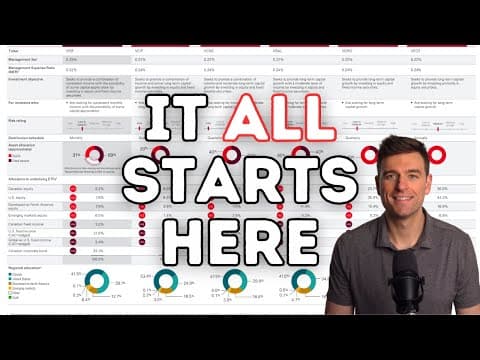
For modern investors, the easiest way to implement a globally diversified index strategy is through Asset Allocation ETFs (Exchange-Traded Funds). These products, offered by firms like Vanguard, BlackRock (iShares), and BMO, provide a "complete" portfolio in a single ticker symbol.
For example, a product like VGRO (Vanguard Growth ETF) holds a mix of thousands of stocks from the US, Canada, international developed markets, and emerging markets, along with a 20% allocation to bonds. These ETFs handle the complex task of "rebalancing"—selling assets that have performed well to buy those that have underperformed—to maintain the investor's target risk level. This automation removes the need for spreadsheets and manual calculations, allowing investors to focus on their long-term goals rather than daily market movements.
### Conclusion
Investing is not about guessing or gambling; it is about capturing the returns the global economy offers through a disciplined, low-cost, and diversified approach. By understanding the trade-off between the volatility of stocks and the stability of bonds, and by avoiding the pitfalls of active management and high fees, individuals can effectively use financial markets as a powerful engine for achieving financial independence. Success requires only baseline knowledge, the right tools like asset allocation ETFs, and the conviction to remain invested through inevitable market cycles.