Covered Calls: What People (Still) Get Wrong
AI Summary
In this transcript, Ben Felix, Chief Investment Officer at PWL Capital, provides a detailed critique of covered call ETFs, arguing that these increasingly popular financial products are fundamentally destructive to long-term wealth. Despite their marketing as high-yield "income" solutions, Felix asserts that they exploit investor biases and deliver inferior returns compared to simple index funds.
The discussion begins by situating covered call funds within the broader history of the financial industry. Felix notes that for decades, high-fee, actively managed mutual funds siphoned wealth from investors. While the rise of low-cost index funds initially countered this trend, the industry has now "come full circle." A new wave of high-fee products—covered call ETFs—is being promoted by unlicensed content creators who sell "hope" and a "better future" without explaining the true costs. Felix references economist John Campbell to argue that the financial system often oversupplies products with hidden costs and exaggerated benefits because consumers are not always rational actors. In the case of covered calls, investors are psychologically attached to the idea of "income," and fund companies are eager to cater to this bias by charging high fees for a service that Felix views as detrimental.
A primary focus of the transcript is debunking the idea that covered calls provide meaningful protection during market downturns. Felix acknowledges that selling call options generates a premium that acts as a small buffer when stocks decline. However, the data shows this benefit is short-lived. Using the Invesco S&P 500 BuyWrite ETF as an example—which launched just before the 2008 financial crisis—Felix demonstrates that while the fund slightly reduced the initial downside, it fell significantly behind during the subsequent recovery. Because covered calls cap upside participation, they prevent investors from capturing the gains necessary to recover from losses. By the end of September 2025, an investor in a standard S&P 500 index fund would have accumulated 3.88 times the wealth of a covered call investor, even when spending levels were held constant between the two.
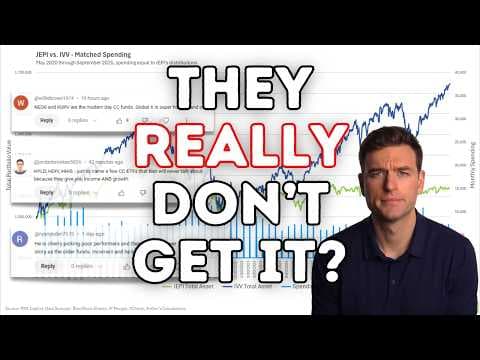
Felix provides an "excruciatingly detailed" comparison between the JP Morgan Equity Premium Income ETF (JEPI) and the iShares Core S&P 500 ETF (IVV) to illustrate the mechanics of this underperformance. He describes a scenario where two neighbors invest $1 million each in May 2020. The JEPI investor lives off the monthly distributions without selling shares, while the IVV investor sells a portion of their shares each month to match those exact dollar amounts. During the 2022 downturn, the IVV investor is forced to sell shares at depressed prices, which seems counterproductive. However, because the IVV shares are not capped by an option strategy, they recover and grow much faster than the JEPI shares. Ultimately, the neighbor holding the index fund ends up with more wealth. Felix emphasizes that it is the total value—share price multiplied by the number of shares—that matters, not the preservation of a constant share count.
The transcript also addresses the claim that certain "new age" or "enhanced" covered call funds are superior to older models. Felix systematically reviews several popular tickers requested by his viewers. He notes that the NEOS S&P 500 High Income ETF (SPYI) has trailed the Vanguard 500 index by 4.61% annualized since mid-2022. Similarly, the JP Morgan Nasdaq Equity Premium Income ETF (JEPQ) has trailed the Nasdaq 100 by 4.36% annualized. Even dividend-oriented funds like DIVO have underperformed their relevant benchmarks.
Felix specifically examines Canadian-listed "enhanced" funds like HYLD and HDIV, which often use leverage to boost yields. He points out that HDIV claims to beat the S&P/TSX 60, but this is a misleading comparison because the fund holds a significant amount of US equities. When benchmarked against a portfolio that actually matches its underlying holdings, the fund underperforms. He argues that if an investor believes in a specific sector or country mix, it would be cheaper and more effective to own those stocks directly without the drag of covered calls and high management fees.
Furthermore, Felix dismisses the idea that reinvesting distributions or using these funds to "retire sooner" changes the mathematical reality. Covered calls reduce expected returns, which inherently reduces the amount of sustainable spending an investor can afford over the long term. He suggests that the only reason these products seem to work for some is the "mental accounting" bias, where investors feel more comfortable spending a dividend check than selling a piece of a share, even if the latter results in more total wealth.
Felix concludes by explaining his motivation for criticizing these products. As a Chief Investment Officer, he views analyzing complex financial instruments as a core part of his professional development. He advocates for a more transparent financial marketplace in Canada, one that isn't filled with "dangerous" or confusing products that cater to psychological biases. His final advice is for investors to stick to low-cost, total-market index funds, which offer higher expected returns and lower costs without the destructive wealth-capping effects of covered call strategies.