Comparing U.S. Equity ETFs: VTI vs. DFUS
AI Summary
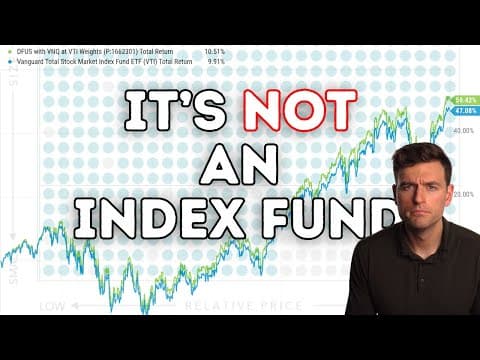
In this detailed analysis, Ben Felix, Chief Investment Officer at PWL Capital, explores the nuanced differences between two prominent investment vehicles: the Dimensional US Equity Market ETF (DFUS) and the Vanguard Total Stock Market ETF (VTI). While VTI is a traditional index fund tracking the CRSP US Total Market Index, DFUS is a total market fund that intentionally avoids following a rigid index. Felix acknowledges that while low-cost index funds are revolutionary tools for long-term wealth building, they are not flawless. By examining the performance of DFUS since its ETF launch in June 2021, he illustrates how a non-indexed approach can potentially offer structural advantages over traditional index tracking.
A central theme of the discussion is the concept of "index drag" caused by rigid rebalancing rules. Traditional index funds like VTI must trade on specific schedules to match their underlying benchmarks. However, research suggests this creates a form of adverse selection. Corporations typically issue new shares or go public (IPOs) when they believe their stock is highly valued, and they execute buybacks when they perceive their stock to be undervalued. Because index funds rebalance quarterly to reflect these changes, they often find themselves buying high and selling low—essentially acting as "bad market timers." Felix cites a 2025 paper suggesting this imposes an implicit performance drag of approximately 60 basis points per year on total market indexes.
In contrast, DFUS utilizes flexible trading rules. By not being tethered to a specific rebalancing date, it can delay incorporating IPOs or new issuances, thereby avoiding the immediate costs associated with these market-timing maneuvers by firms. The transcript highlights that "lazy indexes"—those that rebalance less frequently—tend to boost returns by avoiding these high-priced entries and low-priced exits. By not tracking an index at all, DFUS is able to mechanically avoid buying stocks with low expected returns and selling those with high expected returns in response to market composition changes.
The comparison also hinges on what these funds choose to hold. While VTI seeks to own the entire market, DFUS applies evidence-based exclusions. Specifically, DFUS avoids "small cap growth" stocks characterized by low profitability and aggressive investment—often referred to as "junk" stocks. These securities have historically demonstrated poor returns. Additionally, DFUS excludes Real Estate Investment Trusts (REITs) as a design choice. Felix addresses critics who argue that excluding REITs explains all of DFUS's recent outperformance. By constructing a model portfolio that adds REITs back into the DFUS strategy, he demonstrates that even after accounting for real estate, a significant portion of the excess return remains.
Felix also clarifies the scale of these exclusions. While DFUS holds significantly fewer stocks by count—roughly 2,430 compared to VTI’s 3,564—these exclusions represent a tiny fraction of the total market capitalization. Excluding REITs accounts for about 2.6% of the market weight, while the "junk" small-cap exclusions account for only about 1%. Over the sample period, these excluded small-cap stocks returned approximately -10% annualized. Thus, while the exclusions contribute to performance, the majority of the outperformance is attributed to trading flexibility and the avoidance of adverse selection during rebalancing.
Felix further tackles the argument that DFUS’s predecessor—a mutual fund with the ticker DTMEX—underperformed VTI over the long term prior to its 2021 conversion to an ETF. He argues that this historical data is not a reliable predictor of future performance because the fund’s structure and strategy have fundamentally changed. In its mutual fund era, the strategy was heavily focused on tax efficiency through methods that are now obsolete due to the modern ETF structure. Furthermore, the expense ratio for the mutual fund was significantly higher than VTI’s, a gap that has narrowed considerably since the conversion. Most importantly, the research-driven exclusions currently used by DFUS were not fully implemented during the early years of the mutual fund. Therefore, the pre-2021 performance reflects a different strategy and cost structure than the one investors access today.
Ultimately, Felix positions DFUS as a structural improvement on the index fund model. It maintains the core benefits of indexing—low cost, low turnover, and broad diversification—while adding layers of flexibility that can enhance expected returns. However, he warns that this approach comes with "tracking error." Because DFUS does not follow the index, its performance will inevitably deviate from the benchmark. For many investors, seeing their portfolio underperform a well-known index, even temporarily, can be psychologically taxing. Felix concludes that while the evidence supports the non-indexed total market approach as a superior theoretical model, it requires a high level of discipline and a departure from dogmatic beliefs about the perfection of traditional index funds. If an investor can handle the possibility of performing differently than the market, these slight improvements offer a compelling alternative to standard indexing.