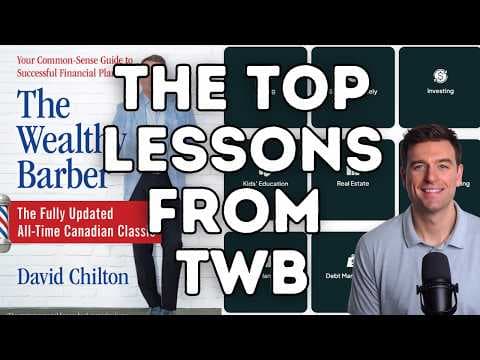
The best introduction to personal finance I have ever read
AI Summary
The 2025 edition of *The Wealthy Barber* by Dave Chilton remains a foundational guide to Canadian personal finance. Narrated through the story of a young couple, Matt and Maddie, who seek advice from Roy, a financially successful local barber, the book demystifies wealth building for those without high incomes. Roy’s central message is that financial success is not a mathematical feat but a matter of discipline and understanding a few straightforward concepts. He emphasizes that anyone is capable of managing their own money effectively once they grasp these core principles.
**The Golden Rule: Pay Yourself First**
Roy’s foundational rule is to save and invest at least 10% of your net income. This strategy relies on the power of compounding, where investment returns eventually far exceed the ability to save. Because humans are not naturally wired to understand exponential growth, Roy insists on "paying yourself first." By automating savings before the money can be spent on immediate desires, individuals bypass the psychological struggle of choosing between their present needs and a "stranger" (their future self). While some economists suggest varying savings rates based on life stages, Roy argues that a consistent 10% rule builds a vital reflex for distinguishing between needs and wants.
**Investment Philosophy: Owners vs. Loners**
Roy distinguishes between being an "owner" (holding stocks) and a "loner" (holding bonds). Stocks represent ownership in a business and carry higher risk but offer higher expected returns. Bonds are loans to companies or governments and are safer but offer lower returns. Roy views stocks as a bet on human ingenuity. Interestingly, he argues that for 99% of people, deep financial knowledge—such as tracking individual stocks or interest rates—actually leads to worse outcomes due to overtrading and market timing.
Instead, Roy advocates for buying the entire market through low-cost index funds or asset allocation ETFs. This approach captures "skewness," a phenomenon where a small number of massive winners drive the majority of market returns. Because it is nearly impossible to identify these winners beforehand, owning the whole market ensures they are always in your portfolio. He warns specifically against high-fee actively managed funds, which rarely outperform the market after costs.
**Market History and Resilience**
Addressing fears about global instability, Roy uses history to show that the world has always felt perilous. He cites a gloomy 1847 magazine article describing commercial chaos and international threats to illustrate that uncertainty is a permanent fixture of investing. This inherent risk is precisely why the stock market provides higher returns than guaranteed investments; the "risk premium" is the reward for enduring uncertainty.
**Canadian Tax-Advantaged Accounts**
Roy provides a clear comparison of the Registered Retirement Savings Plan (RRSP) and the Tax-Free Savings Account (TFSA). He clarifies a common misconception: if your tax rate remains constant, both accounts yield the identical after-tax result. The RRSP uses pre-tax dollars, allowing you to invest the government's deferred tax portion, while the TFSA uses after-tax dollars. For example, a $5,000 pre-tax RRSP contribution and a $3,500 after-tax TFSA contribution will result in the same final amount if the tax rate stays at 30%. The RRSP gains a significant advantage, however, if your tax rate is lower during retirement than during your working years.
**The Realities of Home Ownership**
On housing, Roy emphasizes the "total cost of ownership," including property taxes, insurance, and the "constant flow" of maintenance costs, such as leaking basements or crumbling chimneys. He challenges the notion that renting is "throwing money away." A diligent renter who invests the difference between their rent and the total cost of owning a home can expect to match a homeowner's wealth. He suggests that Canadian society has conditioned people to view home ownership as a mandatory goal, but for many, renting offers better lifestyle simplicity and more predictable costs.
**Spending Habits and "Joy Units"**
Roy introduces the concept of "joy units" to evaluate spending. He observes that much spending is driven by faulty brain wiring or the desire to impress others. To combat this, he recommends a "tedious" but vital multi-month spending summary. This exercise helps individuals identify expenditures that provide little value, allowing them to reallocate funds toward things that truly increase happiness. He echoes Ben Franklin’s warning that "small leaks sink great ships," noting that even saving $11 a day can accumulate to over $4,000 annually.
**Estate Planning and Insurance**
Finally, Roy covers the essential responsibilities of wills and insurance. Without a will, an estate is distributed according to provincial intestacy laws, which rarely align with a person's actual wishes. He stresses the importance of choosing a capable executor and establishing Powers of Attorney for both property and personal care to manage affairs if one becomes incapacitated.
Regarding insurance, Roy advocates for "renewable and convertible term life insurance" over "cash value" or "whole life" policies. Term insurance provides the necessary protection for dependents at a much lower cost, allowing the individual to invest the difference themselves. He also highlights the critical need for disability insurance, specifically "own occupation" coverage. For young workers, the ability to earn a future income is their most valuable asset, and disability is statistically more likely to disrupt that income than an untimely death. Roy concludes that these protective measures are areas where one should never "skimp."