2025 Was Nut(s): A Canadian CIO's Review
AI Summary
In this retrospective of 2025, Ben Felix, Chief Investment Officer at PWL Capital, reflects on a year defined by personal challenges, significant corporate shifts, and market outcomes that defied almost every expert prediction. For Felix, the year began with a personal battle against testicular cancer and a major transition for his firm, PWL Capital, which was acquired by the American firm One Digital. Despite these upheavals, the primary focus of his review is the series of surprising market lessons that unfolded throughout 2025, particularly regarding the resilience of the Canadian market and the enduring value of diversification.
The dominant narrative at the end of 2024 was one of American exceptionalism. Investors were increasingly eager to abandon international diversification in favor of a US-only portfolio, spurred by years of US outperformance. At that time, the US market had beaten the Canadian market by nearly five percentage points annualized over five years. Compounding this was a sense of "doom and gloom" regarding Canada’s economy, fueled by a productivity crisis, proposed capital gains tax hikes, and the potential for damaging tariffs following the election of Donald Trump.
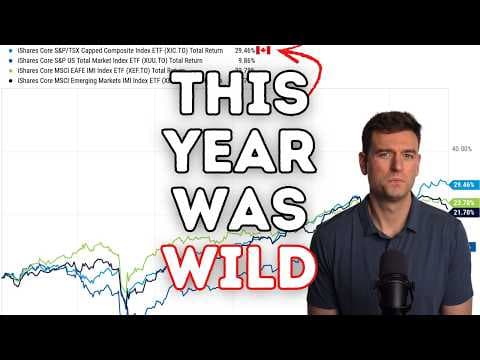
However, 2025 proved that the stock market is not the economy. While economic data is backward-looking, stock prices are forward-looking. By the time negative headlines about Canada’s economy peaked, the market had already priced in the worst-case scenarios. Consequently, when the actual data turned out to be "less bad" than feared, stock prices rose. By mid-December 2025, the Canadian stock market index had returned 29.46%, tripling the Canadian dollar return of a US total market index. This serves as a vital reminder that basing investment decisions on economic headlines is often a losing strategy.
This year also reaffirmed that international diversification is far from dead. While the US market faced significant volatility—including a 16% drop in Canadian dollar terms in April 2025 due to tariff fears—the Canadian market quietly excelled. Felix highlights that even the US has experienced "lost decades" in the past, and 2025 was a year where international exposure paid off handsomely. Within Canada, the performance of "value" and "small-cap" stocks was even more dramatic. The S&P/TSX Small Cap index surged by nearly 48%, while the Canadian Value index rose over 33%. These returns often come in short, unpredictable spurts; Felix emphasizes that missing these windows by trying to time the market is a mistake that is very difficult to recover from.
A significant development for Canadian DIY investors in 2025 was the partnership between Avantis Investors and CIBC. Avantis, a competitor to Dimensional Fund Advisors, launched a suite of Canadian-listed ETFs that allow retail investors to access "factor-based" investing—tilting portfolios toward small-cap, value, and highly profitable companies. Felix notes that while he uses Dimensional funds for PWL clients, the new Avantis ETFs, such as their all-equity asset allocation fund with a 0.28% management fee, provide a low-cost, evidence-based alternative for independent investors.
The year was also a tale of two "alternative" assets: Gold and Bitcoin. Gold had an extraordinary run, returning over 57% in Canadian dollar terms. Despite this, Felix remains cautious, noting that gold is not a productive asset. Historically, gold returns tend to hover around 1% above inflation over the very long term. He warns that buying gold after a massive surge is often a result of performance chasing rather than sound strategy. Conversely, Bitcoin struggled, dropping about 13% in 2025. This divergence was particularly interesting given that Bitcoin is often marketed as a "digital gold" that should shine during periods of geopolitical uncertainty.
In the world of real estate, 2025 saw a continued correction in major Canadian markets. In Toronto, composite home prices fell nearly 26% from their 2022 peak, with single-family homes seeing larger percentage drops than apartments. This shift significantly impacted the "rent versus buy" debate. Felix updated his long-running study comparing the wealth of hypothetical renters and owners across 12 Canadian cities. Due to falling home prices and surging stock market returns, the average renter-to-owner wealth ratio rose to 1.14. This means that, on average, renters who diligently invested their savings outperformed homeowners in 2025. While Felix clarifies that owning a home is not a "bad" decision, he asserts that renting is a perfectly valid financial path if one remains disciplined in their investments.
Looking ahead to 2026, Felix addresses concerns regarding US market concentration and high valuations. Currently, the top seven US stocks account for 32% of the market value—the highest concentration since 1927. While high valuations typically suggest lower expected future returns, Felix argues they are not a reliable market-timing signal. Finally, he warns against "ETF slop"—the influx of complex, high-fee products like buffer ETFs and single-stock covered call funds. He advises investors to ignore these "slop" products, which cater to emotional biases, and instead stick to simple, low-cost, broadly diversified strategies that offer the best chance of meeting long-term financial goals.