The Rise of ETF Slop
AI Summary
In this presentation, Ben Felix, Chief Investment Officer at PWL Capital, argues that the exchange-traded fund (ETF) market has entered a period of "ETF slop." This term describes a wave of low-quality, complex, and high-fee investment products engineered primarily to attract assets rather than improve investor outcomes. For the first time in U.S. history, there are more ETFs than individual stocks, and actively managed ETFs now outnumber index-tracking funds. This shift marks a departure from the low-cost, sensible investing principles that originally made ETFs successful.
Felix highlights that 2025 was a record-breaking year for fund launches, with over 1,000 new ETFs in the U.S. and 300 in Canada, the majority of which are actively managed. While traditional index ETFs often feature fees below 0.1%, the average fee for these new launches exceeds 0.7%, with many topping 1%. This trend threatens to return investors to the "dark ages" of high-fee mutual funds. To help investors navigate this landscape, Felix identifies four specific categories of "ETF slop" that should generally be avoided: thematic ETFs, buffer ETFs, covered call ETFs, and single-stock ETFs.
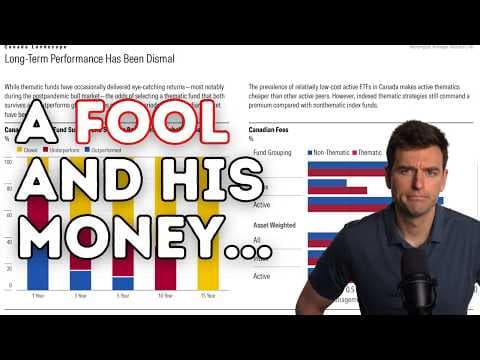
Thematic ETFs focus on specific economic trends like AI, the metaverse, or clean energy. While they capture investor imagination, they typically launch after a theme has already experienced significant price appreciation. Research shows that thematic ETFs underperform broad market benchmarks by an average of 6% per year in the five years following their launch. In Canada, the data is even more stark: 100% of thematic funds either closed or underperformed over a 10-year horizon. Felix explains that by the time an ETF is created, the expected growth is already priced into the stocks, leading to poor subsequent returns once media attention fades and expectations normalize.
Buffer ETFs, or "defined outcome" funds, appeal to loss aversion by offering downside protection in exchange for capped upside potential. For example, a fund might protect against the first 15% of market losses but cap gains at 8%. While this financial engineering is clever, Felix points out significant drawbacks: high management fees (often 0.73% compared to 0.09% for the underlying index), expensive internal option costs, and inconsistent protection outside of narrow target windows. Academic analysis suggests that a simple, low-cost combination of equities and cash generally outperforms these complex buffer products, even during market drawdowns.
Covered call ETFs are designed to attract investors seeking high distribution yields. These funds sell call options on their holdings to generate income, but this mechanically caps their upside potential. Felix notes that while the "yield" branding is a powerful marketing tool, these strategies consistently trail the total returns of their underlying equities. Many investors fail to realize that the high income comes at the direct expense of capital growth. His research indicates that an investor needing income is better off holding a standard index fund and selling shares periodically rather than paying for the structural underperformance of a covered call strategy.
Single-stock ETFs are perhaps the most extreme example of slop. These funds offer leveraged or inverse exposure to individual stocks, or use covered calls on a single security. They are often marketed with aggressive names like "Yield Maximizer" to exploit mental accounting biases. However, the internal costs are devastating. Leveraged single-stock ETFs face high financing costs—often baked into swap contracts—and friction from daily rebalancing. Data shows that long-leveraged single-stock ETFs underperform frictionless benchmarks by roughly 9% per year, while inverse versions trail by 12%. Simulations going back to 1974 reveal that over a one-year horizon, 56% of such hypothetical funds would result in absolute losses, with a non-trivial risk of total loss.
Felix concludes that complexity in investment products is rarely a benefit for the end user. Citing academic research, he notes that the use of derivatives and leverage by funds is strongly associated with higher risk and poorer performance. He echoes the warnings of Vanguard founder John Bogle, who cautioned that the ETF is a brilliant marketing innovation that may not actually serve investors. Bogle’s advice remains relevant: beware of investment products that are new, hot, and complex.
Ultimately, the rise of ETF slop makes it increasingly difficult for investors to find sensible, low-cost investments. The "good" products—simple index funds—are being buried under a mountain of high-fee, speculative junk. Felix advises that most investors will achieve better long-term outcomes by ignoring these engineered products and sticking to a disciplined, low-cost asset allocation strategy. In the world of investing, you generally get what you don't pay for, and simplicity remains the ultimate advantage.