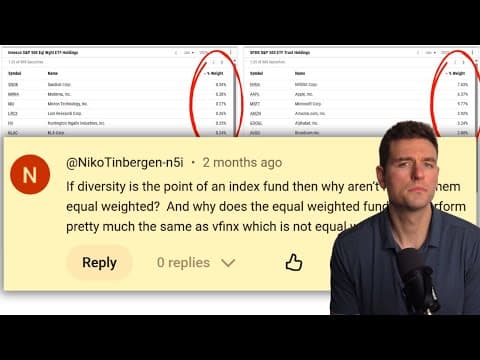
The Problem with Equal Weight Index Funds
AI Summary
In the world of index investing, market capitalization weighting is the standard approach. This method assigns weights to companies based on their total market value, meaning larger companies like Apple or Microsoft occupy a larger share of the index. However, a frequent question among investors is whether equal weight index funds—which assign the same percentage to every stock regardless of size—offer a superior alternative. In this transcript, Ben Felix, Chief Investment Officer at PWL Capital, explores why equal weighting may seem attractive on the surface but ultimately introduces inefficiencies that make it less desirable than other strategies.
The current appeal of equal weight funds stems from two main concerns: high market concentration and high valuations. In the modern US market, a small handful of massive companies represent a significant portion of market-cap-weighted indexes. Equal weight funds naturally solve this by capping the influence of these giants. Furthermore, equal weight indexes have historically outperformed market-cap-weighted ones over several decades. For instance, the Invesco S&P 500 Equal Weight ETF has slightly outperformed the standard S&P 500 since its inception in 2003. However, Felix argues that these benefits come with significant trade-offs in terms of risk, cost, and strategy.
To understand these trade-offs, one must first look at the logic of market capitalization weighting. It is often described as the only truly "passive" form of investing because it allows the market to determine the weight of each stock. It is a self-equilibrating system; as stock prices change, the index evolves without requiring frequent trades. Equal weighting, by contrast, is a deliberate departure from market prices. While investors fear the concentration seen in today’s market, Felix points out that historical data shows no strong relationship between high market concentration and poor future returns. Many international markets are even more concentrated than the US and have functioned effectively for years.
The risks of equal weighting manifest in several ways. First, there is volatility. Data shows that equal weight versions of the S&P 500 have a higher 15-year standard deviation than their market-cap-weighted counterparts. Second, equal weighting creates significant sector imbalances. Because it ignores market value, an equal weight S&P 500 fund is currently heavily underweight in technology and significantly overweight in industrials compared to the broader market. Unless an investor has a specific reason to bet on one sector over another, these deviations represent uncompensated risks.
A more technical but crucial issue is the "factor" exposure of equal weight funds. Through multi-factor regression—which Felix likens to a "blood test" for a fund—it becomes clear that the outperformance of equal weight funds is not due to the weighting method itself, but rather its incidental exposure to small-cap and value stocks. Because an equal weight fund gives more weight to smaller and cheaper companies than a market-cap index does, it captures the "size" and "value" premiums. While these premiums are generally considered good for long-term returns, equal weighting is a "naive" and inefficient way to capture them.
One of the most significant drawbacks of equal weighting is its relationship with momentum. Financial research, specifically the landmark 1993 study by Jagadish and Titman, shows that stocks that have performed well recently tend to continue doing well for a short period. Equal weight funds are forced to trade against this momentum. To maintain equal weights, the fund must systematically sell "winners" that have grown in price and buy "losers" that have declined. This "negative momentum" exposure acts as a drag on performance. Additionally, this constant rebalancing leads to high turnover; equal weight ETFs can have turnover rates ten times higher than market-cap-weighted funds, leading to increased trading costs for investors.
Felix suggests that if an investor wants exposure to smaller, cheaper stocks, there are more intentional ways to achieve it. He highlights Dimensional Fund Advisors (DFA) as an example of a more sophisticated approach. Instead of naively weighting everything equally, Dimensional starts with a market-cap-weighted universe and applies "tilts" toward stocks with smaller caps, lower prices, and higher profitability. This method manages turnover more effectively and, crucially, avoids trading against momentum. By using flexible trading rules, they can wait for a stock’s negative momentum to dissipate before buying, or hold a winner longer to capture its upward trend.
In conclusion, while equal weight index funds appear to be a simple solution to market concentration and high valuations, they carry "baggage" that investors should consider. Their historical success is largely explained by their tilt toward small-cap and value factors, but this exposure is hampered by high turnover, unintended sector bets, and a systematic stance against momentum. Felix argues that for those seeking higher expected returns through factor investing, an intentional, evidence-based strategy that respects market-cap weights as a starting point is more efficient than the blunt instrument of equal weighting. In short, equal weighting is not as exciting as it seems when more refined alternatives are available.