Covered Calls: A Devil's Bargain
AI Summary
In this transcript, Ben Felix, the Chief Investment Officer at PWL Capital, presents a detailed critique of covered call strategies, labeling the promise of passive income from these vehicles as a "devil's bargain." He argues that while these strategies are marketed to exploit the common behavioral bias for high distribution yields, they are mechanically structured to underperform their underlying equities over the long term. Felix’s central thesis is that the yields provided by covered call funds are not equivalent to investment returns and that these strategies fundamentally alter the risk profile of an equity portfolio in a way that is detrimental to long-term investors.
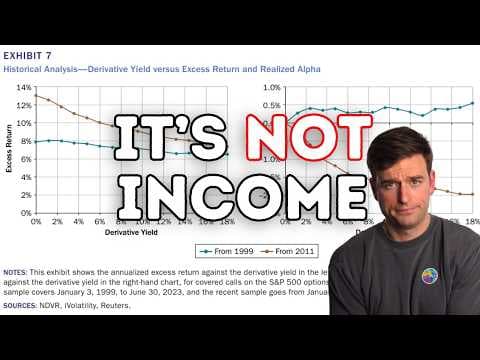
The mechanics of a covered call involve an investor owning an equity and selling a call option on that same asset. This sale generates an immediate premium, which funds typically distribute as cash to investors. However, this premium comes with a significant liability: the fund sells the right for the option holder to buy the stock at a predetermined "strike price." If the stock’s market value rises above this strike price, the fund is forced to sell the asset at the lower price, effectively capping the investor's upside. Felix explains this using the concept of "delta," which measures exposure to the underlying asset. Selling a call option creates a "short delta," reducing the investor's exposure to the equity risk premium. To achieve the high yields that attract retail investors, funds must sell options with lower strike prices, which increases the short delta and further reduces expected total returns.
One of the most significant risks Felix identifies is the elimination of "mean reversion." Historically, stocks have shown a tendency to perform better than average following a period of poor performance. This characteristic makes stocks less risky over long horizons. However, because covered calls cap the upside, they prevent investors from participating in the sharp recoveries that typically follow market downturns. Consequently, an investor in a covered call strategy experiences most of the market's downside while being denied the "right tail" of positive returns necessary for long-term growth. Felix argues that this makes covered calls particularly dangerous for those attempting to fund inflation-adjusted spending in retirement.
Felix also addresses the "volatility risk premium" (VRP), which is often cited as a justification for these strategies. The VRP exists because implied volatility in option pricing tends to be higher than the volatility that actually occurs, allowing option sellers to earn a premium for taking on the risk of extreme events. While this can look good in back-tests, Felix points out that since 2011, the VRP has not been sufficient to offset the loss of equity exposure. He suggests that the proliferation of retail funds chasing this strategy may have "crowded" the trade, diminishing its effectiveness.
To move beyond theory, Felix examines the real-world performance of several prominent covered call ETFs. He notes that the BMO Covered Call Utilities ETF has trailed its underlying index by 2.6 percentage points annually since its 2011 inception, underperforming in 85% of four-year rolling periods. Similarly, the BMO Covered Call Canadian Banks ETF and the Global X S&P TSX 60 Covered Call ETF have consistently lagged behind their benchmarks. Felix highlights that a simple portfolio consisting of the underlying stocks and a portion of cash often outperforms these complex strategies with lower volatility and higher Sharpe ratios.
The situation worsens when funds target even higher yields. Felix points to the Hamilton Yield Maximizer series and the JPMorgan Equity Premium Income ETF (JEPI), both of which have underperformed the S&P 500 significantly despite their popularity in "income investing" and "FIRE" (Financial Independence, Retire Early) communities. He reserves his strongest criticism for single-stock covered call ETFs, such as TSLY (which writes calls on Tesla). Despite a staggering distribution yield of nearly 49%, TSLY has underperformed Tesla by more than 20 percentage points annualized since its inception. This extreme example illustrates the inverse relationship between high derivative yields and total expected returns.
Beyond performance, Felix highlights the drag created by higher fees. The covered call funds he analyzed carry an average management expense ratio (MER) of 0.63% and a trading expense ratio of 0.16%, compared to much lower costs for standard equity funds. He warns that investors who view these distributions as sustainable income are mistaken. Because the distributions often exceed the total expected return of the strategy, investors who spend the cash are likely depleting their capital.
In conclusion, Felix asserts that covered call strategies offer no unique benefits to the typical investor. They essentially mimic a stock-and-cash portfolio but with a more unfavorable, asymmetric return distribution. By capping the upside and maintaining the downside, these funds drive an increasingly large wedge between their performance and that of the broader market. He concludes that marketing these high-yield products as a reliable source of passive income is "financial bullshit" and an indifference to the truth of how total returns are generated.