Curt Jaimungal
AI Audio Summaries
20 videos summarized
1 follower on BriefTube
Last summary: Sep 28, 2026
AI Audio Summaries
20 videos summarized
1 follower on BriefTube
Last summary: Sep 28, 2026
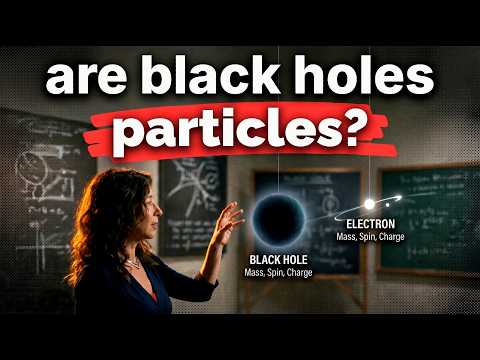
The discussion explores the complexities of black holes, particularly their nature within theoretical models and their potential role as fundamental particles in the universe. The initial thought experiment involves shooting a microscopic black hole into a small dimension within a Klein model. The immediate challenge is that the black hole metric, typically defined for asymptotically flat spaces, would need to be rethought in such a context. It's not as simple as throwing a marble; one would need to consider if it's a 3D or 5D black hole, and whether its event horizon extends in all five directions or only three. This highlights the intricate considerations involved in modeling black holes in non-standard geometries.
Read AI summary
YouTube
Professor Jan Levin, alongside co-author Brian Green, recently published two papers exploring the implications of our universe being compactified on a Klein bottle, a non-orientable surface with surprising physical properties. This bizarre mathematical object could potentially explain the origin of matter and challenges our understanding of spacetime, suggesting it might be an illusion woven from quantum threads. Levin discusses the self-referential nature of the early universe and the laws of physics, drawing parallels to Gödel's incompleteness theorems. Gödel mathematized the liar's paradox, demonstrating that within any consistent axiomatic system, there are true statements that cannot be proven. Levin wonders if this concept applies to the universe, suggesting that the initial conditions of the universe might be true but unprovable by the laws of physics. This would imply that there cannot be a "theory of everything" for the universe, much like there isn't one for mathematics. She proposes that a "Gödel sentence" for the universe might be: "These initial conditions cannot be predicted by the laws of physics."
Read AI summary
YouTube
Entropic gravity is a broad concept, and the discussion clarifies its relationship with Ted Jacobson's work. While Jacobson used Clausius's entropy and Rindler horizons to derive Einstein's equations, the current work aims to derive Newton's equations. The speaker emphasizes that Jacobson was the first to propose that a relationship between horizons and entropy could lead to the derivation of equations, building on Hawking and Bekenstein's observations about black hole thermodynamics. Jacobson showed that if entanglement entropy equals the area of a horizon, Einstein's equations can be derived. However, the speaker argues that Jacobson's approach assumes the existence of spacetime and its geometry, which creates a circularity. The speaker's contribution is to first derive the concept of spacetime itself, positing that something more fundamental than gravitational laws exists. Gravitational laws describe changing forces, and Newton's first law, inertia, is presented as a more fundamental concept that defines mass and the need for force to accelerate objects. While Jacobson derives Newton's third law (action-reaction) by deriving Einstein's equations, the speaker's work derives Newton's second law, F=ma. The core emphasis is on the emergence of spacetime and the fundamental laws, with inertia being a key focus.
Read AI summary
YouTube
The speaker's upbringing, influenced by his father's hands-on approach to fixing things, led him to view physics as a field where conceptual architectures and formulas need to be "fixed" and made to work together to expand our understanding of nature. He sees theoretical physics as a continuous effort to broaden the conceptual tools used to describe the universe. When asked about which of his research results his father might best understand, the speaker suggested something concrete, like how energy flows in particle collisions. He mentioned calculations he did with Diego Hoffman on this topic, which are now being measured in detail in colliders, making it a more accessible concept.
Read AI summary
YouTube
Professor Juan Maldacena, a distinguished theoretical physicist, discusses the nature of spacetime, black holes, and the ongoing challenges in unifying general relativity with quantum mechanics. He emphasizes that spacetime, in general relativity, is a primary, dynamic concept, not "made out of" anything in itself. However, in a more fundamental quantum theory of spacetime, it might emerge from quantum degrees of freedom residing on its boundaries, such as qubits. This perspective views spacetime as an "immersion" from these boundary degrees of freedom. Maldacena highlights the primary difficulty in combining general relativity (GR) with quantum theory: quantum mechanics typically assumes an external observer and a fixed time order for measurements, whereas in GR, spacetime itself is dynamic, and everything, including the observer, is part of the system. The observer's own energy and mass complicate measurements from an "outside" perspective. While mathematical infinities in calculations are often cited as a problem, Maldacena considers these more technical, especially since they might be less severe in lower dimensions, leaving the conceptual issues of observer inclusion and dynamic spacetime unresolved.
Read AI summary
YouTube
The discussion addresses the concept of reductionism, particularly the idea that everything ultimately boils down to physics. The speaker argues against the notion that "it's only physics," explaining that while physics enables events, it doesn't decide outcomes. Instead, context plays a crucial role. Physics is described as a servant, not a master, doing what it's told within a given context. A thermostat serves as a prime example of top-down action. It's a feedback system where a sensor determines temperature, compares it to a set goal, and then takes corrective action—like activating a heater—to reach the desired temperature. This process occurs at a macroscopic scale, but by turning a dial on the thermostat, one causes molecules to move faster at the microscopic level. The physics isn't determining the desired temperature; a human sets it, demonstrating top-down causation where humans tell physics what to do.
Read AI summary
YouTube
Spacetime, in the theory of general relativity, is a primary concept and the main dynamical object; it's not "made out of anything" in that framework. However, in the context of more fundamental theories, particularly when considering the quantum mechanics of spacetime, it can be convenient to think of it as being composed of something else. This "something else" could be qubits or other fundamental quantum degrees of freedom residing on the boundaries of spacetime, a relationship that has been studied extensively in recent decades. This perspective suggests spacetime emerges from these boundary degrees of freedom, with the boundary serving as a larger framework where the interior's degrees of freedom reside. While in general physics, things are often described as made of particles, modern physics often describes reality at short distances as being made of fields—like the electromagnetic, electron, or Higgs fields. These fields are typically thought to exist within a fixed spacetime arena. However, in general relativity, spacetime itself is dynamic, moving and changing. We believe it's described by some form of field, but unlike matter fields, which are described quantum mechanically, the field governing spacetime geometry is currently only described classically. Attempts to describe it quantum mechanically are approximate and fail in critical situations, such as the beginning of the universe and inside black holes. These failures are the primary motivation for seeking a more complete theory.
Read AI summary
YouTube
The speaker explores different levels of freedom, starting with the most radical: reinventing the social contract, and even more profoundly, freedom as "madness" akin to Freud's death drive. This death drive, he clarifies, isn't about simple self-destruction or a desire for oblivion, but rather a persistent, infinite self-destructive tendency. It's about acting terrifyingly for no positive gain, a "suicidal choice" that represents the most radical human freedom, a concept touched upon by Schelling and Hegel. Hegel, referencing German mysticism, calls this the "night of the world," a reduction to zero where one must freely choose to be part of society, emerging from it but choosing to re-enter. Schelling, in particular, suggests that truly free acts are experienced as necessity. Falling in love is an example: it's not a conscious choice made in the present, but a realization that one was already in love, a choice that feels like fate and fundamentally alters one's life. This, for the speaker, is freedom at its most radical in daily life.
Read AI summary
YouTube
The speaker argues that reality itself is not fully constituted, drawing a parallel with quantum reality. He uses the analogy of a video game creator who sets rules but doesn't fully render every detail, like individual trees in a background forest, because it's not essential to the game. He extends this to our reality, suggesting that a creator might have been "too lazy" to fully constitute everything, leaving aspects undetermined, particularly at the micro-level of quantum physics. This perspective, he asserts, offers a materialist interpretation of quantum mechanics, challenging the idea of a "total rational intuitive view of reality" guided by a higher mind. Instead, quantum physics hints at a reality that is ontologically open, with only particular standpoints existing. The speaker introduces an advertisement for ExpressVPN, highlighting its ability to prevent ISPs from logging and selling browsing history by encrypting traffic and rerouting it through secure servers. It also enables safe use of public Wi-Fi and unlocks geo-restricted content by changing online location to one of 105 countries, all while maintaining high speed.
Read AI summary
YouTube
The speaker discusses the concept of freedom, positing that true freedom lies not in making a choice between options, but in choosing oneself and one's identity. This is contrasted with the idea of a stone having freedom, which is deemed impossible. The speaker touches on quantum theory and indeterminacy, clarifying that it doesn't equate to freedom as it still operates within rules, even if unpredictable. Freedom, in their view, is a decision that establishes new necessity. A debate with Carlo Rovelli is mentioned, where Rovelli uses the term "freedom" in the context of choosing which aspect of a quantum entity to measure (wave or particle). The speaker expresses hesitation in using the term "freedom" here, fearing it might lead to an ontological duality between a contingent quantum domain and a free observer. They note that many quantum physicists reject the notion of free will.
Read AI summary
YouTube
The discussion begins by clarifying the definition of "large" in quantum mechanics, moving beyond mass, volume, or persistence in time to focus on Hilbert space dimension, or the number of qubits in a system. This measure of "size" is then connected to gravity, specifically through the information content of a black hole, which can be associated with an entropy. The idea is that the "size" of a system, in terms of its information content, can be related to the size of a black hole that could be formed by collapsing that information. This connection to black holes is crucial for understanding a specific area of research: the information-theoretic analysis of throwing information into a black hole and attempting to retrieve it from the Hawking radiation it emits. This scenario is central to the black hole information paradox, which asks whether information can truly be retrieved from a black hole, as proposed by Patrick Hayden and John Preskill, or if it is lost forever as thermal radiation. Conflicting views exist, with some believing retrieval is possible and others arguing it's not.
Read AI summary
YouTube
The speaker discusses the challenges of applying artificial intelligence (AI) in cosmology, contrasting it with successful AI applications like AlphaFold, which won the Nobel Prize for protein folding. Demis, the creator of AlphaFold, outlined three criteria for a successful AI application: knowing the feature space, knowing the goal function, and having vast amounts of data for training. In cosmology, none of these three criteria are met. First, the feature space is unknown. Unlike the 23 amino acids that combine to form proteins, the fundamental components of the universe, such as dark matter, are not understood. It's unclear if dark matter is a particle or a fluid, making it impossible to define its position and velocity, which would be crucial for understanding structures like galaxy clusters. If the ingredients are unknown, a feature space cannot be properly reserved for them.
Read AI summary
YouTube
The discussion explores the concept of dark matter and how observations of galaxy clusters have been interpreted as evidence for its existence. Initially, the speaker suggests that as we move further from Earth and our local universe, we seem to require more dark matter, or conversely, that our models might be insufficient to explain the observed phenomena without it. The Bullet Cluster is presented as a prime example often cited as irrefutable proof of dark matter. The Bullet Cluster involves the collision of two large galaxy clusters. During this collision, the hot baryonic plasma, detectable via X-rays, interacted and was slowed down. In contrast, the dark matter, inferred from gravitational lensing, appeared to pass through the collision with less interaction, resulting in a spatial offset between the X-ray emitting gas and the inferred dark matter distribution. This offset was interpreted as evidence that dark matter does not follow luminous matter (baryons) and that the total mass is not accounted for by visible elements. This interpretation gained traction around 2004.
Read AI summary
YouTube
Kurt Jiongal, a Toronto-based filmmaker and interviewer known for his podcast "The Theories of Everything," presented a session exploring various topics related to theoretical physics, consciousness, and free will. He began by highlighting common intellectual errors and challenging prevailing maxims, often with an antagonistic, apostate attitude. One error he pointed out is the tendency to use overly complex language for mundane concepts, exemplified by a definition of a washing machine that sounded like a philosophical treatise. Another is the indiscriminate application of theorems or the dismissal of concepts as "not fundamental" and therefore "not real." He also criticized the anachronistic claims that ancient texts like the Vedas already contained modern scientific theories without proper contextualization. Jiongal argued against the notion that words must be polysyllabic to be profound, suggesting a preference for clarity over perceived depth. He also expressed weariness with overly pedantic intellectual quarrels.
Read AI summary
YouTube
The discussion begins by contrasting discrete measurements with the need for statistical averaging in scientific discovery. When a single particle is used to measure a system, there's a trade-off: minimizing disturbance to the system results in poor resolution and limited information. This led to the practice of taking numerous measurements over extended periods, sometimes hours or years, to build up statistics, rather than relying on a single event. For instance, the existence of the Higgs boson wasn't learned from one muon hitting a detector, but from statistical analysis of many events. In the 1980s, Yakhir Aronov and his collaborators started exploring how to make measurements that minimally disturb a system. If such measurements are performed millions of times, and the average is observed, one might learn what the system was doing on average, even if the exact state in a single trial remains unknown. This approach is particularly interesting in quantum mechanics because it challenges conventional thinking about time and measurement. Traditionally, experiments are set up with a defined start and end, and the question is often about what happened in between. For example, if a particle is fired from one position and detected at another, classically, its path is a straight line. Quantum mechanically, however, this is not so clear. The challenge lies in determining the average momentum of a particle between emission and detection, especially when the wave function spreads out, making its average momentum zero if considering the entire function. The goal is to focus only on the part of the wave function that reaches a specific detector.
Read AI summary
YouTube
Professor George Ellis challenges the prevailing reductionist view in physics, arguing that physics is a servant, not a master, and that higher levels of organization and causation are fundamental. He posits that while physics enables phenomena, it does not solely determine outcomes; context and higher-level structures do. Ellis elaborates on five types of causation: physical, purposeful, symbolic, abstract, and social. He highlights purposeful causation in biology and technology, symbolic causation in language and society, abstract causation in computing, and social causation in human decision-making. He also identifies historical and imaginative causation as subcategories of social causation.
Read AI summary
YouTube
The speaker discussed an experiment from approximately ten years ago involving the double-slit experiment and the measurement of a photon's path, an act generally considered impossible before a measurement is made. He clarified that the experiment aimed to demonstrate several interesting concepts, particularly the distinction between strong and weak measurements. When a photon is sent through a double slit, it eventually hits a screen. The challenge in measuring its path along the way is that traditional measurement methods, like absorption, would destroy the photon before it reaches the screen. While non-destructive methods exist, the uncertainty principle dictates that any precise position measurement would disturb the photon's momentum, altering the final pattern observed on the screen. The experiment utilized weak measurement techniques to determine the average position of a photon in a plane without disturbing it, allowing it to continue to the screen. By post-selecting based on where the photon landed on the screen, researchers could infer its average path prior to detection. The motivation for this research was partly to explore hidden variable theories of quantum mechanics. Contrary to a common misconception that EPR experiments rule out all hidden variables, they only rule out *local* hidden variables. David Bohm's theory, developed in the 1950s, is a non-local hidden variable theory that is predictionally indistinguishable from standard quantum mechanics. Bohm's theory is dualistic, positing both a wave and a particle, with the particle "riding along" the wave, possessing a definite position at all times.
Read AI summary
YouTube
The discussion delves into the enigmatic nature of time in physics. Mathematically, time is treated as a parameter, allowing us to pinpoint the state of physical quantities at any given moment. However, a fundamental mystery remains: why we experience time's unidirectional flow from past to future, unlike space. Physicists explore potential new laws or boundary conditions to explain this, or even quantum mechanical frameworks where the universe doesn't evolve in time, presenting a static reality. In such scenarios, the perception of time might emerge as an "illusion" arising from correlations within a quantum wave function, where different parts of an entity exist in different temporal states but remain consistent with each other when observed. The conversation then shifts to a personal reflection on scientific inquiry, specifically on moments when a seemingly known answer dissolves upon deeper explanation. This often happens with intricate technical details, even in subjects taught for decades. The speaker highlights the importance of constantly questioning foundational assumptions, even those taken for granted.
Read AI summary
YouTube
The video explores fundamental questions about the nature of reality, particularly focusing on the indistinguishability of particles like electrons and the challenges and frontiers of quantum mechanics, especially in the context of quantum computing. The speaker begins by addressing the concept of indistinguishable particles. Instead of imagining a universe with a fixed number of uniquely identified electrons, the modern understanding is that particles are excitations of underlying fields. These fields are abundant, and a particle like an electron can be thought of as an excitation in its respective field, signifying a certain energy level above absolute zero. This is the sense in which particles are considered indistinguishable.
Read AI summary
YouTubeBriefTube monitors your YouTube channels, generates AI-powered audio summaries, and delivers them wherever you listen. Telegram, Discord, Slack, or your podcast app. Fully automated.
Start free trial