AI Audio Summaries
5 videos summarized
4 followers on BriefTube
Last summary: Apr 24, 2026
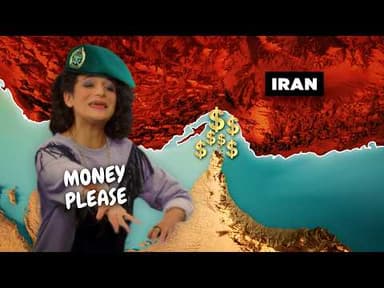
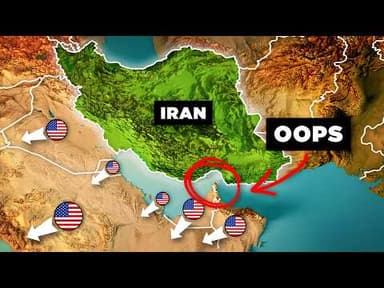
The core of the current conflict between Iran and the United States lies in irreconcilable demands. Iran seeks zero limits on nuclear enrichment, a non-aggression guarantee from the US, withdrawal of American forces from the Persian Gulf, reparations for war damages, removal of all sanctions, and termination of UN Security Council resolutions. The US, likewise, is unwilling to concede these points without significant gains. However, one Iranian demand is highlighted as having the most profound global implications: the permanent control of the Strait of Hormuz, effectively operating it as a toll booth. Historically, the Strait of Hormuz has been an international waterway, regulated by the UN Convention on the Law of the Sea, which guarantees free and unhindered passage for merchant vessels. The US Navy has historically protected this freedom of navigation, ensuring the unimpeded flow of oil and gas from the Persian Gulf to global markets.
Read AI summary
YouTube
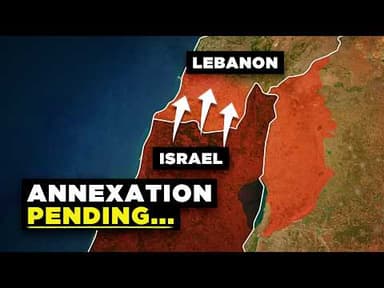
The current conflict in Lebanon, though overshadowed by events in Iran, threatens to permanently alter borders and has initiated a full-scale war between Israel and Hezbollah. Following a missile strike by the US and Israel against Iran, Hezbollah retaliated by firing rockets and drones into northern Israel, breaking a ceasefire established in late 2024. Israel has since conducted hundreds of airstrikes across Lebanon and launched a ground invasion into southern Lebanon, aiming to push Hezbollah away from its border. A significant escalation occurred when Israel's defense minister stated the objective is to seize control of southern Lebanon up to the Litani River, a territory about 30 km deep, representing roughly 10% of Lebanon's sovereign land. This announcement was preceded by evacuation orders for approximately one million Lebanese residents from this area and the southern suburbs of Beirut, predominantly Shiite. This constitutes the largest forced displacement in Lebanon's modern history, affecting one in six people. Israel intends to occupy this territory indefinitely as a "buffer zone" until the threat from Hezbollah is eliminated, raising fears of a prolonged occupation or even annexation, reminiscent of Israel's two-decade occupation from 1982 to 2000.
BriefTube monitors your YouTube channels, generates AI-powered audio summaries, and delivers them wherever you listen. Telegram, Discord, Slack, or your podcast app. Fully automated.
Start free trialRead AI summary
YouTube
The current global crisis stems from a conflict initiated by Donald Trump's administration involving the US and Israel against Iran. Despite a successful, week-long air campaign that crippled Iran's air defenses, missile capabilities, naval fleet, and leadership, the US and Israel are failing to counter Iran's most potent weapon: its ability to disrupt shipping through the Strait of Hormuz. This strait is a critical chokepoint for approximately one-fifth of the world's oil and liquefied natural gas supply. The conflict is characterized by two distinct wars. The first is the conventional aerial war waged by the US and Israel against Iran, which they are winning. The second is Iran's asymmetric war against the global economy, which the US and Israel are losing. Iran, recognizing its conventional inferiority, strategically focused on its ability to disrupt the Strait of Hormuz, a capability the US and Israel have struggled to neutralize. This miscalculation by the Trump administration has led to what is described as a major foreign policy blunder, potentially mirroring the complexities of the Iraq War and evolving into America's "Ukraine."
Read AI summary
YouTube
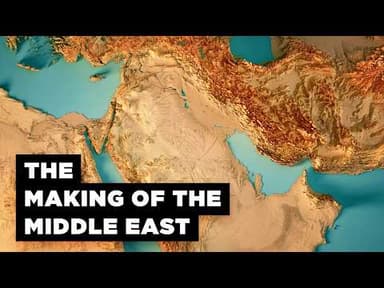
The Middle East has been a region synonymous with conflict for over a century, with major wars in Iraq, Syria, Lebanon, Israel, Palestine, and Yemen claiming millions of lives and costing trillions of dollars in the 21st century alone. This instability is deeply rooted in the arbitrary borders drawn by European powers after the decline of the Ottoman Empire, primarily through the 1916 Sykes-Picot Agreement. This secret treaty, negotiated by British and French diplomats, divided Ottoman lands into spheres of influence and direct colonial rule, with little regard for existing ethnic, linguistic, or religious boundaries. Further complicating the situation were conflicting British promises: one to support a unified Arab state to encourage revolt against the Ottomans, and another, the 1917 Balfour Declaration, favoring a national home for the Jewish people in Palestine. The discovery of vast oil reserves in the region, particularly in Iran, intensified British and later American interest, as oil became a critical strategic resource. After World War I, the Treaty of Sèvres in 1920 further dismembered the Ottoman Empire, proposing independent states for Armenians and Kurds, but Turkish resistance led to the more favorable 1923 Treaty of Lausanne, which established the modern borders but left the Kurdish people stateless, a persistent source of conflict.
Read AI summary
YouTube
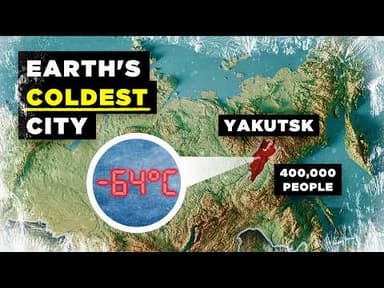
Yakutsk, a city in the middle of Siberia, is arguably one of the most questionably located major cities in the world due to its extreme climate. During winter, average low temperatures hover around -42 degrees Celsius, often staying below -40 degrees Celsius for weeks. Such cold can cause frostbite on exposed skin in minutes, freeze car engine oil and fuel lines, kill batteries, split tires, and make metal brittle. Residents often leave car engines running overnight to prevent freezing. Food bought from stores can freeze solid on the way home, and fish in markets are left outside because the ambient temperature acts as a freezer. Despite its brutal environment, Yakutsk has a surprisingly large population of over 370,000 people, making it the largest city in the world founded within the permafrost zone, where soil remains permanently frozen year-round. It is the capital of Russia's Sakha region, the largest country subdivision globally, roughly twice the size of Alaska. Nearly 40% of the Sakha region's less than 1 million people live in Yakutsk, despite the surrounding hinterland's inability to support agriculture. Yakutsk is a thriving regional capital with universities, theaters, shopping malls, and high-rise apartments, making it the coldest major city on the planet. The lowest recorded temperature in Yakutsk is -64 degrees Celsius, colder than some seasons on Mars, and comparable to the coldest temperatures recorded outside Antarctica and Greenland, neither of which host a metropolis of this size.
Read AI summary
YouTube