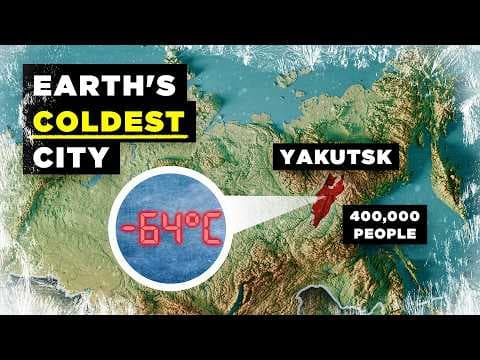
Why 400,000 People Live in Earth's Coldest City
AI Summary
Yakutsk, a city in the middle of Siberia, is arguably one of the most questionably located major cities in the world due to its extreme climate. During winter, average low temperatures hover around -42 degrees Celsius, often staying below -40 degrees Celsius for weeks. Such cold can cause frostbite on exposed skin in minutes, freeze car engine oil and fuel lines, kill batteries, split tires, and make metal brittle. Residents often leave car engines running overnight to prevent freezing. Food bought from stores can freeze solid on the way home, and fish in markets are left outside because the ambient temperature acts as a freezer.
Despite its brutal environment, Yakutsk has a surprisingly large population of over 370,000 people, making it the largest city in the world founded within the permafrost zone, where soil remains permanently frozen year-round. It is the capital of Russia's Sakha region, the largest country subdivision globally, roughly twice the size of Alaska. Nearly 40% of the Sakha region's less than 1 million people live in Yakutsk, despite the surrounding hinterland's inability to support agriculture. Yakutsk is a thriving regional capital with universities, theaters, shopping malls, and high-rise apartments, making it the coldest major city on the planet. The lowest recorded temperature in Yakutsk is -64 degrees Celsius, colder than some seasons on Mars, and comparable to the coldest temperatures recorded outside Antarctica and Greenland, neither of which host a metropolis of this size.
The area around modern-day Yakutsk has been inhabited by indigenous peoples for thousands of years, but its remote and sparsely populated nature persisted until relatively modern times due to the climate. The ethnic Yakut people, also known as Saka, migrated to the area around the 13th and 14th centuries. In the mid-16th century, the Russian state began expanding into Siberia in search of valuable resources like fur. In 1632, Russian explorers founded a small fort that would become Yakutsk, using it to collect fur tribute from local peoples.
Yakutsk's location along the Lena River provided a significant geographic advantage. The Lena, the 11th longest river in the world, stretches thousands of kilometers from Lake Baikal to the Arctic Ocean. Yakutsk was strategically positioned to control this system, and during the summer, the river is navigable for 3,540 kilometers. However, this navigability only lasts for 70 to 125 days a year, as the river is frozen solid or filled with icebergs for more than two-thirds of the year. Nonetheless, as a seasonally useful inland port, Yakutsk was crucial for shipping furs upstream for export to European Russia.
For centuries, until the mid-1800s, the Sakha region was primarily exploited for fur due to the permafrost making agriculture unsustainable. By the end of the 19th century, Yakutsk was a small frontier town with only about 6,500 people, mostly involved in the fur trade. The 20th century brought rapid change. After the Soviet Union's establishment in 1922, the Sakha territory was reorganized into the Yakut Autonomous SSR. In 1923, gold was discovered in the region, triggering a gold rush. By 1925, over 13,000 ethnic Slavs had flooded into the territory.
The Soviet government, under Stalin, used involuntary labor through the Gulag system to harvest gold. Around 100 camps, prisons, and penal colonies were established across the Sakha territory, bringing in at least 50,000 prisoners for labor in the gold mines. This continued a Tsarist policy of treating the Sakha territory as a "prison without walls" for political dissidents, as the harsh environment and vast distances made escape virtually impossible. This influx caused the population of Yakutsk to explode, growing from around 10,000 in 1926 to over 70,000 by 1959. The ethnic Yakut population was diluted from over 80% to less than half due to the arrival of Russians and Ukrainians.
Gold was not the only valuable resource. In 1949, diamonds were discovered in the Sakha region, and in 1954, a rich Kimberley pipe named Tsarnitsa was found. The Sakha territory proved to be the most diamond-rich area outside southern Africa, leading to an even greater population boom as more people migrated in search of diamond fortune. By the end of the 20th century, the Sakha territory produced 25% of the world's diamonds, and new cities were built around mines, staffed by imported workforces. Workers in the diamond mines earned salaries roughly four times the Soviet average, attracting tens of thousands despite the brutal climate. This development fueled the growth of Yakutsk, where mining operations established regional offices.
Since the 1960s, over $1 billion worth of diamonds have been mined annually. By the late 1980s, diamond and gold mining, along with tin and coal operations, brought in about $4 billion to the Soviet treasury each year, driving rapid development in Yakutsk. Between 1959 and 1989, Yakutsk's population more than doubled again, reaching over 186,000, with new high-rise apartments, museums, factories, and airports. The Mir Open Pit Mine, one of the largest man-made holes on the planet, symbolizes these operations.
The Soviets also conducted at least 12 underground nuclear explosions between 1974 and 1988 in the Sakha territory, attempting to locate minerals or dig mines. These resulted in radioactive contamination of the soil and aquifers, further complicating life in an already difficult environment.
Yakutsk's extreme climate is due to its deep inland location in the Eurasian continent, far from the moderating influence of oceans. The Siberian High, a powerful high-pressure system, traps extremely cold, dry Arctic air over central Siberia every winter. Snow-covered taiga and plains reflect sunlight, maintaining low temperatures. Winters are long, dark, and ruthless, with weeks below -40 degrees Celsius. However, summers are bizarrely hot, with temperatures soaring to 41 degrees Celsius, creating a temperature variation of over 100 degrees Celsius annually. Despite the cold winters, hot summers bring plagues of insects and mosquitoes, breeding in stagnant water from melted snow that doesn't drain well due to permafrost.
Building and maintaining Yakutsk in this environment is incredibly challenging. Buildings cannot be placed directly on concrete foundations on the ground because heat would melt the permafrost, turning the soil to mud and causing structures to sag and collapse. Instead, most buildings are built on stilts or concrete piles drilled up to 10 meters deep. Critical infrastructure like wires and pipes are exposed above ground to prevent permafrost melting. Global warming is exacerbating these issues, as the Arctic warms at twice the global rate, causing permafrost beneath Yakutsk to melt and warp structures, leading to sagging buildings and shifting sidewalks.
Yakutsk has an unusual, industrial ambiance, intensified by the omnipresent ice fog in winter. This fog forms because the air is so cold that warm air from buildings, cars, and people instantly freezes, creating a frozen cloud over the city. Moisture from breath can freeze on eyebrows and eyelashes within minutes. Cars typically last only a couple of years and must be run almost continuously in winter to prevent freezing. Electric vehicles lose 40-60% of their range.
Getting into or out of Yakutsk is extremely difficult and expensive due to its isolation. Flights are the easiest option, but winter delays are common due to fog and even jet fuel freezing. Driving is more challenging, as Yakutsk is the largest city on the Eurasian continent not directly connected to the rest of the world by road. Historically, the Lena Highway, which runs parallel to the east bank of the Lena River, was the only tenuous connection. Until 2014, much of it was unpaved, turning into impassable mud during spring and rainy seasons. Even now, the highway doesn't reach Yakutsk directly because the city is on the opposite, west bank of the Lena River, and there is no bridge.
During winter, the frozen Lena River acts as a solid highway, providing a critical overland link to the rest of Russia. In summer, ferries operate across the river. However, during the spring and fall shoulder seasons, transportation is nearly impossible or highly risky due to thin ice or broken icebergs. Yakutsk becomes a logistical island. Ferries are expensive, costing up to 15% of the median monthly wage for a one-way trip, leading some residents to risk crossing on thin ice, resulting in accidents and fatalities annually. Supplies, including food, are primarily transported by summer river barges or expensive winter tractor trains and trucks, making goods significantly more expensive.
Russian authorities have discussed building a bridge over the Lena River for decades to permanently connect Yakutsk, but it has never materialized. Such a bridge would need to withstand extreme temperatures (-60°C to +40°C) and spring ice flows, making it very expensive. Geopolitical shocks have repeatedly delayed the project. Discussions in the 1980s were canceled after the Soviet collapse. Plans in 2012 were halted after Russia's annexation of Crimea, diverting funds to the Crimean Bridge. A third revival in 2019 was interrupted by the COVID-19 pandemic, and Russia's 2022 invasion of Ukraine led to sanctions that complicated funding.
In 2024, the Russian government initiated the bridge's construction, initially estimating a cost of $855 million. However, the estimated cost has nearly doubled to $1.7 billion, and federal funding is lacking due to the ongoing war in Ukraine. It remains unclear if or when the bridge will be completed, meaning Yakutsk will likely remain a logistical island for the foreseeable future, a fascinating human city defying common sense.