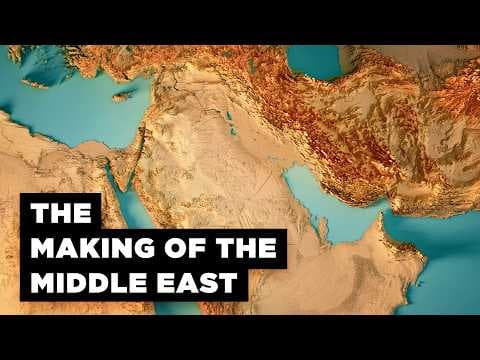
The Making of the Modern Middle East
AI Summary
The Middle East has been a region synonymous with conflict for over a century, with major wars in Iraq, Syria, Lebanon, Israel, Palestine, and Yemen claiming millions of lives and costing trillions of dollars in the 21st century alone. This instability is deeply rooted in the arbitrary borders drawn by European powers after the decline of the Ottoman Empire, primarily through the 1916 Sykes-Picot Agreement. This secret treaty, negotiated by British and French diplomats, divided Ottoman lands into spheres of influence and direct colonial rule, with little regard for existing ethnic, linguistic, or religious boundaries.
Further complicating the situation were conflicting British promises: one to support a unified Arab state to encourage revolt against the Ottomans, and another, the 1917 Balfour Declaration, favoring a national home for the Jewish people in Palestine. The discovery of vast oil reserves in the region, particularly in Iran, intensified British and later American interest, as oil became a critical strategic resource. After World War I, the Treaty of Sèvres in 1920 further dismembered the Ottoman Empire, proposing independent states for Armenians and Kurds, but Turkish resistance led to the more favorable 1923 Treaty of Lausanne, which established the modern borders but left the Kurdish people stateless, a persistent source of conflict.
The creation of new states like Iraq, formed by combining diverse Ottoman provinces (Mosul, Baghdad, Basra) with distinct ethnic and religious populations (Kurdish, Sunni Arab, Shia Arab), embedded internal fragmentation. Kuwait was separated from Basra province by the British, leading to a historical Iraqi claim that Saddam Hussein would later act upon. French mandates similarly created Lebanon by prioritizing Christian demographics, and Syria by merging disparate groups, leading to internal divisions and territorial disputes. The subsequent discovery of oil and gas reserves, often located in areas inhabited by minority groups or near contested borders, further fueled conflict. For example, most of Iraq's oil was in Shia Arab and Sunni Kurdish areas, while Saudi Arabia's oil was largely in its Shia minority eastern region, and Syria's oil was in its Kurdish and Sunni Arab east. This uneven distribution ensured continuous external interest and internal strife.
The establishment of Israel in 1948, following the UN partition plan and the British withdrawal from Palestine, ignited the continuous Arab-Israeli conflict. The 1947 UN plan, which allocated 62% of mandatory Palestine to a Jewish state despite Jews being only a third of the population, was accepted by Jewish groups but largely rejected by Arabs. Israel's victory in the 1948 war resulted in its control over more land than initially proposed, leading to the displacement of 700,000 Palestinian Arabs and the non-emergence of an independent Palestinian state.
The post-1948 era saw the rise of secular Arab nationalism, epitomized by Egypt's Gamal Abdel Nasser, who sought a unified Arab superstate. His nationalization of the Suez Canal in 1956 and subsequent victory against British, French, and Israeli forces cemented his status as an Arab champion. However, military defeats, like in the 1967 Six-Day War where Israel occupied the Golan Heights, West Bank, East Jerusalem, Gaza Strip, and Sinai Peninsula, weakened this movement.
The British withdrawal from the Persian Gulf in 1971 led to increased US involvement, aiming to maintain stability and oil supply. The 1979 Iranian Revolution, which replaced a pro-Western monarchy with a revolutionary Shia theocracy, fundamentally altered the regional power dynamics. The new Iranian regime, led by Ayatollah Khomeini, sought to export its Islamic revolution, destroy Israel, and overthrow Arab monarchies, making it a bitter enemy of Saudi Arabia, Israel, and the United States. This ideological clash ignited the Iran-Iraq War (1980-1988), where Saddam Hussein, fearing the spread of the Shia revolution, invaded Iran, backed by Saudi Arabia and Kuwait. This war, an 8-year long apocalypse, consumed vast resources and lives, solidifying the Saudi-Iranian cold war.
Saddam's subsequent invasion of Kuwait in 1990, driven by historical claims and the desire to control more oil, prompted a US-led international coalition to intervene in the Gulf War, restoring Kuwaiti sovereignty. This cemented the US as the primary security guarantor of the Persian Gulf and its oil supplies, with military bases established across several Gulf states.
The unresolved Israeli-Palestinian conflict continued, with Israel expanding settlements in the West Bank and maintaining a blockade on the Hamas-controlled Gaza Strip since 2007. The Trump administration's recognition of Jerusalem as Israel's capital and the Abraham Accords, which saw several Arab states normalize relations with Israel, signaled a shift in regional diplomacy, largely driven by shared concerns over Iran. These accords, however, bypassed the core issue of Palestinian statehood, further angering Palestinians and leading to increased tensions.
The Strait of Hormuz, a narrow waterway connecting the Persian Gulf to the open ocean, is arguably the world's most critical maritime choke point. It facilitates the passage of roughly 15% of the planet's energy supply, including half of the world's proven oil reserves and 40% of natural gas reserves. Its control is vital for the global economy, particularly for East Asian economies like China, Japan, and South Korea, which are heavily dependent on Gulf oil. Iran's threats to close the strait in response to conflict highlight its immense geopolitical significance and the constant risk of global economic disruption. The US maintains a significant military presence in the Gulf to ensure the strait's security and counter Iranian influence.
Qatar, a small peninsula nation, has transformed into a global economic and political powerhouse due to its vast offshore North Field natural gas reserves, the largest in the world. Despite its tiny citizen population, Qatar's wealth from liquefied natural gas (LNG) exports has enabled massive investments globally, including significant stakes in international corporations and ownership of major sports clubs. Qatar's strategy for security in a volatile region involves close alignment with the United States, hosting the largest US military base in the Middle East, while also maintaining working relations with Iran due to shared gas fields. This complex diplomacy, alongside its support for democratic and Islamist movements during the Arab Spring, has sometimes put it at odds with Saudi Arabia, leading to a temporary Saudi-led blockade.
Djibouti, a small country in the Horn of Africa, has become a critical global military hub due to its strategic location at the Bab el-Mandeb Strait, another crucial maritime choke point for trade between the Mediterranean Sea and the Indian Ocean. Its relative stability in a chaotic region has attracted numerous foreign military bases, including those of the US, France, Japan, Italy, Germany, and China. This concentration of military power underscores the strait's importance for global trade, particularly for oil and gas shipments from the Persian Gulf to Europe, and for China's export routes.
Saudi Arabia, the world's largest oil exporter and holder of a quarter of global proven oil reserves, wields immense geopolitical power through its ability to influence global oil prices. The Saudi state's survival is intrinsically linked to its oil wealth, which funds its extensive welfare state and defense budget. However, the global shift away from fossil fuels poses an existential threat to its long-term viability. Crown Prince Mohammed bin Salman's Vision 2030 aims to diversify the economy and society, but this involves delicate balancing acts with internal religious conservatives, regional rivals like Iran, and global powers like the US, Russia, and China. The kingdom seeks a mutual defense treaty with the US and normalization with Israel to enhance its security against Iran, but these moves face internal and external challenges, including the unresolved Palestinian issue.
The current conflict in Gaza, ignited by Hamas's October 2023 attack on Israel, shattered a brief period of perceived calm in the Middle East. This attack, which resulted in significant Israeli casualties and hostage-taking, prompted an unprecedented Israeli military response, including a total siege and ground invasion of Gaza. The war has exacerbated humanitarian suffering and risks drawing in other regional powers, potentially derailing the Saudi-Israeli normalization process and further destabilizing the region. The broader context includes Iran's "axis of resistance" strategy, aimed at encircling and challenging Saudi and Israeli interests, and the complex relationship between Hamas and Iran. The long-term implications of this renewed conflict include a potential re-evaluation of US engagement in the Middle East and continued regional instability.