
PRO Indicators
AI Audio Summaries
16 videos summarized
1 follower on BriefTube
Last summary: Oct 11, 2026
AI Audio Summaries
16 videos summarized
1 follower on BriefTube
Last summary: Oct 11, 2026
Read AI summary
YouTube
The speaker begins by stating his intention to be as concise and transparent as possible while discussing a complex situation. He outlines three main topics: an intraday technical market analysis, an update on his personal trading position, and the weekly brief. He emphasizes the need to separate his personal position management, which has led him to the brink of his maximum drawdown, from the general technical analysis of the market. He had previously set a limit, stating that if the market reached 7400, he would hit his max drawdown and be forced to react. This has unfortunately happened without the market offering any opportunity to reduce his risk. He explains that he has already cut a quarter of his position, incurring one of his biggest losses in a long time. The total loss amount is still unknown as 75% of the position remains, which he hopes to salvage.
Read AI summary
YouTube
The market has shown no signs of weakening, with monthly closes at historical highs, even surpassing the trend line of the broadening wedge. Despite this, there's no oscillation in the market, and it continues to maintain these elevated levels. The speaker is cautious about declaring an invalidation of his trading strategy, which would imply the American market is so irrationally bullish that he'd have to cut losses. He's unwilling to risk capital fighting against a market that defies physical reality. Instead, he focuses on trading in areas where physical reality seems to materialize. He updates his oil trading strategy, noting that levels have been raised for the new month, with a bullish target of 118, potentially reaching 120-125 for profit-taking on previous long positions. These trades are already secured, having taken profit at the median of the range and stops paid. He plans to reload on purchases if signals appear, reinforcing positions if they trigger. His target remains 118, regardless of the order in which price movements occur. He feels the market is starting the month indecisively but believes it's more likely to reach 118 than not. He anticipates that the large range zone around 100 will become increasingly improbable as June approaches, suggesting a move towards historical highs. This aligns with his long-term plan of an initial rapid ascent, followed by consolidation, and then a new push to historical highs. He doesn't expect this in May but anticipates it in June, believing both bounds will be hit. He prefers the market to hit profit targets first, allowing more cash for subsequent purchases. He foresees a bullish exit next month, with no resistance levels for June, projecting historical highs of $150 per barrel, driven by his disbelief in de-escalation from the US.
Read AI summary
YouTube
The speaker begins by addressing technical issues with the live stream, noting a delay and problems with chat visibility. He then moves into analyzing various stock tickers requested by viewers, emphasizing the importance of clear market structure and company financials. The first stock analyzed is characterized by a lack of clear trend structure and excessive, speculative price movement. The speaker notes a price-to-earnings (PE) ratio of 27, which he considers very high, especially given that the price surged significantly in just six months without corresponding revenue growth. He concludes that the stock is overpriced and likely to experience a substantial pullback, suggesting it’s driven by hype rather than fundamental value. He identifies it as being in the semiconductor sector.
Read AI summary
YouTube
This video discusses the ongoing intraday crisis management of an S&P 500 trade, focusing on the correct method for managing a technical invalidation in a market that appears to be a potential trap. The speaker emphasizes the educational aspect of these videos, allowing viewers to retrospectively analyze decision-making processes and learn from mistakes, even those made by experienced traders. The market has been building a long-term top, with recent movements characterized by brutality, high liquidity, and concentration. After weeks of struggle, a support level was finally broken, only for the market to reintegrate in a V-bottom and subsequently rally. This rally, initially thought to be linked to a Middle East crisis, diverged from that scenario as oil prices fell but remained within their range, indicating other drivers.
Read AI summary
YouTube
The speaker begins by revisiting the short-term S&P 500 situation, noting extreme volatility and market exhaustion rather than aggressive movement. The recent 10-11% rebound over three weeks, while brutal, is seen as a sign of an impending range on the daily chart. While an "historic buying opportunity" is not impossible, many factors contradict this optimistic view. The speaker emphasizes caution regarding the current market rally, especially since the S&P 500 is nearing historical highs and algorithmic trading is likely targeting stop losses. The speaker warns that the channel is not officially broken, and a reversal pattern (bearish harami or evening star) could form if the market closes below the trendline today. The 6900 point level represents a dense technical zone. The core question is whether the market will continue its straight-line ascent to new historical highs or if this is another "bull trap." The speaker believes short-term technical analysis is limited due to the current "buyer squeeze" driven by algorithms. Instead, a long-term perspective is needed to determine if the recent monthly sell signal was a trap for sellers or if the current rally is the real trap. The speaker expresses serious doubt that the market can sustain the gains of the last three weeks.
Read AI summary
YouTube
Hello everyone. I'm very happy to be back with you. We're going to do a quick, purely graphical review. I won't delve into the various news of the past two weeks, or particularly the last two or three days, as the market completely disregards the physical reality of things. We'll just review the setup and recent evolution of probabilities concerning the weekly brief context. Specifically, we are supposedly in the phase where the next step is a "bull trap." This doesn't mean an all-time high, but it's still quite a rebound for a bull trap, to say the least. As mentioned in the brief, there's also a probability of this scenario being invalidated, with a return to an all-time high and so on. There is indeed a possible invalidation, and the idea today, or this morning, is that when I read your reactions, I see you immediately jumping to the conclusion, "Well, we're getting wiped out, it's over, all-time high," etc. I have a few technical arguments to counter this interpretation.
Read AI summary
YouTube
The speaker begins by outlining a framework for trading a potential bull trap situation in the US stock market, emphasizing that they are not a financial analyst and cannot predict the future with certainty. Instead, they rely on technical assumptions and long-term data patterns, aiming for probabilities that significantly exceed a 50-50 chance of success, generally achieving over 70-75% accuracy. They caution listeners against blindly following their advice and to be prepared for potential losses. The speaker then introduces three models that suggest a potentially dangerous future for the US stock market. The first is Ray Dalio's cycle, which indicates the US is in the worst part of its cycle, characterized by accelerating slowdown, financial bubbles, disappearing middle class, and increased conflict, both external (wars) and internal (risk of revolution). This cycle suggests a painful return to a more realistic global standing for the US.
Read AI summary
YouTube
The speaker aims to clarify the concept of a "bull trap" to provide a clear framework for understanding market dynamics, emphasizing a focus on strategic and technical risk management rather than fortune-telling. While acknowledging the role of psychology, the speaker stresses the need for a strictly defined and explicit framework. The discussion is situated within a broader context of ongoing themes, including the current psychological pattern in the United States and the positioning within the American macrocycle. The speaker asserts that the US is in a "free fall" regarding its global dominance, not implying the empire's demise, but rather a significant loss of momentum where the positive effects of its ascending phase are now reversed and working against it, exacerbated by denial. This analysis extends specifically to financial markets, not just geopolitical standing.
Read AI summary
YouTube
This update focuses on monthly forecasts for the S&P 500, triggered by a significant monthly candle close. The strategy employed relies on technical signals, which act as triggers, not as definitive sell signals in isolation, but as confirmations of market reactions within specific technical areas. The current market context suggests a divergence pattern within a primary bullish trend that has matured to an intermediate stage. This pattern typically leads to a pullback, representing a final bearish cycle before a reversal of the bullish upward trend. This technical analysis aligns with long-term economic cycle forecasts. Martin Armstrong's ECM model suggests a commodity boom cycle peaking in 2024, followed by a four-year consolidation until 2028-2029, leading to an "authoritarian peak" before a final economic confidence peak in the West around late 2032 or 2033. Concurrently, Ray Dalio's models of credit and productivity cycles indicate two opposing forces at play. The US is entering the most negative part of its cycle, characterized by a shift from money printing and credit cycles (like the 2008 aftermath) towards revolution and wars. This phase is projected to lead to debt and political restructuring, aligning with Armstrong's authoritarian regime peak, likely starting around 2028.
Read AI summary
YouTube
The speaker provides a long-term market brief, emphasizing his role as a risk management strategist who predicts future market levels based on technical analysis, rather than an economist. He acknowledges that his technical strategies have a high failure rate (70%) but stresses the importance of understanding market movements and their potential real-world impacts. He cautions against confusing financial markets with the global economy, as he is not an expert in economics or macroeconomics. He references models from Ray Dalio and Martin Armstrong to position current events within economic and macro cycles. According to these models, a market peak was anticipated around June of last year (2024), driven by technical saturation signals in the S&P 500. While a decline in sentiment did occur, it did not translate into a market downturn, with markets continuing to rise due to speculative bubble formation.
Read AI summary
YouTube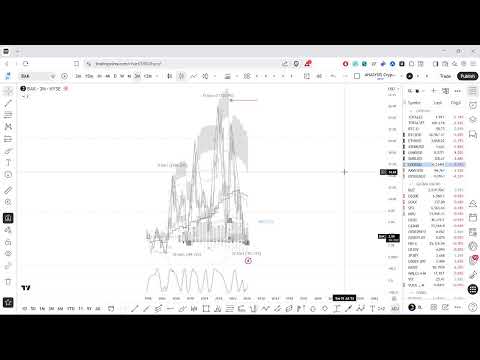
The speaker begins by addressing questions about the future of various commodities and assets, starting with wheat. He notes that wheat appears to be on monthly support in a bullish context, having already experienced a significant appreciation after the first inflationary wave. He anticipates a second, less durable inflationary wave, lasting one to two years, which will drive up prices of raw materials, including agricultural ones. However, he doesn't foresee a parabolic rise in wheat prices, suggesting a new price range rather than an infinite upward trend. He emphasizes that agricultural commodities are not like gold or silver, which can be sent "into the stratosphere"; pushing wheat prices too high would have significant consequences for basic food supplies. He personally doesn't speculate on wheat, holding only an indirect exposure through an ETF indexing grains. He stresses the ethical considerations of speculating on agricultural staples. Regarding his crypto portfolio, it remains largely unchanged: over 60% Ethereum (ETH), 20% Cosmos (ATOM), and the rest distributed among well-known DeFi products like AAVE and Chainlink. He notes Chainlink’s appealing chart structure, as long as it remains valid. Monero is also part of his portfolio, with all other holdings being minor (less than 2%). He holds 0% Bitcoin (BTC).
Read AI summary
YouTube
This summary provides a technical analysis of current market volatility, specifically focusing on WTI Crude Oil, the S&P 500, and the broader macroeconomic landscape based on the provided transcript. ### Managing Volatility in WTI Crude Oil
Read AI summary
YouTube
This summary provides a comprehensive overview of the monthly market update, focusing on the speaker’s technical analysis, psychological models, and strategic decisions regarding global commodities, the US stock market, and the cryptocurrency sector. ### The Trader’s Perspective and the War Cycle
Read AI summary
YouTube
The current market volatility is the manifestation of a systemic event that has been brewing for months. While many observers are only now reacting to the headlines, the speaker emphasizes that his strategy—rooted in technical signals and risk management—has been preparing for this disruption for a long time. The core message is that the era of ignoring real-world physical constraints is ending, and the financial markets are about to face a harsh reality check. The primary catalyst for this shift is the energy sector, specifically the closure of the Strait of Hormuz. The speaker argues that the rise in oil prices is not a temporary spike but a systemic move. Monthly technical indicators suggest that the consequences of this disruption will last between two and three years. This is a fundamental repricing of the world’s most essential commodity. He observes a significant shift in the ratio between the price of gold and the price of oil. Gold has functioned as a financial refuge, largely traded on paper, but it has become excessively expensive compared to the physical necessity of energy. As the "elastic" of this mispricing snaps, capital will likely migrate from "paper gold" into tangible energy assets. He references his book, "The Crisis of Value," to reiterate that the next major crisis will originate in the real world of physical resources rather than the purely financial sphere.
Read AI summary
YouTube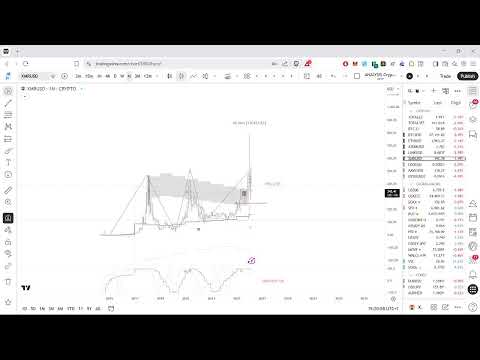
This summary provides a comprehensive overview of the key market insights, strategic decisions, and technical conclusions presented in the transcript. The discussion focuses on macroeconomic shifts, the future of decentralized finance, and the divergence between the United States and global emerging markets. ### Macroeconomic Correlations and the Energy Market
Read AI summary
YouTubeBriefTube monitors your YouTube channels, generates AI-powered audio summaries, and delivers them wherever you listen. Telegram, Discord, Slack, or your podcast app. Fully automated.
Start free trial