💬Session Question/Réponse AVRIL 26 (LIVE)
AI Summary
The speaker begins by addressing questions about the future of various commodities and assets, starting with wheat. He notes that wheat appears to be on monthly support in a bullish context, having already experienced a significant appreciation after the first inflationary wave. He anticipates a second, less durable inflationary wave, lasting one to two years, which will drive up prices of raw materials, including agricultural ones. However, he doesn't foresee a parabolic rise in wheat prices, suggesting a new price range rather than an infinite upward trend. He emphasizes that agricultural commodities are not like gold or silver, which can be sent "into the stratosphere"; pushing wheat prices too high would have significant consequences for basic food supplies. He personally doesn't speculate on wheat, holding only an indirect exposure through an ETF indexing grains. He stresses the ethical considerations of speculating on agricultural staples.
Regarding his crypto portfolio, it remains largely unchanged: over 60% Ethereum (ETH), 20% Cosmos (ATOM), and the rest distributed among well-known DeFi products like AAVE and Chainlink. He notes Chainlink’s appealing chart structure, as long as it remains valid. Monero is also part of his portfolio, with all other holdings being minor (less than 2%). He holds 0% Bitcoin (BTC).
He then addresses a question about a potential market crash and the decoupling of BTC and ETH. He refers to a previous video for a full strategic explanation but reiterates his belief that cryptocurrencies are uncorrelated with traditional indices and won't suffer similar downturns. He sees no interest in Bitcoin but expects Ethereum to surpass its all-time high in the coming years, potentially consolidating at $5,000 afterward. He views $5,000 not as a resistance but as a level Ethereum will "explode" past due to its fundamentals and utility, especially in the context of the current AI explosion. He argues that large-scale AI deployment will require decentralized verification systems, for which Ethereum is uniquely suited. Bitcoin, in his view, serves primarily as a store of value and is not needed in the current environment; it currently sits between a strong resistance and lower supports, making it uninteresting to trade.
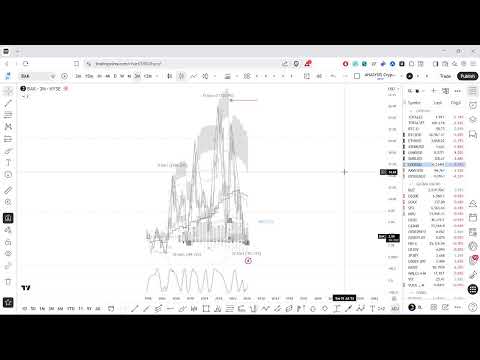
For the stock market, particularly in the US, he predicts a significant downturn, reinforcing his bearish stance. He has been anticipating a monthly signal for months, and now that it's here, he is aggressively shorting US markets. He believes the current market is dangerously illiquid and speculative, with supports at Wall Street no longer holding. He warns against the "denial phase" where investors believe markets will always recover, contrasting it with his current conviction based on strong signals. While he acknowledges the possibility of being wrong and incurring substantial losses (20% of his portfolio if proven incorrect), he is prepared to capitalize on the crisis by accumulating cash for the next investment cycle, which he places around 2027-2028. He plans to reinvest in the US but not in technology stocks, specifically the "Magnificent Seven," which he believes have already peaked and will never revisit their all-time highs. He expects them to retrace 40-50% or more, with any rebounds being "dead cat bounces."
He also touches on the Euro-Dollar, stating he finds the current price range (around 1.15) uninteresting. His primary interest is the relative weakness of the dollar, which he finds more compelling against the Japanese Yen. Thus, he prefers selling the dollar against the Yen rather than buying the Euro.
The speaker believes the impending US market collapse will present golden investment opportunities in 2027-2028, coinciding with the end of a potential second Trump term. He clarifies he is not anti-American but sees US markets as currently the most dangerous, illiquid, and speculative. He plans bipartisan investments, with a significant allocation to China, which he believes offered better opportunities in 2022 and continues to do so. He warns that staying invested in US markets could lead to a 50% loss, especially for those in tech stocks, compounded by currency exchange effects.
He declines to discuss specific company stocks like Téléperformance or TotalEnergies in this strategic session, reserving such analyses for practical workshops. He advises investing in raw materials over underlying companies, citing the example of Morel et Prom, which significantly outperformed oil prices due to its undervalued stock.
On macroeconomics, he admits not being a macro-analyst but uses monthly and quarterly charts to gauge macroeconomic health, as these longer timeframes are harder to manipulate. He responds to a detractor who claims he has been wrong about Ethereum, ATOM, and Bitcoin. He asserts his Ethereum trade has been successful and profitable. For ATOM, he acknowledges the price suggests he might be wrong but maintains that as long as the Cosmos blockchain is running, the token has value. He offers a public wager: if Cosmos Hub reaches $40 billion valuation, he is right; if the blockchain ceases to exist, he is wrong. For Bitcoin, he states he correctly identified the 2018 top, 2019 bottom, and a market top at $120,000, but finds its current price range uninteresting for trading. He asserts his track record shows far more successes than failures over 10 years, contrasting himself with mainstream analysts who he claims are wrong most of the time.
He foresees a "sectorized alt season" around 2026, driven by the utility of projects that were unfairly "massacred." He believes the current focus on AI has diverted attention and critical analysis from crypto, creating opportunities for those willing to understand and select projects based on utility rather than hype. He re-emphasizes Ethereum as the most qualitative token in terms of risk-reward and protocol quality, expecting it to outperform the rest of crypto, especially Bitcoin, before any broader alt season.
He sees the US debt situation as untenable, with rising long-term rates due to a lack of investor demand. He predicts the Fed will have to intervene with yield curve control, setting a 5% cap on long-term rates, which will be enormously expensive for the US government.
He is not concerned by departures of influential figures from decentralized autonomous organizations (DAOs) like AAVE, as the decentralized nature means the protocol should survive its creators. He views DAOs as dematerialized companies that will outlast short-term political whims.
He clarifies his personal crypto strategy: he never sells his Ethereum for stablecoins, as he considers fiat currencies (including stablecoins) as consumption money. His Ethereum is his capital, his financial freedom, allowing him to tap into it anywhere in the world without intermediaries. He believes the capitalist world will migrate on-chain, and his Ethereum is a one-way transfer into this future.
He explains his seemingly contradictory predictions of an S&P 500 crash and an Ethereum explosion by pointing to technical biases. Ethereum, he argues, has no resistance at $5,000 and strong support at $2,000, while the S&P 500 has no real support left, with prices stretched to "madness." He expects the S&P 500 to revisit 4,000-4,400 points by 2028, a 30-35% drop. Combined with a declining dollar, foreign investors would face massive losses. He warns against the "AI bubble" and US tech giants, which he considers a "black hole" for capital.
He dismisses critics as "charlatans" who lack statistical understanding and risk management expertise, contrasting their 70% failure rate with his 70% success rate. He advises listeners to be critical and not blindly follow anyone, including himself.
He discusses the potential for an Ethereum roadmap to succeed without the token itself benefiting, acknowledging it as a valid concern. However, he believes the advent of "zk-proofs" (zero-knowledge proofs) will make Ethereum's security and validation unparalleled, ensuring the token's value. He dismisses "optimistic rollups" as having no future for high-value transactions.
Finally, he reiterates his bearish view on US markets, advising investors to disengage before it's too late due to illiquidity and potential credit problems. He also speculates on a major US market maker, possibly JP Morgan, politically manipulating markets, believing they are "too big to fail," which he thinks will lead to a spectacular failure. He expects investments leaving the US to return to their home countries and later be reallocated to both China and the US in a bipartisan investment cycle from 2027-2033, noting that US tech giants will likely never regain their previous valuations as they benefited from unique, favorable conditions that won't recur.