AI Audio Summaries
10 videos summarized
3 followers on BriefTube
Last summary: Apr 28, 2026
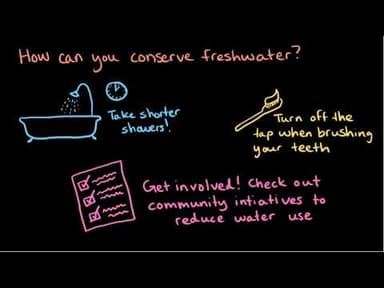
Only 2.5% of Earth's water is freshwater, with a portion safe to drink. We use freshwater daily for domestic purposes (8%), agriculture (70%), and industrial uses (22%). Agriculture consumes the most due to the need to grow food for increasing populations. Industries prefer freshwater as saltwater corrodes machinery. The total amount of freshwater on Earth remains constant, but human population growth has led to increased demand and less available treated water. In many regions, freshwater sources are depleted faster than they can be replenished. Threats include pollution, agricultural runoff, habitat loss, and climate change. Agricultural runoff, for instance, causes harmful algal blooms.
Read AI summary
YouTube


The conversation highlights a recurring theme: the policy environment's impact on education. It's suggested that organizations like Khan Academy, AXA, Cali, Coase, and ISTE should collaborate to influence legislators and public opinion. The goal is to counter the negative perception of edtech, clarifying that the aim is not to passively plug students in while teachers disengage. Instead, the focus should be on dispelling "straw man" arguments and advocating for policies that reduce reliance on standardized testing (ADA). This would enable multi-age learning and the development of assessments that accurately measure skills businesses have long desired but which current systems fail to capture. The transcript points out a disconnect where project-based learning (PBL) is adopted, but student scores don't improve because the assessments don't measure the valuable skills being developed, such as creativity, resilience, and traits outlined in a "portrait of a graduate." These crucial skills are often honed outside traditional academic settings, in areas like sports or performing arts, rather than within the classroom itself, indicating a significant tension between current assessment methods and desired educational outcomes.
Read AI summary
YouTube
We are at a crossroads with AI and its applications, requiring a different approach than past EdTech tools. Previously, we focused on how to integrate and substitute tools using frameworks like SAMR. However, AI is different; it's an interactive partner, not an inanimate object. Unlike previous technologies requiring simple input/output, AI allows us to collaborate and solve problems at new levels. This shift is comparable to the digital transformation of moving from paper to digitized school districts. Therefore, an AI transformation is necessary across all levels of a school district, from administration to students. This requires new models, frameworks, and questions to effectively integrate AI and solve problems.
Read AI summary
YouTube
The discussion centers on the challenges and potential shifts in educational practices, particularly concerning teaching to the test and the integration of educational technology. A core argument is that the current emphasis on standardized test scores creates pressure on school districts, leading teachers to adopt a narrow, test-focused approach. This "teaching to the test" mindset, along with siloed thinking, hinders teachers' agency and prevents them from integrating broader, more innovative teaching methods into the core curriculum. There's a perception that a lack of innovative leadership contributes to this issue, with some leaders being hesitant to grant teachers autonomy due to fear of negative outcomes. The idea is proposed that loosening these rigid structures and providing more autonomy could actually improve engagement and cognitive demand, leading to better results, rather than suffering scores.
Read AI summary
YouTube
The discussion highlights a significant gap in professional development, specifically for school administrators like principals, in the area of educational technology, particularly AI. While professional development for teachers is common, principals often lack the necessary knowledge about new tools and platforms. This deficiency impacts decision-making, especially regarding budget allocation for technology. Principals who are not tech-savvy may misdirect funds, for example, by allocating them to less critical areas like yard supervisor hours instead of educational software subscriptions. The transcript points out that even when districts have access to subscriptions, principals might not understand how to utilize the associated dashboards for usage analysis. This lack of understanding can lead to situations where valuable tools are underused or remain inaccessible because the principal is unaware of their potential or even their existence. The conversation suggests that this is a systemic issue, with a lack of dedicated professional development opportunities for administrators in this domain.
Read AI summary
YouTube
The discussion begins by exploring the concept of angular momentum for objects moving in a straight line, using the example of a stone with mass ‘m’ and velocity ‘v’. Initially, one might assume that since the stone is not rotating, its angular momentum is zero. However, this assumption is incorrect. The explanation illustrates this by imagining a thin, fixed rod that the stone could hit and stick to. If the stone hits the rod perpendicularly, the system (rod and stone) would begin to spin. Since angular momentum is conserved in the absence of external torques, and the collision involves only internal forces, the angular momentum of the system after the collision must be equal to the angular momentum before the collision. Given that the rod's mass is considered negligible, all the initial angular momentum must have resided with the stone, even though it was moving in a straight line. To quantify this angular momentum, the magnitude is defined as the product of the stone's rotational inertia and its angular speed. Assuming the stone is a tiny point mass at a distance 'r' from the axis of rotation, its rotational inertia is 'mr²'. The angular speed (omega) is 'v/r', where 'v' is the linear speed. Substituting these into the formula for angular momentum (L = I * omega), we get L = (mr²) * (v/r), which simplifies to L = mvr. Since 'mv' represents the magnitude of the stone's linear momentum (P), the angular momentum can also be expressed as R * P.
Read AI summary
YouTube
The African savanna, with its diverse array of animals like zebras, wildebeest, elephants, giraffes, and lions, raises the question of how so many different organisms can coexist in the same ecosystem, all requiring food, water, and space. The answer lies in ecological interactions, which describe how organisms affect one another within their shared environment, explaining how an ecosystem functions and how its populations survive, grow, or shrink over time. There are three main types of ecological interactions: competition, predation and herbivory, and symbiosis. Competition occurs when organisms need the same limited resources, such as food, water, space, or safe places to rest and reproduce. For instance, zebras and wildebeest both graze on savanna grasses. If many animals feed in the same area, there might not be enough grass for all, leading to competition. This doesn't necessarily involve fighting; if one group consumes more, less remains for the other. Competition can occur between different species, like zebras and wildebeest, or within the same species. Intense competition can lead to reduced reproduction and lower population sizes if resources become too scarce. However, organisms can mitigate competition by utilizing resources differently, such as giraffes feeding high in acacia trees while zebras eat ground-level grass, thereby competing less directly. Competition significantly influences where organisms live and how many can survive in an ecosystem.
Read AI summary
YouTube
A satellite or space telescope can rotate around any axis in space without using external forces or thrusters, a phenomenon explained by the principle of conservation of angular momentum. This concept builds upon the more familiar principle of conservation of linear momentum. Linear momentum, the product of mass and velocity, is conserved in a system of particles if the total external force on that system is zero. For example, in a collision between two blocks where external forces like friction are negligible, the total momentum of the system before the collision equals the total momentum after. This is because internal forces, like those between the colliding blocks, are equal and opposite, meaning any momentum gained by one object is lost by the other, keeping the total momentum constant. Even in real-life scenarios where external forces exist, during brief events like collisions, internal forces are often significantly larger, allowing the principle to be used for accurate predictions. Similarly, for a spinning rigid body, angular momentum is the product of its rotational inertia and angular velocity. The conservation of angular momentum states that if the net external torque on a system of rigid bodies is zero, then the total angular momentum of the system remains constant. This principle is crucial for understanding rotational motion.
Read AI summary
YouTube
For millennia, accounts describe locust swarms appearing, consuming crops, and then vanishing. This phenomenon is explained by the availability of resources, which are essential for all living things to survive and reproduce. Resources can be biotic, like food, or abiotic, such as water, air, shelter, and space. When organisms have sufficient resources, they thrive, grow, and reproduce, leading to population growth. However, most resources are limited. A field can only yield so much food, a pond holds a finite amount of water, and a forest offers limited living spaces. When a population expands while resources remain constant, competition ensues. Imagine rabbits in a meadow: initially, ample grass and water allow their population to boom. As their numbers increase, they must share resources, eventually leading to scarcity. This triggers competition for food and space, causing some rabbits to struggle for survival, fewer births, and ultimately, a slowdown or even a decline in the rabbit population.
Read AI summary
YouTube
This video explores how to predict the linear and angular velocity an object gains after being flicked, using the concepts of linear and angular momentum. The instructor explains that when an object like a ruler is flicked, it undergoes both translational (forward) and rotational (spinning) motion. Understanding these motions is crucial, not just for a simple ruler, but for more complex scenarios such as controlling orbiting satellites. The analysis begins by separating translational and rotational motion. For translational motion, the key concept is linear momentum, defined as mass times velocity (p = mv). If the linear momentum of the ruler after being flicked can be determined, its linear velocity can then be calculated by dividing by its mass.
Read AI summary
YouTubeBriefTube monitors your YouTube channels, generates AI-powered audio summaries, and delivers them wherever you listen. Telegram, Discord, Slack, or your podcast app. Fully automated.
Start free trial