Ecological interactions | Middle school Biology | Khan Academy
AI Summary
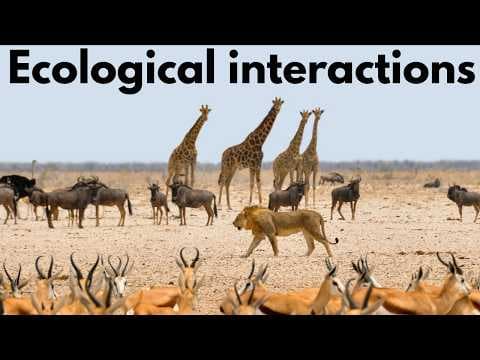
The African savanna, with its diverse array of animals like zebras, wildebeest, elephants, giraffes, and lions, raises the question of how so many different organisms can coexist in the same ecosystem, all requiring food, water, and space. The answer lies in ecological interactions, which describe how organisms affect one another within their shared environment, explaining how an ecosystem functions and how its populations survive, grow, or shrink over time.
There are three main types of ecological interactions: competition, predation and herbivory, and symbiosis. Competition occurs when organisms need the same limited resources, such as food, water, space, or safe places to rest and reproduce. For instance, zebras and wildebeest both graze on savanna grasses. If many animals feed in the same area, there might not be enough grass for all, leading to competition. This doesn't necessarily involve fighting; if one group consumes more, less remains for the other. Competition can occur between different species, like zebras and wildebeest, or within the same species. Intense competition can lead to reduced reproduction and lower population sizes if resources become too scarce. However, organisms can mitigate competition by utilizing resources differently, such as giraffes feeding high in acacia trees while zebras eat ground-level grass, thereby competing less directly. Competition significantly influences where organisms live and how many can survive in an ecosystem.
Predation and herbivory involve organisms feeding on others. Predation is when one organism hunts, kills, and eats another. The hunter is the predator, and the hunted is the prey. For example, a lion is a predator, and an antelope is its prey. An increase in prey population typically leads to an increase in predator population due to more available food, and vice versa. This interaction helps balance populations within an ecosystem. Herbivory, on the other hand, is when animals eat plants, such as giraffes eating acacia trees or elephants eating grass. In this interaction, the animal gains energy and nutrients, while the plant is damaged. An abundance of plants can lead to an increase in herbivore populations, but too many herbivores can reduce plant populations, subsequently affecting herbivore numbers. Both predation and herbivory influence survival, reproduction, and population sizes.
The third major type is symbiosis, which involves organisms forming close, long-term relationships. One subtype is mutualism, where both organisms benefit. An example is oxpecker birds eating ticks and parasites from buffaloes. The birds get food, and the buffaloes are rid of parasites. Another subtype is commensalism, where one organism benefits, and the other is mostly unaffected. Cattle egrets following elephants illustrate this; as elephants move, they stir up insects that the birds eat, with no discernible effect on the elephants. The third subtype is parasitism, where one organism benefits, and the other is harmed. A tick feeding on a mammal's blood is an example; the tick gains nutrients, while the mammal loses blood and may become irritated or weakened. This is a survival strategy, not intentional harm.
In conclusion, the ability of numerous organisms to coexist in an ecosystem stems from these ecological interactions. Organisms compete for limited resources, feed on one another, and form long-term relationships, all of which influence survival, reproduction, and population numbers. Ecosystems are not random collections but are continuously shaped by these intricate interactions.