Angular momentum of satellites | AP Physics | Khan Academy
AI Summary
The discussion begins by exploring the concept of angular momentum for objects moving in a straight line, using the example of a stone with mass ‘m’ and velocity ‘v’. Initially, one might assume that since the stone is not rotating, its angular momentum is zero. However, this assumption is incorrect. The explanation illustrates this by imagining a thin, fixed rod that the stone could hit and stick to. If the stone hits the rod perpendicularly, the system (rod and stone) would begin to spin. Since angular momentum is conserved in the absence of external torques, and the collision involves only internal forces, the angular momentum of the system after the collision must be equal to the angular momentum before the collision. Given that the rod's mass is considered negligible, all the initial angular momentum must have resided with the stone, even though it was moving in a straight line.
To quantify this angular momentum, the magnitude is defined as the product of the stone's rotational inertia and its angular speed. Assuming the stone is a tiny point mass at a distance 'r' from the axis of rotation, its rotational inertia is 'mr²'. The angular speed (omega) is 'v/r', where 'v' is the linear speed. Substituting these into the formula for angular momentum (L = I * omega), we get L = (mr²) * (v/r), which simplifies to L = mvr. Since 'mv' represents the magnitude of the stone's linear momentum (P), the angular momentum can also be expressed as R * P.
A crucial point is then raised about the meaning of 'r' in this context, especially since the imaginary rod isn't real. 'r' is defined as the radius of a "would-be circle" the stone *could* move in if it were rotating, emphasizing the stone's *ability* to rotate in the future. More technically, 'r' represents the perpendicular distance from the reference point (the potential axis of rotation) to the line of action of the stone's velocity. This is denoted as 'r_perpendicular' * P.
Angular momentum is a vector quantity, possessing both magnitude and direction. The direction is determined using the right-hand thumb rule: curl the fingers of your right hand in the direction of rotation, and your thumb points in the direction of the angular momentum.
A significant implication is that angular momentum is dependent on the chosen reference point. If a different reference point is selected, the 'r_perpendicular' value changes, leading to a different magnitude of angular momentum. The direction can also change based on the reference point, as demonstrated by considering different points relative to the stone's path. If the reference point lies directly along the line of the stone's motion, 'r_perpendicular' becomes zero, and consequently, the angular momentum is zero. This highlights that any point mass moving with velocity 'v' has angular momentum, and its value depends on the chosen reference point or origin.
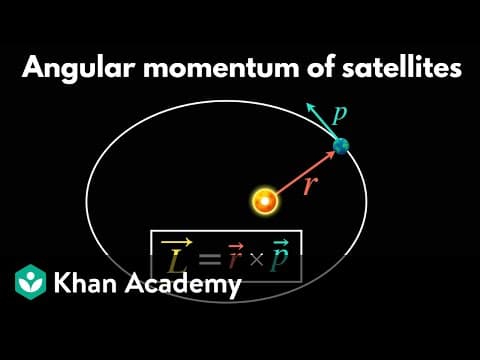
To express angular momentum more formally, it is defined using a position vector 'R' drawn from the reference point to the point mass. Using trigonometry, 'r_perpendicular' can be expressed as 'R * sin(theta)', where 'theta' is the angle between the position vector 'R' and the momentum vector 'P'. Therefore, the magnitude of angular momentum is 'R * P * sin(theta)'. This leads to the vector definition of angular momentum as the cross product of the position vector 'R' and the momentum vector 'P': L = R x P.
The cross product inherently includes both magnitude (R * P * sin(theta)) and direction. The direction of the cross product (R x P) is also found using the right-hand rule: point your four fingers in the direction of 'R', then curl them towards 'P', and your thumb will indicate the direction of the cross product, which aligns with the angular momentum. It's important to note that R x P is not commutative; R x P = -(P x R).
The concept is then applied to orbiting satellites and planets, taking Earth orbiting the Sun as an example. The question is whether Earth's angular momentum about the Sun's center changes. Angular momentum of a system changes only if an external torque acts on it. Torque is also defined as a cross product: Torque (τ) = R x F, where 'F' is the force. For Earth orbiting the Sun, the gravitational force 'F' always acts directly opposite to the position vector 'R' (from the Sun to Earth). The angle between 'R' and 'F' is 180 degrees, and since sin(180°) is zero, the torque produced by gravity about the Sun's center is always zero. Consequently, Earth's angular momentum about the Sun's center remains conserved throughout its orbit.
While this might seem obvious for perfectly circular orbits where R, M, V, and theta are constant, it's a powerful principle for elliptical orbits too. In elliptical orbits, R, V, and theta all change. However, because the gravitational force is always a central force (acting towards the center), the torque remains zero, ensuring the conservation of angular momentum even in elliptical paths. This principle allows for predictions of planetary velocities at different points in their orbits.
The conservation of angular momentum about the parent body's center holds true for any orbiting object (planet around a star, satellite around a planet) because gravity is a central force and cannot produce torque about the center. However, it's acknowledged that in a multi-body system like our solar system, other planets exert gravitational forces on Earth, creating torques that can alter Earth's angular momentum with respect to the Sun. If the entire solar system is considered as a single system, its total angular momentum would be conserved. Finally, the planet's own spin also contributes to its total angular momentum, though for orbital mechanics at this scale, it's often considered negligible, treating the planet as a point mass.
In summary, any mass with velocity 'V' possesses angular momentum, defined as L = R x P, which depends on the chosen reference point. A crucial takeaway is that the angular momentum of any orbiting body about the center of its parent body is always conserved because gravity, being a central force, produces no torque about that center.