Conservation of angular momentum | AP Physics | Khan Academy
AI Summary
A satellite or space telescope can rotate around any axis in space without using external forces or thrusters, a phenomenon explained by the principle of conservation of angular momentum. This concept builds upon the more familiar principle of conservation of linear momentum. Linear momentum, the product of mass and velocity, is conserved in a system of particles if the total external force on that system is zero. For example, in a collision between two blocks where external forces like friction are negligible, the total momentum of the system before the collision equals the total momentum after. This is because internal forces, like those between the colliding blocks, are equal and opposite, meaning any momentum gained by one object is lost by the other, keeping the total momentum constant. Even in real-life scenarios where external forces exist, during brief events like collisions, internal forces are often significantly larger, allowing the principle to be used for accurate predictions.
Similarly, for a spinning rigid body, angular momentum is the product of its rotational inertia and angular velocity. The conservation of angular momentum states that if the net external torque on a system of rigid bodies is zero, then the total angular momentum of the system remains constant. This principle is crucial for understanding rotational motion.
Consider a spinning disc on a frictionless table with an initial angular velocity. If a second, non-rotating disc is dropped onto it, friction between the two discs will cause the larger disc to exert a torque on the smaller one, making it spin, while the smaller disc exerts an equal and opposite torque on the larger one, slowing it down. Eventually, both discs will spin together at a new, common angular velocity. If both discs are considered as a single system, there are no external torques, so the total angular momentum before and after the interaction must be conserved. This allows for the calculation of the final angular velocity. It's important to note that rotational inertia depends not only on mass but also on how that mass is distributed; mass farther from the axis of rotation results in higher rotational inertia.
Another example involves an automobile with jacked-up, independently spinning tires. If the clutch is engaged, the tires are forced to spin together. Assuming negligible friction and clutch mass, the conservation of angular momentum can be used to predict the new combined angular velocity. The initial angular momentum of each wheel, considering their individual rotational inertias and angular velocities, sums to the total initial angular momentum. After the clutch engages, the total rotational inertia becomes the sum of the individual inertias, and this total multiplied by the final common angular velocity must equal the initial total angular momentum.
The principle is also demonstrated by a box floating in outer space with a spinning disc inside. The disc, motor, and battery are all contained within the box. Since there are no external torques on this system, its total angular momentum must remain constant. If the speed of the spinning disc is reduced, its angular momentum decreases. To conserve the total angular momentum, the box itself will begin to rotate in the same direction, compensating for the disc's loss of angular momentum. Conversely, speeding the disc back up will cause the box to stop rotating. If the disc's speed is increased beyond its original value, the box will rotate in the opposite direction to maintain the overall angular momentum. This device, called a reaction wheel, is how satellites control their rotations along different axes, often using multiple wheels for redundancy.
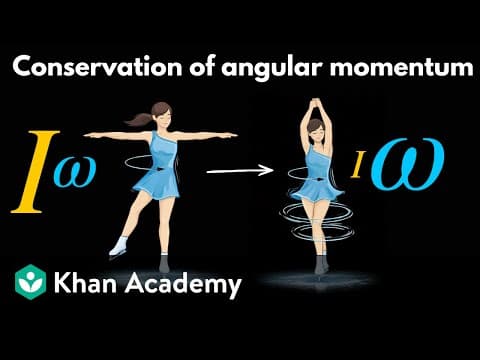
The conservation of angular momentum also applies to non-rigid bodies, such as an ice skater. When an ice skater starts spinning with arms and legs outstretched, her mass is distributed far from the axis of rotation, resulting in high rotational inertia. As she pulls her arms and legs closer to her body, the mass distribution shifts closer to the axis, significantly decreasing her rotational inertia. Since the forces involved in pulling her limbs are internal, and external torques like friction are minimal, her total angular momentum remains conserved. For the product of rotational inertia and angular velocity to stay constant, a decrease in rotational inertia must be accompanied by an increase in angular velocity, causing her to spin faster.
A similar phenomenon occurs in the formation of stars and neutron stars. A star forms from a vast, swirling cloud of gas. Initially, the gas particles are spread out, leading to high rotational inertia. As the cloud collapses under gravity to form a star, the mass becomes concentrated much closer to the axis of rotation, drastically reducing the rotational inertia. Due to the conservation of angular momentum (as external torques are negligible), the star's angular velocity must increase significantly to keep the product constant, making it spin much faster than the original cloud. This effect is even more pronounced in the formation of neutron stars. When large stars exhaust their nuclear fuel, gravity crushes them into extremely dense, tiny objects. This dramatically reduces their rotational inertia, causing them to spin at incredibly high rates—tens or even hundreds of rotations per second—to conserve their angular momentum. These rapidly spinning neutron stars, known as pulsars, were initially mistaken for signals from alien life due to their precise, regular radio pulses, but were later identified as natural celestial phenomena.