3Blue1Brown
AI Audio Summaries
5 videos summarized
Last summary: Oct 28, 2026
The Physics of Euler's Formula | Laplace Transform Prelude
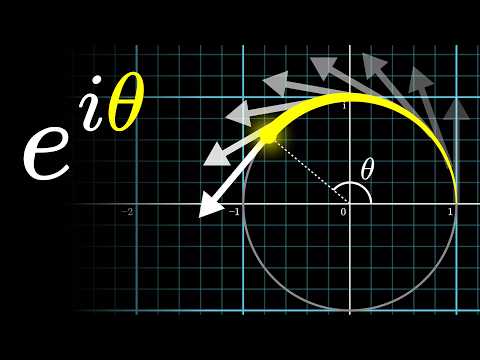
This lesson serves as the foundation for understanding the Laplace transform by focusing on the behavior of exponential functions, specifically in the form $e^{st}$. Here, $t$ represents time and $s$ is a parameter that determines the specific nature of the exponential. To understand the transform, one must first master the mental framework of how these functions behave when $s$ is allowed to be a complex number. The starting point is the fundamental property of $e^t$: it is its own derivative. While derivatives are often visualized as slopes on a graph, a more dynamic approach is to view them as velocity. If $e^t$ represents the position of a point on a number line, the derivative tells us that the velocity is always equal to the current position. Starting at 1, the point moves right, and as its position increases, its velocity increases, leading to accelerating growth. If we change the exponent to $e^{2t}$, the velocity is twice the position, causing even faster growth. Conversely, with a negative exponent like $e^{-0.5t}$, the velocity is half the position but pointed in the opposite direction, resulting in exponential decay toward zero.
Read AI summary
YouTube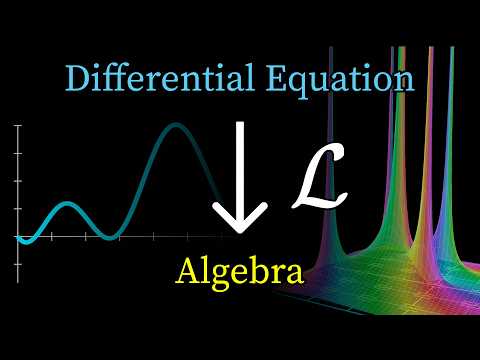
Why Laplace transforms are so useful
In this exploration of the Laplace transform, we begin with a physical simulation: a mass on a spring influenced by an external, oscillating force—much like a gust of wind blowing back and forth. When left alone, the spring has a natural frequency at which it wants to oscillate. However, when an external force is applied at a different frequency, the system behaves strangely at first. It produces an irregular, "wibbly" startup trajectory, growing stronger and weaker before eventually settling into a steady, predictable rhythm. To analyze this behavior and predict how long it takes for the system to find its stride, we utilize one of the most powerful tools in engineering and physics: the Laplace transform. The Laplace transform acts as a translator, moving a function from the domain of time into the "s-plane." This s-plane represents all possible values of a complex number, $s$, which sits in the exponent of functions like $e^{st}$. In this language, the vertical imaginary axis represents oscillation, while the horizontal real axis represents growth or decay. Specifically, poles—points where the transformed function blows up to infinity—reveal the "exponential pieces" hidden inside a system’s behavior. If a pole has a negative real part, the system decays toward zero; if it has a positive real part, the system is unstable and explodes. If it has an imaginary component, the system oscillates.
Get automatic AI summaries for all your channels
BriefTube monitors your YouTube channels, generates AI-powered audio summaries, and delivers them wherever you listen. Telegram, Discord, Slack, or your podcast app. Fully automated.
Start free trial