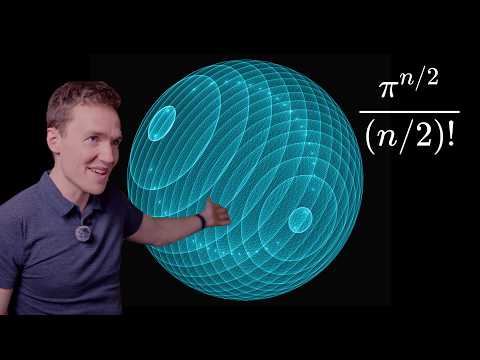
The most underappreciated formula | Exploring high-dimensional spheres
AI Summary
This lecture explores one of the most underappreciated gems in mathematics: the formula for the volume of an $n$-dimensional sphere. While high-dimensional geometry may seem abstract, it is a practical reality in modern fields like machine learning, where data is represented as points in spaces with hundreds or thousands of dimensions. The speaker’s goal is to move beyond simply stating the formula, instead demonstrating why it is true and how it reveals the bizarre, counter-intuitive nature of high-dimensional space.
To set the stage, the speaker presents two puzzles. The first is a probability question: if you choose two random numbers between -1 and 1, what is the probability that the sum of their squares is less than or equal to 1? Geometrically, this is the area of a unit circle divided by the area of a 2x2 square ($\pi/4$). This logic extends into any number of dimensions; asking the same question for 100 numbers is equivalent to calculating the volume of a 100-dimensional unit ball.
The second puzzle warns us not to trust our 3D intuitions. Imagine a 2x2 square with unit circles at its corners and a smaller circle in the center tangent to the others. In 2D, the inner circle’s radius is $\sqrt{2}-1$. In 3D, it is $\sqrt{3}-1$. In $n$ dimensions, the radius is $\sqrt{n}-1$. By the 10th dimension, the "inner" sphere actually pokes outside the 2x2 bounding box. This reveals a fundamental truth: high-dimensional spheres are not "spiky," but high-dimensional cubes are. The distance to the corners of a cube grows significantly faster than the distance to its sides, making cubes appear stretched and "spiky" relative to the perfectly round spheres.
The derivation of the volume formula relies on a chart comparing the interior volume ($V_n$) and the boundary area ($\partial V_n$) of balls across dimensions. A key calculus relationship is established: the boundary is the derivative of the interior volume with respect to the radius. For example, the derivative of a circle’s area ($\pi r^2$) is its circumference ($2\pi r$). Conversely, the interior is the integral of the boundary.
To move horizontally across the chart—from lower to higher dimensions—the speaker utilizes a "knight’s move" logic inspired by Archimedes. Archimedes showed that the surface area of a sphere is equal to the area of its enclosing cylinder. This projection is area-preserving because the stretching in one direction is perfectly cancelled by squishing in another. The speaker generalizes this: the boundary of an $n$-dimensional ball can be calculated by multiplying the interior of an $(n-2)$-dimensional ball by the boundary of a 2D circle ($2\pi r$).
Applying this "knight’s move," the boundary of a 4D ball is the area of a 2D circle ($\pi r^2$) multiplied by $2\pi r$, resulting in $2\pi^2 r^3$. Integrating this gives the 4D volume: $\frac{\pi^2}{2} r^4$. This recursive pattern—shifting two dimensions, multiplying by $2\pi$, and dividing by the new dimension $n$ through integration—allows us to find the volume for any dimension.
This recursion leads to a general formula involving factorials. For even dimensions, the volume constant is $\frac{\pi^{n/2}}{(n/2)!}$. However, odd dimensions present a problem, as they require "half-factorials" (e.g., $1.5!$). By forcing the formula to remain consistent across all dimensions, we find that $0.5!$ must equal $\frac{\sqrt{\pi}}{2}$. This aligns perfectly with the Gamma function, a mathematical tool that generalizes factorials to all real and complex numbers.
The most startling conclusion is the behavior of the unit ball’s volume as dimensions increase. Initially, the volume grows, peaking at five dimensions. After this, it begins to shrink rapidly. By the 100th dimension, the volume of a unit ball is approximately $10^{-40}$—effectively zero. This happens because the integration factor ($1/n$) eventually dominates the $2\pi$ multiplier in the recurrence relation.
This "vanishing" volume has profound implications. In high dimensions, almost all the volume of a ball is concentrated in a thin shell near its surface. Furthermore, most of that surface area is concentrated around the equator. Comparing spheres to cubes in high dimensions highlights the disparity: the cube becomes massive, while the sphere, despite being "round," occupies an infinitesimally small fraction of the space.
In conclusion, the speaker emphasizes that the beauty of these formulas—such as $\pi$ appearing within factorial calculations—is only visible when we step back to view them in a generalized, high-dimensional context. What seems like a collection of isolated rules for circles and spheres is actually a single, unified, and elegant geometric truth. Understanding these patterns allows us to navigate the counter-intuitive "spiky" reality of higher dimensions with analytical clarity.