This picture broke my brain
AI Summary
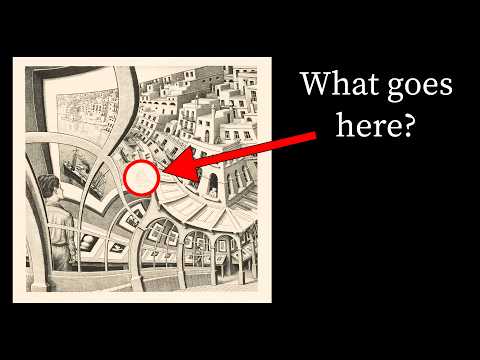
M.C. Escher’s 1956 lithograph, *The Print Gallery*, depicts a young man in a gallery looking at a print of a seaside town. As the viewer’s gaze follows the harbor and the buildings in the print, the world warps, eventually leading back to the entrance of the very gallery where the young man stands. This self-contained loop is a masterpiece of paradoxical geometry. In 2003, mathematicians Bart de Smit and Hendrik Lenstra analyzed the piece to uncover the mathematical framework behind this recursion. Their work revealed that Escher had intuitively navigated complex mathematical principles to create a "Droste effect"—a self-similar image nested within itself—with a unique twist.
The core of the piece is the Droste effect, named after a cocoa brand that featured a nurse holding a tray with a box of cocoa that featured the same nurse. In Escher’s work, the self-similarity is extreme; the internal copy of the image is 256 times smaller than the original. Escher’s genius was in transforming this simple "zoom" into a warped loop where the magnification happens implicitly as the viewer’s eye moves around the center. To understand how he achieved this, one must look at his three-step process.
First, he started with a straightened, "unwarped" version of the scene. This reference image contains the harbor, the town, the gallery, and the man, repeating infinitely as one zooms in. Second, Escher created a warped grid. This grid was designed to distribute the 256-fold zoom across the four corners of the square. By scaling the image by a factor of four as the gaze moves from one corner to the next, the path eventually joins the self-similar part of the image. Finally, Escher used a "mesh warp" technique. He laid a square grid over the straight image and meticulously copied the contents of each small square into the corresponding warped square on his distorted grid.
A crucial observation made by mathematicians is that Escher’s warped grid is "conformal." In a conformal map, although the global image is highly distorted, the grid lines always intersect at right angles, and small squares remain approximately square. This property ensures that local details—like a window or a face—remain recognizable and undistorted to the eye, even as the overall composition curves and scales.
This leads into the field of complex analysis. In mathematics, functions of complex numbers naturally produce conformal maps. A complex number $z$ represents a point on a two-dimensional plane. When we apply functions to these numbers, such as $f(z) = z^2$, the resulting transformation preserves shapes at a small scale. This is because these functions have derivatives; as you zoom in on a point, the transformation behaves like a simple combination of rotation and scaling.
To recreate Escher’s effect mathematically, two specific functions are required: the exponential function ($e^z$) and the natural logarithm ($\ln(z)$). The exponential function is unique because it transforms vertical lines into concentric circles. Specifically, a vertical line segment with a height of $2\pi$ wraps into a perfect circle. Conversely, the natural logarithm performs the inverse operation: it "unwraps" circles into straight lines.
If you take the natural logarithm of a Droste image, the result is a "doubly periodic" tiling pattern. Because the original image repeats as you rotate (periodicity in angle) and as you zoom (periodicity in scale), the logarithmic version repeats infinitely both vertically and horizontally. This creates a bizarre, repeating grid of the entire scene.
The final mathematical reconstruction of *The Print Gallery* involves three steps:
1. Take the natural log of the straightened Droste image to create the tiling pattern.
2. Rotate and scale this tiling pattern in the complex plane. This is done by multiplying the complex coordinates by a specific constant. This step is designed to align a diagonal path in the log-space with the vertical axis.
3. Apply the exponential function to the result.
This process "warps" the straight image into the spiraling loop Escher drew. Unlike Escher’s original lithograph, which features a blank white hole in the center, the mathematical version fills this space with an infinite, spiraling descent. Escher left the center blank because the ambiguity of the perspective—where the gallery, the town, and the frame all collide—became impossible to resolve manually.
The mathematical analysis shows that Escher’s intuitive artistic choices align perfectly with advanced concepts like elliptic functions. These are functions that are doubly periodic in the complex plane, providing a bridge between different areas of mathematics. Escher, who had no formal mathematical training, arrived at these structures through a desire to represent infinity within a finite space and an aesthetic preference for preserving local shapes.
Ultimately, *The Print Gallery* is more than a visual trick; it is a solution to a geometric puzzle. The fact that an artist’s intuition and a mathematician’s formal theory arrive at the same complex structure suggests a universal appeal in these perfectly fitted patterns. Escher’s work continues to fascinate because it captures the creative genius required to dream up a puzzle that is as deep as it is beautiful.