
Alex Hormozi
AI Audio Summaries
20 videos summarized
2 followers on BriefTube
Last summary: Oct 2, 2026
AI Audio Summaries
20 videos summarized
2 followers on BriefTube
Last summary: Oct 2, 2026
Read AI summary
YouTube
Alex Hormozi, an entrepreneur and investor, owns a portfolio of companies generating over $250 million in aggregate revenue annually. His journey began 15 years ago, sleeping on his gym floor to make his first business work. This experience led him to found acquisition.com, where his team supports entrepreneurs through the challenges of starting and scaling businesses. To demonstrate this process, Hormozi brought together eight business owners to compete for $100,000 and a "golden ticket." This ticket grants a year of guidance from Hormozi and his team, leveraging their expertise from his successful portfolio. Each business owner has 60 minutes to present their business, ranging from roofing companies and adventure parks to sticker-making businesses.
Read AI summary
YouTube
The discussion centers on a business owner catching a main employee skimming money from the company and what actions to take, especially in the context of an impending sale of the business. The host, who discovered the employee’s theft, is seeking advice on how to handle the situation. The first response emphasizes honesty and integrity. The speaker advises that when looking back at 85, one would want to have been honest. Furthermore, knowingly concealing such an issue exposes the seller to significant liability. If a buyer discovers that the seller withheld information about a liability, such as an employee stealing, the buyer could sue, potentially taking back money or even the business itself.
Read AI summary
YouTube
The speaker delves into the complex concept of trust, noting its common misuse and lack of clear definition. They propose a breakdown of trust from a behavioral perspective, identifying four distinct types, all linked to the ideas of risk and punishment. The core idea is that trusting someone means making oneself punishable by them. For example, sharing a secret gives the other person information they could use against you, making you vulnerable. This represents a "bet" that they won't use that power to punish you.
Read AI summary
YouTube
The video outlines four paths to accumulating significant wealth, emphasizing that true financial success comes from sustained commitment rather than seeking quick riches. The four paths are: 1) Bootstrapping (your money, your business), 2) Raising Capital (other people's money, your business), 3) Investing (your money, other people's businesses), and 4) Fund Management (other people's money, other people's businesses). **1. Bootstrapping:** This involves funding a business entirely from personal savings and profits, reinvesting earnings to fuel growth without outside investors. Typical bootstrapped businesses are low-cost service providers, local businesses, or e-commerce brands that can start with minimal inventory. While this path offers maximum control and equity, it is generally the slowest due to capital constraints. It also incurs "debt" in areas like talent acquisition, technology, and data, as money isn't available to solve these issues immediately. The advantage is lower cost basis and the ability to exit on one's own terms. The speaker recommends this for first-time entrepreneurs to avoid losing others' money due to inexperience.
Read AI summary
YouTube
The speaker, with over 21 million followers across platforms, discusses building a personal brand in 2026, focusing on leveraging and succeeding in spite of AI. The core idea is that AI will not equally disrupt all creators, who exist on a continuum from low-risk to high-risk. Low-risk creators, termed "entertainers," create content whose objective is solely to be consumed. Examples include memes or stand-up comedy clips. The risk for the consumer is just the time invested. If the content delivers its intended value (e.g., laughter), the cycle is complete. AI is best suited to disrupt this category because the "product" is self-contained and doesn't require deep, demonstrable credibility from the creator beyond the content itself.
Read AI summary
YouTube
The speaker outlines six principles, or rather, actionable steps, for ambitious individuals unsure of their next move, drawing from personal experience of transitioning from financial hardship to building a successful company portfolio. The core message is about building capacity to recognize and capitalize on opportunities. **Principle 1: Build Capacity.** This means investing in yourself when you don't have immediate direction. Examples include resting when unsure of tomorrow's tasks, getting in shape without immediate dating prospects, and saving money even without a clear investment plan. Opportunities are universally presented, but only those with built-in capacity can identify and leverage them. A study at Princeton involving seminary students illustrates this: those who were late for a presentation were significantly more likely to stop and help someone in need than those who were on time or early. This highlights that being rushed or unprepared (lacking capacity) can prevent one from acting on opportunities, even moral ones. The speaker emphasizes that many current opportunities are unrecognized due to a lack of capacity.
Read AI summary
YouTube
Corey runs ProShine Professional Cleaning, an HVAC cleaning and ductwork repair company, with his wife Nicole. They generate $1.25 million in annual revenue but face $60,000 in debt and challenges with lead generation. Alex Hormozi, owner of Acquisition.com, a portfolio of companies with over $250 million in aggregate revenue, offers tactical advice to help Corey scale his business and eliminate debt. ProShine's services include HVAC unit cleaning at $15.75 per unit with a two-year warranty, ductwork rewrapping, and dryer vent cleaning for $175. They provide customers with access to a profile containing pictures of their vents, which can be used as an advantage when selling their home.
Read AI summary
YouTube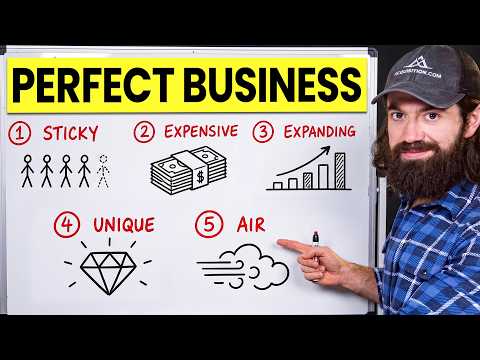
To build a perfect business, focus on five key advantages that enhance growth and profitability: stickiness, expensiveness, expansion, air (operational scale), and uniqueness. These advantages have contributed to a portfolio of companies generating over $250 million in revenue. The first advantage is **stickiness**, defined by high revenue retention. This means a business retains a significant portion of its previous year's revenue from existing customers. There are two types of retention: logo retention (how many customers remain) and revenue retention (how much revenue those customers generate). While 100% logo retention is rare due to structural churn (e.g., customers moving or businesses closing), over 100% net revenue retention is achievable. This occurs when remaining customers increase their spending enough to offset those lost. A strategy to achieve this is offering clear pathways for customers to spend more, such as tiered memberships. Data from businesses like "School" shows that the highest churn occurs in month one (over 20%), followed by month three (10%), and month six. The goal is to get customers to month six, after which churn drops significantly to about 2% per month. Businesses lacking stickiness include one-time services like roofing or car sales. Sticky businesses include term life insurance, alarm systems, internet providers, banking, and community-based educational platforms with consumable content. A sticky business, even without acquiring new customers, can grow revenue significantly over time, leading to higher profitability and less marketing expense compared to businesses constantly replacing lost customers.
Read AI summary
YouTube
This summary addresses common challenges in scaling businesses, particularly brick-and-mortar operations, and offers tactical solutions for growth, talent acquisition, and strategic focus. One recurring theme is the necessity of making trade-offs when pursuing aggressive growth. An entrepreneur aiming to scale from $6 million to $100 million acknowledged comfort, distractions, and fear—specifically fear of losing family time—as barriers. The advice provided emphasizes that regrets often stem from imagining upside without considering the necessary costs. There's no "right" work-life balance; it's a preference. If one desires both comfort and aggressive growth, dissatisfaction arises. The solution is to either desire less or trade more. For significant growth without personal time sacrifice, one must be willing to invest heavily in high-level talent, accepting a short-term hit to profitability. This talent can then drive expansion, provided they believe in the vision. The speaker noted a progression in hiring, from $50,000 employees to multi-million dollar per year executives, illustrating that "the best talent is always in the future." To achieve substantial growth without personal time trade-offs, a change is inevitable. The question becomes what one values least: short-term profit or family time. Giving up short-term profit allows for hiring top talent to lead growth. Regarding distractions like real estate investments, the advice is to keep passive investments truly passive, ensuring they don't become active management burdens that detract from the core business.
Read AI summary
YouTube
This video explains how Acquisition.com (ACQ) generates revenue and reinvests its capital, with the overarching mission of making true business education accessible to everyone. The founders, Alex and Leila, were motivated by their own experience in personal development and recognized a gap in credible business education. They identified an opportunity to provide this education, leveraging their credibility and the fact that many highly credible individuals in business are not focused on teaching. The revenue generation process starts with capturing attention, referred to as "eyeballs." ACQ targets business owners and aspiring entrepreneurs. While most of their content and initial help is provided for free, they focus on monetizing relationships with successful business owners. This process is visualized as an onion, with layers of engagement.
Read AI summary
YouTube
The speaker opens with a critique of Thanos's strategy from the Marvel universe, finding his plan to save the universe by reducing population flawed despite his good intentions. He then transitions into the "Hormozy hotline," where he answers questions from members of "Vantage," a community of million-dollar-plus business owners. A question is posed about why people don't follow through on their stated intentions. The speaker explains that short-term reinforcing contingencies often outweigh long-term goals. To combat this, one must take action, create a label for that behavior, and internalize it as an identity. For example, by performing organizational tasks and affirming "I am organized," one reinforces consistent behavior aligned with that identity. This self-creation of identity is crucial for adults to avoid short-term thinking and achieve long-term results.
Read AI summary
YouTube
The most courageous thing the speaker did was quitting their white-collar job to start a gym and become a personal trainer, despite fearing their father's judgment. To avoid confrontation, they drove across the country before informing their father, calling him from Texas to announce their decision. Their father, who had always envisioned a specific career path for them involving Harvard or Stanford, initially tried to dissuade them. The speaker realized they were succeeding at a life plan not of their own making and chose to pursue their own path. Contrary to expectations, their father was not supportive; he was "freaked out," leading to a few years of estrangement. The speaker felt like the "prodigal son" for deviating from their father's successful life plan to live their own.
Read AI summary
YouTube
Luis, the owner of Optimum Works, a railing company, is generating $2.5 million in revenue with a 15% net margin and $384,000 in profit. However, 81% of his customers come from Google Ads, creating a significant risk if this channel falters. His key challenges are a high customer acquisition cost (CAC) that has doubled, low conversion rates, and a low repeat purchase rate (only 10%), impacting his customer lifetime value (LTV). The business primarily serves DIY homeowners (70%), with contractors and designers making up the rest. Seventy percent of sales are for standard off-the-rack items, while 30% are custom orders. Currently, 10-20% of sales occur over the phone, with the majority happening directly on the website. The primary issue identified is a critical data attribution problem. While Luis spends heavily on advertising, he lacks clear insights into which channels are truly profitable. His reported LTV to CAC ratio of 1:1, and specifically a 41:1 ratio for Google Ads, is mathematically impossible given his profitability, suggesting a severe flaw in his tracking or reporting. This lack of accurate data prevents any meaningful optimization of his marketing spend. He acknowledges that while increased ad spend has correlated with increased revenue, the underlying data is not providing actionable insights.
Read AI summary
YouTube
The video features a compilation of old clips from the creator's content, dating back 10 to 13 years, offering a look at his past work. One segment focuses on recruiting highly motivated individuals for a free 6-week challenge, emphasizing that only those who demonstrate motivation through their actions are selected. Another clip discusses the mind game series, specifically contrasting love and discipline within the fitness industry. The speaker criticizes the common misconception that trainers should push people to "grit their teeth" or adopt extreme mottos like "eat clean or die trying," suggesting these approaches are misconstrued.
Read AI summary
YouTube
This video illustrates how far anyone can come, emphasizing the importance of not judging one's initial efforts by the advanced stages of others. The speaker shares their journey from creating their first piece of content and ad to now producing 450 pieces weekly, breaking a Guinness World Record for fastest-selling non-fiction with $16 million in sales in a weekend, and owning a portfolio of companies that generated over $250 million in aggregate revenue last year. A core concept introduced is "cringe," defined as supposed secondhand embarrassment, often interpreted as a defensive status play. When someone calls your efforts "cringe," it suggests you are changing your status relative to others, indicating you are on the right path. The speaker questions whose rules we are breaking and what outcomes those rules optimize for.
Read AI summary
YouTube
The speaker, with 14 years in business and aggregate revenue exceeding $250 million across his companies, co-owns the School platform, which has over 22 million users and helps people start and scale digital businesses. This gives him access to millions of data points on what makes digital businesses succeed or fail. He is answering questions about scaling businesses. One entrepreneur, who started by flipping homes, built an ecosystem including a contracting company, HVAC, roofing, and dumpster companies, and a coaching channel to teach others the process. Initially, he flipped 30-40 homes annually in the same market, generating about $4 million in revenue. However, increased competition made profitability per flip difficult. He transitioned to converting competition into collaboration by becoming the product and teaching others. His current challenge is being an owner-operator and feeling too busy too fast. He recently hired a COO to transition operations, but he's unsure how to manage a COO or how to transition himself out of the business.
Read AI summary
YouTube![Helping Strangers Build A $1,000,000+ Business [LIVE]](https://img.youtube.com/vi/A8p2HCI_23E/hqdefault.jpg)
This session addresses various business challenges, from scaling an auto detailing business to building a brand for tax strategy services and increasing qualified leads for a weight loss program. For an auto detailing business looking to scale and find technicians, the suggestion is to recruit from other detailing places or train people in-house. It’s noted that auto detailing isn't a complex skill to teach, and training someone to do an "okay" job could take just a weekend, a value often underestimated.
Read AI summary
YouTube
AI is here, and its impact will be a significant shift for Main Street businesses, not just tech companies. AI will only improve from this point forward, making learning to use it a top priority. This video aims to prepare individuals and businesses for this change by offering ways to think about and utilize AI today to make substantial improvements or start new ventures. This era presents an unprecedented opportunity to launch "AI-first" businesses that can disrupt existing markets. Traditional businesses are often too engrossed in daily operations to fully embrace AI, giving new, agile AI-first companies a distinct advantage. Companies that integrate AI from day one can achieve remarkable revenue per employee. Large organizations often struggle with AI adoption due to resistance to new, uncomfortable technologies and a reluctance to address roles that can be automated. Businesses must be willing to raise the bar for employees, retaining those who can adapt and letting go of those who cannot. Recent economic data, such as zero net job creation in the private sector, suggests that automation is already impacting the job market.
Read AI summary
YouTube
In 2021, the speaker, Alex, successfully sold his e-commerce company, Prestige Labs, for $46.2 million and recently achieved a Guinness World Record for the fastest-selling non-fiction book, generating over $16 million in a weekend through a Shopify store. He aims to provide tactical solutions for scaling e-commerce businesses. **Scaling Leads for Luxury Gaming Tables**
Read AI summary
YouTubeBriefTube monitors your YouTube channels, generates AI-powered audio summaries, and delivers them wherever you listen. Telegram, Discord, Slack, or your podcast app. Fully automated.
Start free trial