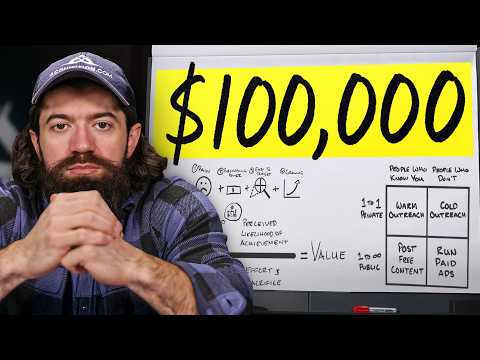
If I Wanted to Make My First $100K in 2026, I’d Do This
AI Summary
While many people assume that the height of wealth is measured by multi-million dollar exits or massive distribution checks, the reality is often different. For many successful entrepreneurs, the moment they felt the wealthiest was not when they hit their first million, but when they reached their first $100,000 in the bank. This specific milestone represents a fundamental "unlock" because it marks the transition from survival mode to strategic thinking. When you are sleeping on a gym floor or calculating whether you can afford groceries, you cannot focus on a long-term vision. Reaching $100,000 removes the immediate anxiety of rent, bills, and insurance, allowing you to finally look toward the future.
To reach this first major checkpoint, one must follow a disciplined six-step roadmap designed to maximize both capital and time.
**Step 1: Cut All Costs to Enable Risk**
The foundation of wealth-building is the ability to take risks, and you cannot take risks if your overhead is too high. This stage requires extreme frugality. You must eliminate all unnecessary expenses: no eating out, buying only from discount grocery stores, and wearing the clothes you already own until they wear out. Housing should be as cheap as possible, even if it means living with family or sharing a room with roommates. By driving down living expenses to the absolute minimum—ideally living on just a few hundred dollars a month—you create a "cash flow fluff." This surplus is the fuel you will eventually reinvest into your own skills.
**Step 2: Reclaim and Organize Your Time**
Many people blame their 9-to-5 jobs for killing their dreams, but the reality is that most people waste the two four-hour windows available to them: 5:00 AM to 9:00 AM and 5:00 PM to 9:00 PM. To move forward faster than the competition, you must utilize these hours for "extra practices."
Productivity during this time is achieved through subtraction, not addition. A helpful framework is the 4-4-4 split: four hours for promotion (letting people know about your product), four hours for delivery (fulfilling promises to customers), and four hours for building (curating and prioritizing future opportunities). Furthermore, you must distinguish between being a "maker" and a "manager." A maker needs a completely empty calendar to focus on deep work like writing or coding, while a manager thrives on frequent touchpoints and decisions. To maximize output, protect the first four to six hours of your day as "maker time" and avoid the productivity-killing trap of task-switching.
**Step 3: Research High-Demand Skills**
Once you have reclaimed your time, you must decide which skill to master. The most effective strategy is to find what people are already paying for. In the business-to-business (B2B) sector, this includes skills like advertising, content creation, outreach, or funnel building. In the business-to-consumer (B2C) sector, you can identify opportunities by looking at your own bank statements; consumers generally pay for things that give them their time back. The "1-1-1 Rule" is essential here: focus on selling one product to one avatar on one channel until you hit $1 million in revenue. Do not get distracted by the multitude of options; pick one high-value skill and commit.
**Step 4: Commit to Deep Learning**
True learning is defined as a change in behavior under the same conditions. If your daily actions haven't changed, you haven't learned. This process requires "10,000 iterations" rather than just 10,000 hours. Iterations imply a feedback loop; you must do the work, receive feedback (even if it is the silence of a post getting no views), and adjust. To accelerate this, analyze the top 10% of performers in your chosen field. Identify the specific details that differentiate them from the bottom 90%, then perform hundreds of repetitions, intentionally mimicking the successful traits of the top tier until the skill becomes second nature.
**Step 5: Invest Money in the Right Places**
With the money saved from your initial cost-cutting, you must now invest in leverage. This falls into three buckets: tools, implementation help, and trial attempts. Tools include software like CRMs or landing page builders that save time. Implementation help involves buying courses, joining communities, or hiring one-on-one tutors to shorten the learning curve. Finally, trial attempts involve spending capital on things like advertisements or testing new content formats. These are not expenses; they are investments that increase your active income.
**Step 6: Resist Lifestyle Creep**
The final and most difficult step is maintaining your low-cost lifestyle even as your income grows. Many people start making $20,000 or $40,000 a month and immediately increase their spending, effectively staying "poor" despite a high income. To bank $100,000, you must remain "rich, not look rich." Everything beyond basic food and shelter should be considered profit or reinvestment capital.
By following these steps, you reach a point where your basic needs are covered for years. This is the "Maslow’s Hierarchy" of business: once you no longer worry about food and shelter, you gain the mental freedom to think long-term, take bigger risks, and eventually change the world.