Théophile Eliet
AI Audio Summaries
9 videos summarized
1 follower on BriefTube
Last summary: Oct 13, 2026
AI Audio Summaries
9 videos summarized
1 follower on BriefTube
Last summary: Oct 13, 2026
Read AI summary
YouTube
The speaker outlines their investment decision-making process, emphasizing that it's not about replicating their specific choices but about developing one's own strategy. They begin by recounting past financial decisions, including selling off their stock portfolio before a market crash due to high valuations, and later reinvesting significantly after their online income "exploded" during the pandemic. They mention specific past stock recommendations like Equinix, General Electric, Lockheed Martin, and Boeing, highlighting their impressive one-year returns. More recently, they've invested 7% of their net worth into the SCHG ETF, a US technology-focused fund, and have since doubled that allocation to 14%, seeing over 7.6% growth in about ten days. They also allude to a new online business acquisition in the US through a private equity club deal, ananaset.com, citing past successes with similar ventures. The core of the video focuses on the speaker's investment process, broken down into several key steps. The first stage involves observing the US market and "spying" on what major finance content creators are discussing. If these creators warn of an impending crash, the speaker views this as a potential indicator that fear is at its lowest, defensive assets are at their peak, and a market rebalancing might be imminent. This often prompts them to research the opposite of what these influencers are suggesting.
Read AI summary
YouTube
The popular belief is that wealth correlates with real estate ownership, yet the wealthiest individuals are increasingly holding less real estate as a percentage of their total assets. This video argues that as one's financial level increases, real estate is often de-emphasized in favor of other asset classes. Studies, including one from UBS and Knight Frank, show that Family Offices hold only 15-25% of their wealth in direct real estate. Ultra-high-net-worth individuals, with over $30 million in liquid assets, hold even less than 15% in real estate personally. Instead, they increasingly hold company shares, either directly through private equity or via public markets like stocks and ETFs.
Read AI summary
YouTube
The current global landscape, marked by conflicts in Iran, bombings in Dubai, and fluctuations in the Strait of Hormuz, has led to significant volatility in oil prices, which in turn impacts the U.S. dollar. Historically, such periods present opportune moments for investment. The speaker plans to share real statistics supporting this view and detail their strongest convictions and investment strategies, particularly as they aggressively re-enter financial markets after holding large positions for several months. The immediate risk is stagflation—economic stagnation coupled with rising inflation—which is often considered the worst time to invest. This scenario sees money losing value faster than usual, while risk assets either underperform, stagnate, or decline. This situation is closely tied to the Strait of Hormuz, despite recent negotiations for its reopening. The speaker emphasizes that controlling these geopolitical events is impossible, but they have created investment opportunities due to widespread fear-driven selling.
Read AI summary
YouTube
This video aims to provide concrete tools and strategies to protect personal wealth, assets, and freedom in an environment of increasing data collection, cryptocurrency scrutiny, rising aggression, and the taxation of unrealized gains in some European countries. The speaker, who has personally implemented these strategies, will guide viewers through various layers of security, starting with the simplest and most affordable, and progressing to more ultimate protections that offer greater freedom, albeit requiring more time and investment. The first layer of security focuses on capital protection, specifically through the use of brokers outside the European zone. Three brokers in different jurisdictions are compared: Interactive Brokers (IBKR) in the United States, Swissquote in Switzerland, and MooMoo in Singapore. A comparison table highlights transaction fees for a $1000 stock purchase, showing IBKR and MooMoo as the most cost-effective, while Swissquote is significantly more expensive. Exchange rates are also a crucial factor, with IBKR again offering the most attractive rates, followed by MooMoo, and Swissquote being quite costly. In terms of deposit protection, IBKR and MooMoo offer high levels of protection for uninvested capital, with Swissquote providing protection up to 100,000 Swiss francs. The speaker concludes that Interactive Brokers is likely the most appealing immediate option for depositing and investing capital. MooMoo is also a strong contender, and for very wealthy individuals seeking diversification, Swissquote could be considered.
Read AI summary
YouTube
Celebrating his 33rd birthday, the speaker addresses approximately 30 questions on business, personal life, and expatriation. He provides authentic, unfiltered answers, emphasizing that his opinions are not always perfect but are genuine. Regarding expatriation, the speaker notes that the "best" country is subjective and has changed for him over time. Thailand, his initial choice at 21 due to budget constraints, is now more expensive. Bali is suggested for freelancers or new entrepreneurs who don't require extensive networking, though its taxation is not as favorable as Thailand or Dubai. Dubai is recommended for established entrepreneurs earning at least €10,000 per month, as the network and cost of living cater to a higher income bracket. Singapore is an excellent option for those in finance or entrepreneurs who don't need to network, but it comes with a higher price tag. Hong Kong is also a strong contender, having relaunched a residency program for investors.
Read AI summary
YouTube
This video addresses comments from a previous YouTube video about investments in Dubai, aiming to analyze these comments and provide a realistic perspective with real figures and investment strategies. The speaker emphasizes that the goal is not to prove who is right or wrong, but to learn, share experiences, and ultimately help others make money through investment. Several comments focused on the perceived instability of the Middle East, with claims like "the Middle East equals instability," "Dubaï remains a risky place for now," and "there's a real risk that desalination plants could be hit or destroyed, with nuclear risks." Some comments even suggested a mass exodus of French expatriates from Dubai, with their assets losing 60% of their value.
Read AI summary
YouTube
In the world of finance, the most dangerous dividend is often the one that appears the most generous. Over the last decade, financial markets have been sustained by extremely low interest rates and massive monetary injections. This "infusion" has artificially boosted corporate activity and, more importantly, investor perceptions of future profits. However, looking at the current data, we can see that the average Price-to-Earnings (PE) ratio stands at roughly 29. This means that for every dollar of profit a company generates, investors are paying 29 dollars. Historically, buying into high PE ratios suggests that returns over the next decade will likely trend toward zero. While the Federal Reserve is expected to lower interest rates, it will likely do so much more slowly than in the past. This environment suggests that market performance will stagnate and valuation multiples will compress. To navigate this, investors must build a resilient portfolio that focuses on profit distributions—through both interest and dividends—while protecting against potential recessions or market downturns.
Read AI summary
YouTube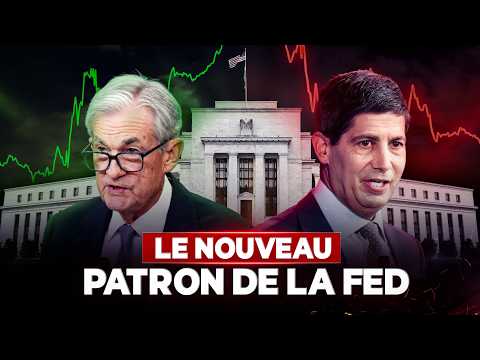
This video highlights a significant leadership change at the United States Federal Reserve, framing it not as a mere administrative update but as a pivotal macroeconomic shift. This transition is expected to redefine global liquidity, interest rate trajectories, and stock market valuations for the next decade. For investors, understanding this change is crucial, whether they are already positioned in the markets or are waiting for a clear direction before committing capital. The core role of the Fed Chair involves adjusting monetary policy through Quantitative Easing (QE) or Quantitative Tightening (QT). The goal is to balance inflation control with economic stimulation. Historically, lowering interest rates tends to boost inflation and growth, while raising them cools inflation but often increases unemployment. According to the transcript, the current economic landscape as of early 2026 features an inflation rate of 2.4%, unemployment at 4.3%, a money supply (M2) of $22.3 trillion, and a federal debt-to-GDP ratio of approximately 125%.
Read AI summary
YouTubeBriefTube monitors your YouTube channels, generates AI-powered audio summaries, and delivers them wherever you listen. Telegram, Discord, Slack, or your podcast app. Fully automated.
Start free trial