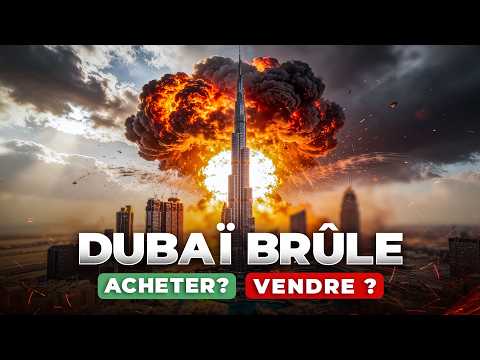
Dubaï brûle… Faut-il vendre ?
AI Summary
This video addresses comments from a previous YouTube video about investments in Dubai, aiming to analyze these comments and provide a realistic perspective with real figures and investment strategies. The speaker emphasizes that the goal is not to prove who is right or wrong, but to learn, share experiences, and ultimately help others make money through investment.
Several comments focused on the perceived instability of the Middle East, with claims like "the Middle East equals instability," "Dubaï remains a risky place for now," and "there's a real risk that desalination plants could be hit or destroyed, with nuclear risks." Some comments even suggested a mass exodus of French expatriates from Dubai, with their assets losing 60% of their value.
The speaker counters these claims by presenting statistics on missile and drone attacks in Dubai, noting that significant events were concentrated within a two-week period, not over decades. He explains that media outlets, especially those associated with political groups or those aiming for buzz on social media platforms like Instagram, often exaggerate information. For example, a minor risk might be amplified to "probable nuclear explosion" and then to "Dubai market dropped -60%."
In reality, the speaker explains that stock markets are much more volatile than real estate. While the shares of Emaar, a major Dubai developer, saw a -30% drop, this would translate to an estimated -10% to -15% in real estate. Despite having significant liquidity ready to invest, the speaker, along with a more powerful real estate investor friend, has been unable to find "deals" on high-quality properties in premium locations with premium developers in Dubai, indicating that the market for desirable assets remains strong.
Another comment questioned Dubai's political system, stating, "knowing that it is forbidden to criticize the Dubai regime, to question security rather the lack of security, it is a dictatorship above all." The speaker acknowledges that the Emirates closely monitor information shared, attributing this to differences in political systems compared to Europe. He argues that current statistics over the past decade in areas like education, health, and security suggest that the UAE's approach is effective. He contrasts this with France, which he describes as "the bad student in the class pointing fingers at the slightest flaw of the top student." He then provides crime statistics for France in 2025, noting 982 crimes (2.7 per day) and over 4500 attempted homicides.
The speaker also addresses a comment about wealthy individuals returning to Europe via private jets at €25,000 per seat. He expresses that if people can afford such measures for their safety and that of their families, it's a positive outcome, highlighting that money provides not just luxury but also security and freedom. He perceives a sense of schadenfreude against expatriates in Dubai, suggesting it stems from resentment towards those who don't pay taxes in France. He clarifies that expatriation isn't always enjoyable, and people would stay in France if it offered better opportunities or treatment. He shares his own experience of being an expatriate in Asia for over 10 years, not out of malice, but because he appreciates the culture and benefits, despite the drawbacks.
Regarding a rumor about Citibank leaving Dubai due to threats, the speaker dismisses it as false, likely originating from Instagram.
A particularly insightful comment noted, "despite the comments, no one is able to say the impact on Dubai real estate. We can at least say that the longer the conflict with Iran lasts, the longer the real estate will take to rebound. Today, foreign investment is frozen. Note that in Dubai, 1200 new homes are arriving while the supply was already abundant."
The speaker refutes the idea of a "frozen" market but acknowledges a "sorting" process. He explains that many developers create properties that don't meet demand, particularly studios or one-bedroom apartments in average locations, which are the ones that suffer most. However, Dubai attracts over 10,000 millionaires annually, who seek high-quality properties from reputable developers in excellent locations. In this specific, high-end segment of the market, demand far outstrips supply.
Finally, the speaker addresses a recurring comment about why someone investing millions would make YouTube videos. He explains that many wealthy individuals, including Logan Paul and other French entrepreneurs, create YouTube content for two main reasons: passion for what they do (he loves investing and sharing his insights) and to generate more opportunities, networks, and clients for his various businesses. He dismisses the notion that wealth precludes YouTube activity, suggesting it's more of a French mindset where discretion about finances, especially cryptocurrencies, is emphasized. He asserts that he has nothing to hide, has been making videos for over 10 years, has never engaged in scams or crypto schemes, and genuinely enjoys sharing his investment passion to help others, as it transformed his own life. He adds that for those who don't understand complex financial concepts like trusts, holdings, or private banking products requiring multi-million euro deposits, proof is often demanded, but he believes he has provided ample proof over the years, even mentioning past restaurant businesses with significant daily client numbers and annual revenues. He concludes by stating his goal is to inspire freedom, not luxury, and encourages viewers to learn from his videos.