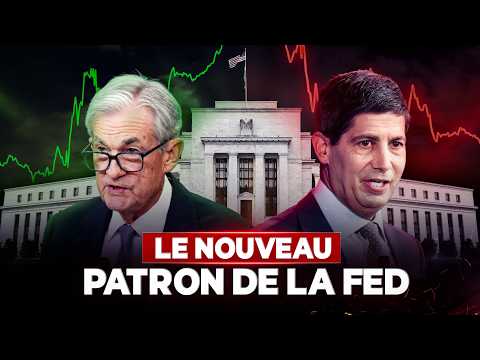
La FED change TOUT et les marchés tremblent..
AI Summary
This video highlights a significant leadership change at the United States Federal Reserve, framing it not as a mere administrative update but as a pivotal macroeconomic shift. This transition is expected to redefine global liquidity, interest rate trajectories, and stock market valuations for the next decade. For investors, understanding this change is crucial, whether they are already positioned in the markets or are waiting for a clear direction before committing capital.
The core role of the Fed Chair involves adjusting monetary policy through Quantitative Easing (QE) or Quantitative Tightening (QT). The goal is to balance inflation control with economic stimulation. Historically, lowering interest rates tends to boost inflation and growth, while raising them cools inflation but often increases unemployment. According to the transcript, the current economic landscape as of early 2026 features an inflation rate of 2.4%, unemployment at 4.3%, a money supply (M2) of $22.3 trillion, and a federal debt-to-GDP ratio of approximately 125%.
The likely candidate to lead this new direction is Kevin Warsh, a former Fed governor who served from 2006 to 2011. Warsh is characterized by a "hawkish" and disciplined philosophy. His past actions suggest a preference for strict interest rate policies that prioritize fighting inflation over stimulating the economy. He advocates for an accelerated reduction of the Fed’s balance sheet and believes the Fed should be independent and predictable, offering less artificial support to financial markets. Crucially, Warsh favors a strong dollar to maintain American purchasing power and is less interventionist during crises; he is known for being willing to accept corporate failures or higher unemployment if it prevents hyperinflation.
The video outlines three potential scenarios under this new leadership. The first scenario involves raising interest rates specifically to protect the dollar. This would likely lead to a "multiple compression" for the S&P 500, where stock prices remain stable or decline even if company earnings grow. A stronger dollar would also encourage American investors to move capital into emerging markets where their currency has more purchasing power. Furthermore, high interest rates would negatively impact Private Equity firms that rely on Leverage Buyouts (LBOs), as the cost of borrowing to acquire companies would become prohibitive.
The second scenario considers a return to rate cuts and Quantitative Easing. While this would trigger an explosion in "risk-on" assets like Bitcoin and technology stocks (Nasdaq), it would weaken the dollar in the long term through currency dilution. While a weak dollar can be beneficial for long-term exports—making American products like iPhones or Coca-Cola cheaper for foreign buyers—it reduces the immediate purchasing power of U.S. citizens.
The third and most probable scenario, according to the speaker, is a period of prolonged high interest rates combined with a return to some form of Quantitative Easing. This would result in heightened market volatility. Since the Fed would no longer act as a "safety net" to rescue markets from every dip, investors should expect deeper and more frequent corrections. This volatility, however, creates strategic entry points. The speaker suggests that traditional Dollar Cost Averaging (DCA) may not be the most effective strategy in 2026; instead, investors should look for specific market lows.
This shift would lead to lower valuations for growth-heavy sectors. Technology, Real Estate Investment Trusts (REITs), and the Healthcare sector—all of which depend on cheap debt for research, development, or property acquisition—would face headwinds. Consequently, the speaker predicts a major sectoral rotation toward "Value" stocks and companies that pay consistent dividends. Additionally, the appeal of gold and other precious metals is expected to diminish. As the dollar strengthens and the Fed becomes more predictable, the perceived risk of currency failure decreases, making the current high prices of gold less attractive from a risk-reward perspective.
In conclusion, the Federal Reserve faces a binary choice: protect the value of the dollar for consumers or protect the broader economy. The speaker notes that moving interest rates rarely benefits both simultaneously. For conscientious investors, the recommended path is diversification away from overvalued growth stocks and toward tangible business value, a strategy the speaker applies in his own investment club by acquiring U.S. companies without the use of risky bank leverage.