AI Audio Summaries
13 videos summarized
1 follower on BriefTube
Last summary: May 17, 2026

Brian Shin and his girlfriend developed a mobile app called Once, a disposable camera app for events, which achieved over $20,000 in monthly revenue within 83 days of its December 2025 launch. Their success stems from a unique validation method called the "commitment metric," ensuring user commitment before writing any code. Once functions as a digital disposable camera for group events like weddings, birthday parties, and corporate gatherings. Its pricing is based on the number of guests, ranging from $2 for 10 people to $50 for 150 guests. The app currently boasts 10,000 to 12,000 weekly active users and has generated approximately $22,000 in revenue this month. Their internal dashboard shows over 300 events scheduled in February and around 700 for March.
Read AI summary
YouTube

Raphael, a 19-year-old entrepreneur, has built over 50 mobile apps, with his latest project, Face Kit, generating over $100,000 in revenue in just two months. His success is attributed to a unique growth strategy: AI-generated influencers. The core growth channel for Face Kit relies entirely on these AI-driven content creators. Face Kit is an app in the "looks maxing" space that uses Apple's TrueDepth camera to create a 3D scan of a user's face. It operates on a subscription model, offering yearly, monthly, or weekly payment options. Since mid-January, the app has achieved over $100,000 in sales, with daily revenue fluctuating between $1,000 and $2,000, occasionally spiking to $6,000.
Read AI summary
YouTube
The speaker, a solo entrepreneur earning $77,000 monthly, attributes his success to a consistent work ethic and a focus on "shipping" new ideas. He has built 35 startups and operates on a principle of constant creation rather than taking days off, even during holidays. He emphasizes that many people have brilliant ideas but fail to execute them, while he has never encountered someone who failed after trying multiple times. His daily routine is highly structured and repetitive, starting every day, 365 days a year, with coffee and breakfast with his wife, followed by a gym session. They currently train for Hy Rocks, incorporating sled pushes, squats, and running. After returning home, he enters "work mode" by staying completely offline for a significant block of 4 to 6 hours. During this "deep work" period, he avoids checking his phone, emails, or social media. He explains that social media, especially with the rapid advancements in AI, can trigger a fear of missing out, leading to wasted time and decreased motivation. His phone remains off, as it's considered the "worst enemy" of deep work.
Read AI summary
YouTube
Jeremy, a successful "solopreneur," built and sold a Software as a Service (SAS) business for millions. His journey began with a direct message, leading to a discussion of his "tentpole strategy," which he claims revolutionized software building. The speaker, Pat Walls, traveled to Los Angeles to meet Jeremy and learn more about this strategy, particularly in light of current discussions about SAS being "dead" due to AI and low-code tools. Jeremy's business, Taskmagic, focused on automating messy browser human behavior, going beyond the limitations of API-based tools like Zapier. As a solo founder, with the help of his CTO, he scaled Taskmagic to over 60,000 users and approximately 8,000 paying customers, sometimes generating over $400,000 per month and reaching about $3 million in annual revenue. This success led to Taskmagic making the Inc. 500 list. Jeremy decided to sell the business before turning 38, securing an offer in the mid-upper seven figures, which he described as life-changing.
Read AI summary
YouTube
Jordan, a solo bootstrap entrepreneur, has built two businesses, each generating over a million in total revenue. While his first venture was in a mainstream field like self-driving cars and drones for famous companies, his second business operates in a niche that 95% of people don't even recognize as an industry. This second product, which has no user interface or mobile app, has generated over $1.5 million from a single app. Jordan's journey into app development began after a corporate job as a researcher at a Fortune 100 company left him feeling bored. He taught himself to code and moved to San Francisco, where he delved into entrepreneurship. By the time he started his current project, he had about a decade of software development experience. He built a prototype for his app in a month to validate the idea, and then another month to build the payment system. Within the second month, the app became profitable, acquiring its first 200 users.
Read AI summary
YouTube
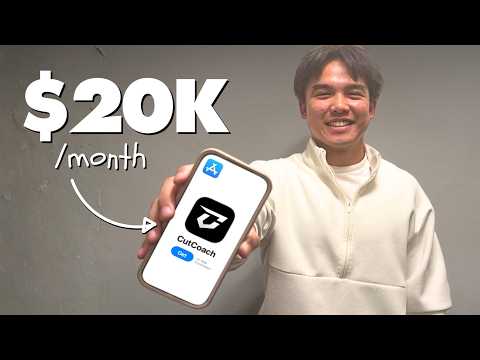
Ethan, a 19-year-old college dropout, developed a mobile app called Cut Coach that generates $20,000 per month. This app, launched in September, has garnered over $60,000 in total revenue and approximately 38,000 downloads in six months. Cut Coach helps combat sport athletes, particularly wrestlers, cut weight for competitions by providing a science-based protocol. The app's success is attributed to solving a very specific pain point for a niche community that no other app addressed, leading to high conversion rates despite not going viral. Ethan's journey into app development began in the summer of 2024, before he started university to study computer engineering. His first app, which took six months to build, automated parts of his mother's workflow. He then built another app using only AI tools, which made him realize the rapid changes AI was bringing to software development. This led him to leave university to learn development independently. In early 2025, he built several apps but made the mistake of not marketing any of them. Discovering Cursor, a tool that significantly sped up app building, allowed him to shift his focus from development to learning sales and marketing.
Read AI summary
YouTube
Flo, a solo developer from Germany, built an expense tracking app called Monai. After a year and a half of working on it by himself, the app was only generating $300 in monthly recurring revenue (MRR). However, after partnering with a content creator, the app's MRR skyrocketed to over $35,000 in just over a year, representing a 10,000% growth. Monai is a minimalistic money tracking app that uses AI for frictionless expense entry, allowing users to input expenses via voice or automations. The app is subscription-based and offers a 7-day free trial, a model they found to be more effective than a freemium approach after A/B testing.
Read AI summary
YouTube
Evan scaled his app, Locked, to $14,000 per month in just a few months without a large audience or paid ads, relying on a single, effective strategy from day one. His approach, focused on influencer partnerships, offers a playbook for anyone looking to launch a new app successfully. Evan's journey into entrepreneurship began at age nine, developing Roblox games. He later experimented with various business models like dropshipping and reselling, all of which failed until his brother suggested the app space. His first app, Problem Pal, reached $2,000 per month before being sold. A subsequent app, Clear AI, didn't gain traction. The idea for Locked emerged when a friend expressed difficulty staying motivated, leading Evan to create a gamified health and fitness app to make staying on task more engaging than traditional habit trackers.
Read AI summary
YouTube
Ombberto, founder of Floa, a mobile app for yoga teachers and practitioners, successfully pre-launched his app using a Lifetime Deal (LTD) strategy, generating over $120,000 in just 24 hours. This approach, which involved selling lifetime access to the app rather than starting with a free trial, is presented as a rapid way to validate an idea and secure early funding. Ombberto's journey to building Floa was non-linear. With a background in economics, a failed startup, and experience as a fashion photographer, he later became an advertiser and growth strategist, learning how to launch and position products. In 2020, he co-founded PlayosB, a brand focused on physical yoga decks of cards, which raised over $200,000 on Kickstarter. This experience with physical product launches, particularly crowdfunding, provided valuable insights into generating upfront capital and building community. He then envisioned transforming this physical business into a technology-driven app, sketching the concept and finding a developer to build Floa.
Read AI summary
YouTube
This summary explores the journey of Ivan, a builder from Macedonia, who transformed a tedious manual process into a thriving software-as-a-service (SaaS) business called Lancer. By leveraging the power of AI agents and a unique "connector" distribution strategy, Ivan managed to scale Lancer from zero to $10,000 in monthly recurring revenue (MRR) within just four months of its launch. Remarkably, he achieved this growth without spending a single dollar on paid advertising or relying on a pre-existing social media audience. **The Genesis of Lancer: Solving a Personal Pain Point**
Read AI summary
YouTube
In this episode of Starter Story, Pat Walls interviews Mickey, an entrepreneur from Spain who has achieved remarkable success with his app, Late. In just seven months, Mickey took his business from zero to over $40,000 in monthly recurring revenue (MRR). The most striking aspect of Mickey’s journey is his hyper-focused distribution strategy. While many indie hackers attempt to juggle multiple social media platforms, viral trends, and complex personal branding, Mickey built a profitable business using a single, traditional channel: Google. By combining organic search engine optimization (SEO) with strategic paid search ads, he created a predictable growth engine that allowed him to scale rapidly without relying on luck or viral algorithms. Mickey’s product, Late, is a social media API designed specifically for developers. He identified a significant gap in the market while experimenting with startups over the last five years. Most existing social media automation tools were either too expensive, overly complicated, or lacked the high-quality documentation that developers require. Late solves this by wrapping around official APIs like Facebook, Instagram, Twitter, and LinkedIn. It handles all platform permissions and pays for the highest-tier plans, providing users with a single, streamlined API that offers access to all features without the usual limits. The business model is based on connected accounts, offering three plans: Build, Accelerate, and Unlimited. Today, Late has over 50,000 signups, 700 paying users, and a churn rate of less than 10%.
Read AI summary
YouTube
Maddox Schmidtoffer’s journey from a college dorm room to a six-figure business exit provides a blueprint for modern entrepreneurial success. While still a student, Maddox built an unblocked games website called duckmath.org, which eventually scaled to 150,000 daily active users and generated $15,000 in monthly revenue. His story highlights a shift in the digital landscape where marketing volume and AI-assisted development can turn a simple idea into a highly profitable asset in a matter of months. The business began almost by accident. Inspired by a TikTok video of a younger creator building a similar site, Maddox decided he could do the same. He built the initial version in about a week using Google Sites, a simple drag-and-drop tool. For the first two years, the site sat largely ignored, earning a small amount of passive income. The turning point came when Maddox noticed the site randomly made $240 in a single day without any active effort. This "luck" served as a proof of concept; he realized that if the site could perform that well passively, it had massive potential if he actually focused on growth.
Read AI summary
YouTube
Pat Walls introduces Jonathan Fishner, the co-founder of ChartDB, a tool proving you don't need a massive, complex idea to build a profitable business. ChartDB is an open-source database visualization tool specifically designed for developers. Despite its niche focus, the project generates approximately $9,000 in monthly recurring revenue. The core of the product is a self-hosted, open-source tool that developers can install locally to visualize their databases. This free version serves as the primary acquisition funnel, leading users toward a paid cloud version that offers a hosted experience and more streamlined workflows. To date, the project has amassed over 21,000 stars on GitHub and has been used by roughly 250,000 developers. Jonathan emphasizes that the success of Chart
Read AI summary
YouTubeBriefTube monitors your YouTube channels, generates AI-powered audio summaries, and delivers them wherever you listen. Telegram, Discord, Slack, or your podcast app. Fully automated.
Start free trial