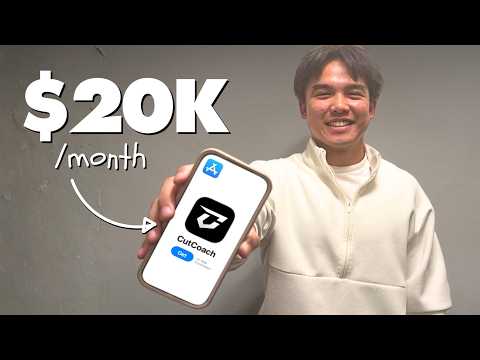
I Left College to Build This Niche App (Now I Make $20K/Month)
AI Summary
Ethan, a 19-year-old college dropout, developed a mobile app called Cut Coach that generates $20,000 per month. This app, launched in September, has garnered over $60,000 in total revenue and approximately 38,000 downloads in six months. Cut Coach helps combat sport athletes, particularly wrestlers, cut weight for competitions by providing a science-based protocol. The app's success is attributed to solving a very specific pain point for a niche community that no other app addressed, leading to high conversion rates despite not going viral.
Ethan's journey into app development began in the summer of 2024, before he started university to study computer engineering. His first app, which took six months to build, automated parts of his mother's workflow. He then built another app using only AI tools, which made him realize the rapid changes AI was bringing to software development. This led him to leave university to learn development independently. In early 2025, he built several apps but made the mistake of not marketing any of them. Discovering Cursor, a tool that significantly sped up app building, allowed him to shift his focus from development to learning sales and marketing.
The idea for Cut Coach stemmed from Ethan's personal experience as a high-level combat sports athlete, having been a provincial judo champion and national wrestling champion. He frequently had to cut significant weight in short periods and struggled to do so properly until a coach provided a plan. Two years after his brief time in college, he connected his passion for wrestling with his hobby of app creation, leading to Cut Coach. Unlike his previous apps, he prioritized marketing for Cut Coach, learning it immediately after finishing the app and shipping it quickly to iterate based on user feedback.
Ethan built the Cut Coach MVP in June of the previous year using Cursor and ChatGPT, taking about a month. The initial version was designed for coaches to provide weight-cut plans to athletes. However, beta testing with his wrestling club revealed friction, as the coaches didn't use it. In July and August, he revamped the app's concept, making it so the app itself would generate the weight-cut plans for athletes. He personally tested the weight cuts and redesigned the app, releasing the final version in September.
Ethan's story highlights that one doesn't need years of coding experience to build a successful app, especially with tools like Cursor. His process for building a niche app starts with solving a problem within one's hobby, leveraging existing understanding and enjoyment of the activity. He uses ChatGPT for brainstorming app ideas within a chosen niche. Once an idea is formed, he designs the app in Figma, often referencing popular apps in similar niches for layout and elements, adapting them rather than reinventing the wheel.
For development, Ethan codes the app using Cursor and ChatGPT, focusing on the front end first to match the Figma design, then building the back end. He integrates Superbase for the database, Vercel for hosting the landing page and JavaScript files, and OpenAI API for AI functionality. For monetization and analytics, he uses RevenueCat, Mixpanel, and Superwall for paywalls. Cron job is used for scheduled automations if needed.
Regarding marketing, Ethan began with organic social media posts, drawing inspiration from pages within the same niche. An example was a video showing a UFC fighter's appearance before and after a weight cut, with a call to action to download the app. Although these videos didn't gain many views (200-500 views), they resulted in 10-15 downloads per day, indicating high-intent viewers. This high conversion rate (5-10%) demonstrated the potential of niche apps, where millions of views aren't necessary for success.
After establishing effective organic posts, Ethan moved to influencer marketing. Given the app's niche, he partnered with small creators (1,000-10,000 views per video) found by direct messaging on TikTok and Instagram. Most creators agreed to partnerships. This strategy proved effective due to the highly engaged audience and the app's unique offering. Later, these influencer videos were converted into paid ads, significantly boosting revenue and scaling efforts.
The Cut Coach app itself displays daily nutrition values that users must adhere to. Users log their meals, and the app extracts nutritional values, integrating them into their daily goals. The objective is to stay within these limits to cut weight. Users can also track their daily weight progress. The app provides recommended meals to help users stay within their limits, ensuring they make weight for competition.
Ethan's advice for aspiring niche mobile app developers is to follow one's own intuition. He learned to adapt advice from others to his life rather than letting it control him, leading to greater fulfillment and purpose. The success of Cut Coach underscores the opportunity in high school and college sports, where small, passionate communities face painful problems that they are willing to pay to solve, such as making weight for a competition. The takeaway is that no niche is too small if it addresses a genuine pain point for a dedicated community.