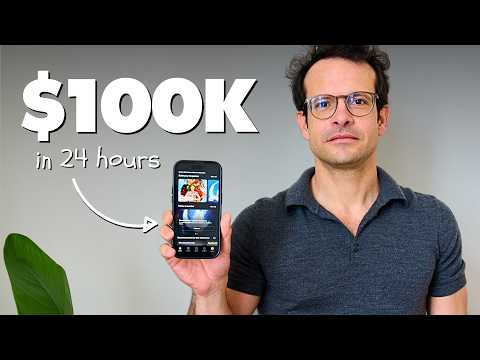
My App Made $120K in 24 Hours
AI Summary
Ombberto, founder of Floa, a mobile app for yoga teachers and practitioners, successfully pre-launched his app using a Lifetime Deal (LTD) strategy, generating over $120,000 in just 24 hours. This approach, which involved selling lifetime access to the app rather than starting with a free trial, is presented as a rapid way to validate an idea and secure early funding.
Ombberto's journey to building Floa was non-linear. With a background in economics, a failed startup, and experience as a fashion photographer, he later became an advertiser and growth strategist, learning how to launch and position products. In 2020, he co-founded PlayosB, a brand focused on physical yoga decks of cards, which raised over $200,000 on Kickstarter. This experience with physical product launches, particularly crowdfunding, provided valuable insights into generating upfront capital and building community. He then envisioned transforming this physical business into a technology-driven app, sketching the concept and finding a developer to build Floa.
Floa is designed to help yoga teachers and practitioners build and practice sequences. The app features a "sequence builder" where users can select yoga styles, poses, filter by categories, chakras, or benefits, and receive intelligent pose suggestions. Each pose includes detailed videos and information. Users can personalize their practice by adjusting pose order, time, and side, and then be guided through their custom sequence. Currently, Floa has approximately 4,000 active users (both paid and free) and generates between $9,000 and $10,000 per month in recurring revenue through monthly, quarterly, and yearly subscription tiers. The app was developed using Flutter, Firebase, RevenueCat for subscriptions, Vimeo for video hosting, and OneSignal for push notifications.
The core of Ombberto's successful launch was his LTD playbook. He decided to monetize as early as possible, simultaneously building the product and a revenue engine. The strategy involved identifying the minimum set of features necessary to convince users to purchase a lifetime deal. He meticulously planned the entire launch sequence, including emails, landing pages, videos, and ad creatives, while also generating new leads to expand his audience.
The pre-launch phase lasted about a month and a week, building curiosity through a series of emails. The initial emails used storytelling to create interest without revealing the product. Subsequent emails progressively unveiled more details, creating anticipation, and eventually introduced the app with a video demonstration. A crucial element was the "no-refund" policy for the LTD, emphasizing that those wanting to try the app first should wait for the upcoming subscription plans. The LTD itself was offered for a limited time (5-7 days maximum) and with a limited number of spots, a tactic designed to reduce procrastination and encourage immediate decision-making. Ombberto stressed the importance of never revealing the price before the actual launch day, allowing potential customers to evaluate the product based solely on its features and long-term vision.
His pricing strategy for the LTD involved three tiers:
1. **Tier 1:** Around $109 for lifetime access to a limited set of features.
2. **Tier 2:** Around $199 for more features.
3. **Tier 3:** Around $349 for the full vision and all planned features.
This tiered approach leveraged psychological pricing, where the lower tiers served as a reference point, making the highest tier more appealing, and also captured skeptical users.
Ombberto shared a comprehensive playbook for anyone looking to achieve a great launch:
1. **Validate before you build:** Talk to 5-10 people in your target market about their problems without revealing your solution, seeking unbiased feedback. He recommended reading "The Mom Test."
2. **Define your Minimum Launchable Product (MLP):** Determine the minimum development required for the product to convey enough value for early adopters to pay. Plan everything around this timeline.
3. **Build your content machine before promoting:** Prepare a buffer of content—emails, graphics, videos, landing pages—and ensure explanations are simple and clear for the end-user, building trust and educating the audience.
4. **Structure your pricing:** Avoid underpricing out of fear. Implement tiered pricing to offer options and create reference points.
5. **Be transparent in launch mechanics:** Clearly show how the app works, its current limitations, and future plans. Set a clear "no refunds" policy for the LTD to maintain its value, directing hesitant users to wait for the subscription model. Limit the deal's time and spots to drive urgency.
Addressing criticisms that LTDs forgo future revenue and diminish business valuation, Ombberto strongly defended the strategy. He argued that in early stages, when LTV and churn are unknown, an LTD converts assumptions into real capital without giving away equity or control. He highlighted the difference in incentives: monthly subscribers have optionality and might cancel easily, whereas lifetime buyers are committed and become invaluable sources of detailed feedback and support, actively helping to improve the product (e.g., through a Telegram group for early adopters). Furthermore, he noted a segment of users who dislike subscriptions and are willing to pay 3-5 times more for a lifetime plan. For an early-stage, bootstrapped business, an LTD is presented as the smartest move, effectively raising capital from customers while gaining crucial feedback and motivation.
Ombberto's ultimate advice to his younger self and aspiring entrepreneurs is to "stop waiting for perfect." He believes perfection is fear disguised as preparation, and that true breakthroughs occur when an unfinished product is presented to real people, leading to invaluable feedback. His mantra is to "move sooner, ship earlier, and trust the process," emphasizing that learning happens faster in public than in private.