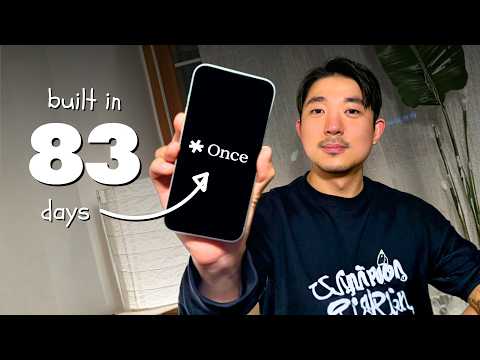
I Built a $20K/Month App in 83 Days
AI Summary
Brian Shin and his girlfriend developed a mobile app called Once, a disposable camera app for events, which achieved over $20,000 in monthly revenue within 83 days of its December 2025 launch. Their success stems from a unique validation method called the "commitment metric," ensuring user commitment before writing any code.
Once functions as a digital disposable camera for group events like weddings, birthday parties, and corporate gatherings. Its pricing is based on the number of guests, ranging from $2 for 10 people to $50 for 150 guests. The app currently boasts 10,000 to 12,000 weekly active users and has generated approximately $22,000 in revenue this month. Their internal dashboard shows over 300 events scheduled in February and around 700 for March.
Brian's background includes co-founding a venture-backed B2B startup, which provided experience in building a fast-growth company. However, he was drawn to the bootstrap scene, appreciating the safer, smaller bets indie hackers make. This led him and his girlfriend to pursue a fully bootstrapped venture with Once, seeking full control over their product.
The idea for Once originated from their personal travel experiences. They noticed the magical quality of traditional disposable cameras, with their limitations (no instant viewing, limited shots) creating a more authentic experience. They aimed to replicate this digital experience with Once.
The initial version of Once was a web app built in one to two weeks, focusing on core features. They tested it at a friend's Halloween party, printing invitation codes for guests to join and take photos. Despite breaking multiple times, the test validated the core idea: people enjoyed capturing candid moments into a shared album, mimicking the disposable camera experience.
While Brian utilizes AI for development and finance, he emphasizes that design for consumer apps requires taste and opinionated choices, which AI currently lacks. He credits this belief to his decision to build the app's design without AI. The tech stack includes Figma for design, Cloud Code for development (with Conductor for running multiple instances), and Superbase for the database and backend. The web app aspects still run on Vercel.
Brian’s validation process involved two key steps. First, he leveraged his personal network. He opened his X, LinkedIn, and Instagram/Facebook profiles, going through his friends list to identify anyone with an upcoming event. Four friends agreed to try the product for a Halloween party, a birthday party, a wedding, and a networking event.
Second, he expanded beyond his inner circle by searching Instagram for relevant hashtags like #wedding and #birthdayparty. He compiled a list of 250-300 potential users and sent a concise, two-to-three-sentence cold message pitching the idea. This outreach resulted in 15 responses and 12 confirmed events for the month, signaling market potential and prompting them to commit to building the full product.
Brian's playbook for starting from scratch involves five steps:
1. **Define your commitment metric:** Set a specific date and a target number of customers or clients. For Once, it was event hosts using the product, signifying genuine usage.
2. **Exhaust your personal network:** Reach out to relevant contacts across social media platforms. Crucially, apply the "mom test" to ensure honest validation rather than seeking encouragement.
3. **Build a quick mockup:** Create a simple product in two to three days using tools like Figma or AI, focusing on presenting the core idea to users, no matter how scrappy.
4. **Go where your users are:** Identify platforms where target users are active (Reddit, TikTok, YouTube) and engage through cold messaging. Brian advises pushing boundaries, even to the point of being temporarily banned, to maximize outreach.
5. **Set a confidence-boosting number:** Establish a specific goal that signals the product's potential. For Once, it was securing 10 events with actual dates and commitments to use the product. This commitment, involving friends and family, was considered a strong proxy for payment.
The app's demo showcases its simplicity: users create a "film," name it, set an end date, choose photo reveal settings (like a disposable camera), apply filters, design invitation cards, and specify participant numbers and shots per person. Photos are saved and revealed according to settings, all gathered in a shared album.
Brian's advice to aspiring founders is to "stop overthinking and just launch." He emphasizes that initial assumptions often prove wrong once users interact with the product. The focus should be on talking to users and building a minimal viable product within a week or two, as quickly getting user feedback is paramount.
The validation strategy, particularly the commitment metric, is highlighted as a crucial differentiator in an era where AI tools make building easy. This approach forces founders to engage with potential users, saving time and preventing the creation of unvalidated products.