
a16z crypto
AI Audio Summaries
14 videos summarized
1 follower on BriefTube
Last summary: Oct 16, 2026
AI Audio Summaries
14 videos summarized
1 follower on BriefTube
Last summary: Oct 16, 2026
Read AI summary
YouTube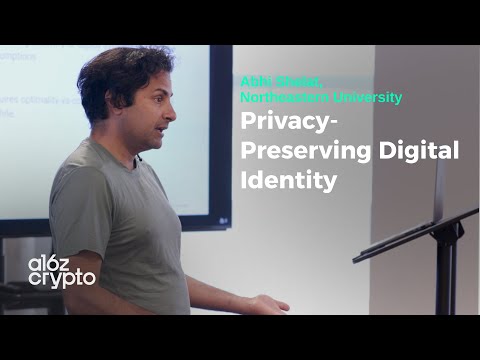
Abby Shalad introduced a recent work on zero-knowledge credentials from ECDSA, aiming to address the challenges of digitizing identity and improving existing digital credential protocols. The context involves Erica, who is tired of carrying a physical government-issued ID card and concerned about the privacy implications of uploading photos of her ID online for KYC or age verification. The goal is to digitize this identity into a "digital credential" stored on a user's device, signed by the issuing government, with data private to the user and issuer. This type of digital credential is a real-world protocol already deployed in many US states and countries like Australia, Japan, South Korea, and India, with the EU also adopting a similar mechanism through its EUD wallet project. These systems aim to solve the problem of carrying physical cards and enable selective disclosure of attributes (e.g., proving age over 18 without revealing birthdate or address).
Read AI summary
YouTube
This seminar introduces Twist and Shout, cryptographic protocols designed to accelerate Snark provers, which are currently a limiting factor in Snark applicability. A Snark (Succinct Non-interactive ARgument of Knowledge) allows an untrusted prover to demonstrate knowledge of a witness satisfying a property without revealing the witness itself. Snarks are typically used in a two-step process: converting a high-level computer program into a circuit (front-end) and then applying a proof system to the circuit (back-end). While Snark verifiers are generally efficient, provers often perform a million times more work than native execution, although this overhead is highly parallelizable. The goal of Twist and Shout is to significantly reduce this prover overhead, aiming for a 10,000 to 100,000-fold overhead rather than a million-fold. Snark back-ends are designed in three stages: a polynomial IOP (Interactive Oracle Proof), a polynomial commitment scheme, and finally, applying the Fiat-Shamir transformation to make the interactive argument non-interactive. A polynomial IOP involves the prover sending a large polynomial encoding the witness, which the verifier can only query at specific points. There are two classes of polynomial IOPs: univariate, which are good for verifier costs, and multivariate (multilinear), which are better for prover costs. This talk focuses on multivariate polynomials due to the emphasis on prover speed. While multivariate polynomials have higher verifier costs than univariate ones, they are still relatively low (handful to dozens of kilobytes), making them suitable for many applications, especially those not requiring sub-kilobyte proofs or a trusted setup.
Read AI summary
YouTube
The presentation by Itai Abraham discusses mental models for Trusted Execution Environments (TEEs), focusing on the intersection of distributed computing, cryptography, and game theory. Abraham begins by exploring the fundamental trade-off between security and friction in system design. He notes that most traditional systems prioritize low friction, often at the expense of high security, which can create an illusion of safety. Bitcoin is presented as an extreme example of high security with relatively high friction. The broader blockchain movement aims for high security with lower friction, striving to create a "global computer." Abraham predicts that AI will significantly reduce friction, enabling new points in this trade-off, making previously infeasible or inefficient security measures more viable. A core question posed is whether secure hardware is necessary when cryptography is robust. Abraham argues that without some form of physical security, cryptography alone is insufficient. In a world with "no physical security," where an adversary can access any secret, most cryptographic applications like public key cryptography, secret keeping, and signing become impossible. This leads to the conclusion that all cryptographic systems implicitly rely on some root of physical trust. Therefore, if hardware must be trusted, the discussion shifts to which hardware to trust and whether this minimal trust can be extended to build more capable, trusted hardware that does more than just keep secrets. The ultimate question is what constitutes the minimal trusted hardware and how its trustworthiness can be guaranteed, especially against backdoors in devices like secure wallets.
Read AI summary
YouTube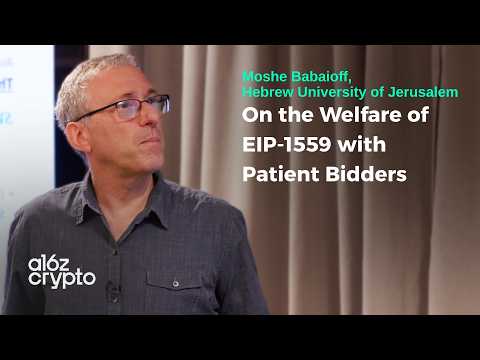
This seminar focuses on the welfare properties of EIP-1559, the transaction fee mechanism used in Ethereum, particularly when dealing with "patient bidders." The research aims to provide a formal proof of its performance, specifically regarding welfare, without considering strategic behavior. Ethereum, as the second-largest blockchain, processes a significant volume of transactions, each with associated fees. EIP-1559 was adopted without a formal proof of its strategic or welfare performance. While prior work has explored its strategic properties, this research delves into its algorithmic welfare properties.
Read AI summary
YouTube
The A16Z Crypto team announces Crypto Fund 5, highlighting a significant shift in the crypto landscape. They see a move away from ideological, revolutionary fervor towards pragmatism, product focus, and integration with existing systems. This evolution is driven by increased regulatory clarity, particularly with the passage of the Genius Act for stablecoins, and growing interest from traditional financial institutions. Chris Dixon emphasizes that the most successful founders will be product- and go-to-market focused, and pragmatic rather than ideological. He believes crypto needs to work *with* the system, not overthrow it. Finance is seen as a low-hanging fruit for onboarding a billion users onto blockchains through stablecoins, stocks, bonds, payments, and remittances. Once users are onboarded and familiar with the infrastructure, adjacent services can be offered. Regulation, like the Genius Act, provides a clear path for builders and consumer protections, preventing scandals like Terra Luna. Stablecoins, now a regulated term, are enabling new use cases, with companies like Stripe leveraging them to expand global coverage due to lower fees and faster transactions compared to traditional payment networks. This creates a global financial network analogous to how services like WhatsApp built upon SMS. Lending markets are a natural next step on top of stablecoins.
Read AI summary
YouTube
The increasing capabilities of AI models, now often referred to as agents, are rapidly transforming how humans interact with computers, particularly in the realm of commerce. These agents, having advanced significantly in the last five months, are capable of understanding complex tasks over long time horizons and utilizing various tools to complete them. The key difference between a traditional Large Language Model (LLM) and an agent is that an agent is essentially a chatbot that can use a computer on your behalf, achieving parity with average human computer usage but at a significantly lower cost. This means anything a human can do with a computer, an agent can also do. This shift presents two main categories of agentic commerce. The first is "conversational commerce," where LLMs like ChatGPT facilitate checkout processes, offering empathetic recommendations and streamlining purchases. This is expected to be beneficial for consumers, merchants, and platforms alike, leading to better product discovery, increased conversion rates, and new revenue streams. The second category involves agents with more autonomy, capable of delegating money and paying for services to enhance their productivity for their human users. This is a "less skeuomorphic" version, suggesting a fundamental change in the internet's structure, moving towards an "agent-native internet" where agents directly pay for necessary resources.
Read AI summary
YouTube
The discussion begins by highlighting a significant shift towards autonomous machines with on-chain identities, capable of making their own decisions and updating their objective and reward functions. This, combined with crypto-economic property rights, is expected to transform them into sovereign economic actors within the next 12 months, leading to a "Darwinian market for intelligence" with unpredictable outcomes. A core misunderstanding people have about the problem being solved is its depth. Many perceive AI at a product level, interacting with systems like ChatGPT, without realizing the extensive, centralized infrastructure behind them. A small number of companies control these systems, processing vast amounts of user data through their servers. This centralization is problematic for several reasons. Technologically, it’s inefficient; decentralized systems could leverage the powerful devices individuals already own, leading to greater efficiency in resource utilization compared to centralized, company-owned infrastructure.
Read AI summary
YouTube
The core problem discussed is "Proof of Human," which addresses the increasing difficulty of distinguishing humans from AI agents online. This challenge is amplified by the rapid advancement of AI, particularly with the advent of models like ChatGPT and the rise of sophisticated bots used for psyops and propaganda. The speaker, Alex, from Proof of Human, explains that the current situation is just a glimpse of what's to come, with AI capabilities expected to become superhuman and understanding humans far better than humans understand AI. The concept of "Proof of Human" aims to verify that an individual interacting online is indeed a unique human, ideally with a single, controlled account. This contrasts with the current state where platforms like X (formerly Twitter) struggle to combat millions of bots daily, often operated by a single human. A new distinction is introduced: "agent on behalf of a human," where an AI acts with explicit permission and rights granted by a unique human owner of an account. This means the platform still belongs to a verified human, even if an AI performs actions on their behalf.
Read AI summary
YouTube
The speaker, Paul, discusses the future of finance and the role of DeFi, particularly through his work with Morpho, a non-chain lending and borrowing infrastructure. He addresses common misconceptions about DeFi, such as the idea that it should be risk-free, and explains how Morpho aims to disintermediate traditional banking by enabling open access to capital. A significant misconception in DeFi lending, according to Paul, is the belief that lending protocols are responsible for issuing loans and that these opportunities should be risk-free. He clarifies that while the *execution* of loans should be trustless, the loans themselves inherently carry risk. The industry has struggled with under-collateralized loans due to the lack of legal recourse in the blockchain space. Morpho's approach is to have trustless execution of loan logic but to let the market price the risk, rather than the protocol issuing the loan.
Read AI summary
YouTube
Jetto is described as the largest liquid staking protocol on Solana, viewing itself as the economic growth engine for the Solana network. The long-term vision for Solana is a future where all finance happens on-chain, on a single state machine, at high speed. This vision contrasts with traditional financial systems, highlighting the ease of access on Solana where users can download a wallet, press a few buttons, and access a full financial system, unlike the multi-step KYC processes and limitations of platforms like Robinhood. Jetto's work involves a liquid staking protocol and building a validator client designed to optimize transaction ordering on the network. The company's origins in 2021 were based on the thesis that Solana would experience significant transaction spam due to its low transaction costs, which are less than a hundredth of a penny. The technology has improved, but earlier on, Solana experienced some outages. The speaker's background includes working on MEV (Maximal Extractable Value) on Ethereum before discovering Solana in early 2021 and being drawn to its low-level technical approach. While others focused on L2s for scaling, Solana aimed to synchronize an entire state machine on one network. Jetto's validator client and system help filter spam on Solana, similar to how Cloudflare acts as an intermediary and DDoS shield for websites, now transitioning to filtering AI bots. Jetto measures its success not just by its own metrics, but by its deep integration with the Solana network, with 80-90% of the network running its validator client, and by the overall growth in Solana usage and trading volume. Solana is noted for having the most DEX volume and being the cheapest place to buy Solana itself, a contrast to Ethereum where it's often cheaper to buy ETH on centralized exchanges.
Read AI summary
YouTube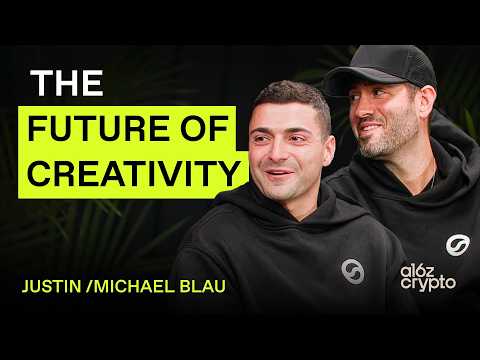
In this conversation, Justin and Michael discuss the launch of **Bond**, a protocol designed to solve the fundamental data and monetization problems facing modern creators. By leveraging blockchain technology and decentralized finance (DeFi), Bond introduces a new economic model for the relationship between artists and their fans. ### The Fundamental Problem: The Missing Creator CRM
Read AI summary
YouTube
This conversation features Emily, the creator behind Shabuya and the project "White Rabbit," discussing the intersection of blockchain technology and creative storytelling. The central highlight of the discussion is the success of "White Rabbit," which made history as the first crypto-based project to win an Emmy Award. Emily views this achievement as a "beacon of hope" for independent creators, proving that projects born in the niche crypto space can achieve mainstream recognition and disrupt traditional media models. **The Vision of Shabuya and Permissionless Creativity**
Read AI summary
YouTube
In this discussion, Cynthia, the head of digital asset management at Fidelity, outlines the firm's strategic approach to the evolving landscape of digital markets and the tokenization of traditional assets. Her division, which sits within Fidelity’s broader asset management business, was established several years ago with a dual purpose: to understand crypto-assets as a new investable class and to explore how blockchain technology might transform capital markets. The team focuses on building new applications, allocating capital on-chain, and facilitating the flow of capital between traditional and digital environments. Fidelity views the adoption of digital markets through a specific three-phase roadmap. The first phase is the "Hold" phase. This is characterized by providing investors with exposure to on-chain assets through traditional vehicles, such as the Bitcoin Exchange-Traded Products (ETPs) that Fidelity recently launched. These products allow traditional investors to trade and hold digital assets within their existing brokerage portfolios using familiar infrastructure.
Read AI summary
YouTubeBriefTube monitors your YouTube channels, generates AI-powered audio summaries, and delivers them wherever you listen. Telegram, Discord, Slack, or your podcast app. Fully automated.
Start free trial