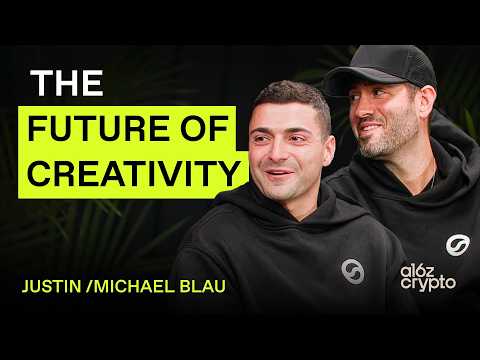
AI Is Changing the Internet. What Does It Mean for Creators? (with Justin and Michael Blau)
AI Summary
In this conversation, Justin and Michael discuss the launch of **Bond**, a protocol designed to solve the fundamental data and monetization problems facing modern creators. By leveraging blockchain technology and decentralized finance (DeFi), Bond introduces a new economic model for the relationship between artists and their fans.
### The Fundamental Problem: The Missing Creator CRM
The core issue in the current "Web2" landscape is that creators do not own their audience data. Platforms like Spotify, YouTube, and TikTok act as intermediaries that withhold critical information; an artist does not know who their top 1% of listeners are and cannot communicate with them directly. If a platform’s algorithm changes or the company goes down, the creator’s social graph vanishes.
Furthermore, traditional creator monetization is often flawed. Current crypto-native solutions rely on speculative trading volume, which rewards creators based on market volatility rather than audience growth. In the traditional world, creators often lose over 40% of their income to managers, agents, and lawyers, while dealing with antiquated royalty accounting and fraud.
### The Bond Protocol: A New Economic Model
Bond proposes a "middle ground" between a social media "follow" (which is low-value) and a "subscription" (which is high-friction).
**The Mechanism:**
* **One-Time Staking:** Instead of paying a monthly fee (like Patreon or Substack), a fan "bonds" a specific amount—for example, $5—one time.
* **Interest as Revenue:** While that money is bonded, it stays in a vault where it earns interest. The creator receives this interest as their income.
* **Full Refundability:** The fan can withdraw their $5 at any moment. This creates a "cost-free" support system where the fan retains their principal while providing the artist with a continuous stream of yield.
* **New Social Metrics:** This shifts the metric of success from "follower count" to "total value bonded." It allows creators to identify high-value fans—those who might bond $5,000 instead of $5—and prioritize them in a "Creator CRM."
### Why Onchain?
The speakers argue that this model is only possible through blockchain. Building this on traditional financial rails would require thousands of lines of code and numerous intermediaries to handle the micro-transactions and interest splits. Onchain, the protocol is only 500 lines of code.
However, they emphasize that for mainstream adoption, the "crypto" part must become invisible. They utilize Layer 2 solutions with sub-penny fees and smart contract wallets that allow users to sign up via email without ever knowing they are interacting with a blockchain. The biggest remaining hurdle is the "on-ramp"—making it as easy to convert credit card or Apple Pay funds into stablecoins as it is to buy a t-shirt online.
### The AI Revolution and the Death of IP
Justin offers a controversial take on the future of creativity in the age of AI. He argues that as AI makes the friction of content creation drop to zero, traditional Intellectual Property (IP) and copyright laws will become unenforceable and antiquated.
**Key Insights on AI:**
* **Curation Over Creation:** When anyone can generate a song or image with a prompt, the human value shifts from the *act* of creation to the *art* of curation.
* **The Human Relationship:** In a world of infinite AI content, the only thing that cannot be replicated is the human connection between the artist and the fan.
* **The End of Copyright:** Justin suggests that the next generation of creators will move away from relying on IP rights and toward a value system based on reputation and "provenance"—the transparent history of who originated an idea.
### Lessons from Magic and Music
Michael, a professional magician, notes that the magic industry has never had copyright protection for performances. This lack of defensibility forces magicians to differentiate through personality and unique execution. If two magicians perform the same trick, the "better" one is the one with the superior human connection and presentation. This, the speakers argue, is the future of all art: when the "trick" (the content) is easily copied, the "performer" (the artist’s brand and relationship) is the only thing that matters.
### The Future of Crypto Products
The founders advocate for a shift in how builders approach the space. They believe the industry is moving past the phase where every product needs its own token or a complex decentralized protocol. Instead, they view crypto as a superior "backend" tool to build better financial products and consumer experiences. Like stablecoins eventually just being viewed as "digital dollars," they believe blockchain will eventually be an invisible layer of the internet stack.
### Lightning Round and Conclusions
* **Advice for Founders:** Avoid hiring "smart people" who aren't passionate about the specific culture of crypto. Without a "cultural perspective" and a habit of using the products, engineers struggle to build effective blockchain solutions.
* **Productivity Hacks:** Both founders rely heavily on AI-driven tools. Justin uses voice-to-AI summaries to capture thoughts, while Michael uses "Speechify" to listen to emails and "Obsidian" to organize concepts.
* **Recommended Reading:**
* *The Machiavellians* (Politics)
* *Broken Money* by Lyn Alden (Economics)
* *The Courage to Be Disliked* (Personal Philosophy)
* **The Persistence of NFTs:** Despite market volatility, they maintain that NFTs (specifically ERC-721 and 1155 standards) are the most significant technological innovation for digital ownership and provenance.
Ultimately, Bond aims to be the "Salesforce for artists," providing a transparent, permissionless ledger of fan loyalty that allows creators to maintain independence and capture the full value of their social graph.