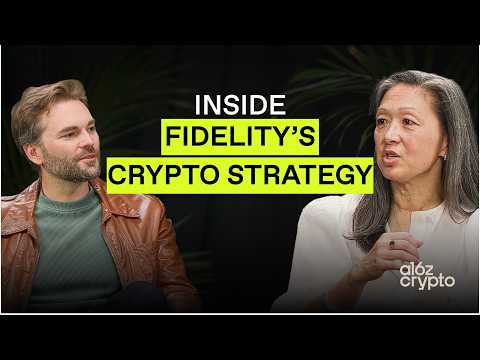
Why Tokenize? Fidelity on On-Chain Assets, Yield, and the Next Phase of Adoption
AI Summary
In this discussion, Cynthia, the head of digital asset management at Fidelity, outlines the firm's strategic approach to the evolving landscape of digital markets and the tokenization of traditional assets. Her division, which sits within Fidelity’s broader asset management business, was established several years ago with a dual purpose: to understand crypto-assets as a new investable class and to explore how blockchain technology might transform capital markets. The team focuses on building new applications, allocating capital on-chain, and facilitating the flow of capital between traditional and digital environments.
Fidelity views the adoption of digital markets through a specific three-phase roadmap. The first phase is the "Hold" phase. This is characterized by providing investors with exposure to on-chain assets through traditional vehicles, such as the Bitcoin Exchange-Traded Products (ETPs) that Fidelity recently launched. These products allow traditional investors to trade and hold digital assets within their existing brokerage portfolios using familiar infrastructure.
The second phase is the "Use" phase, which Cynthia identifies as the current frontier. In this stage, the goal is to make tokenized assets functional for investors in ways that traditional brokerage accounts cannot. Fidelity is focusing on making these assets "mobile" on-chain. This includes allowing investors to use tokenized assets as collateral to access capital or making them more easily tradable within highly customizable portfolios. A major differentiator in this phase is the ability to generate "native yield" through staking. By packaging this on-chain yield into a traditional ETP wrapper, Fidelity can deliver a unique value proposition to traditional investors.
The third and final stage is the "Build" phase. This involves having both on-chain assets and on-chain wrappers, which enables the delivery of hyper-personalized exposures. In this future state, investors could construct complex portfolios that blend tokenized traditional assets with native digital assets, all within a fully on-chain ecosystem.
Cynthia emphasizes that the most important question for any firm exploring tokenization is the "why." One must determine what an asset can do on-chain that it cannot do in its current form, and who the intended user is. Fidelity’s launch of a tokenized money market fund earlier this year serves as a primary example of this utility. While issuing a token is technically straightforward, the real challenge lies in building the relationships and infrastructure to make that token useful.
The conversation highlights a significant shift in the market, with approximately $30 billion in assets—largely U.S. Treasuries and private credit—now living on-chain. Cynthia attributes this rapid growth to several factors. A pivotal moment was the regional banking crisis and the subsequent de-pegging of the USDC stablecoin. These events created an "aha moment" regarding the limitations of the traditional banking and payment systems. Investors began to see the value in tokenized money market funds as a way to bridge the gap between payments and yield.
Historically, cash in brokerage accounts is swept into interest-bearing products, but many payment platforms leave cash idle. Tokenized funds allow for a hybrid approach where assets remain liquid for payments while still earning interest. Cynthia notes that this mirrors a historical innovation by Fidelity’s Ned Johnson, who popularized the cash management account and the ability to write checks against money market funds. The current move toward on-chain money funds is essentially the modern evolution of that concept, allowing users to manage short-term liquidity and long-term investments without moving cash between multiple fragmented accounts.
Fidelity’s proactive stance on crypto, including mining Bitcoin a decade ago, is rooted in a philosophy called "Kaizen," or continuous improvement. This culture, championed by Abby Johnson, encourages curiosity and the deconstruction of new technologies to truly understand their mechanics. By mining Bitcoin early on, Fidelity was able to figure out how the system worked from the ground up, allowing them to better anticipate the possibilities for the future of the monetary system.
Regarding business strategy, Cynthia explains the "build versus partner" dilemma. Fidelity tends to build internally when a project offers a high degree of differentiation or requires total control over the client experience. However, they are willing to partner when time-to-market is the priority. When evaluating startups, Cynthia looks for founders with a clear vision of where their project fits into the larger ecosystem and a strong grasp of the regulatory environment. She values partners who can help Fidelity think outside traditional boundaries while remaining within a regulated framework.
In a concluding personal segment, Cynthia shares that her biggest productivity hack is skimming news headlines to stay informed across business and entertainment. She reflects on her career transition from a legal role to leading a digital asset division, noting that the worst advice she ever received was to stay in her comfort zone. Finally, she identifies authenticity and honesty as her core values, advocating for directness even when delivering difficult news, as it is the most effective way to maintain genuine human connections.