
AI Audio Summaries
5 videos summarized
4 followers on BriefTube
Last summary: May 5, 2026

Germany faces an impending fertility crisis, exacerbated by the mismanagement of the boomer generation, threatening to dismantle its welfare state and generational contract. With fertility rates below replacement at 1.4 children per woman since the 1970s, Germany is experiencing a population collapse, leading to a 76% drop within four generations if current trends continue. This demographic shift, combined with increased longevity, results in a fatal mix of more elderly and fewer young people. By 2026, Germany will be one of the oldest countries globally, with a median age over 45. Almost two in five Germans are over 50, and nearly one in four is over 65, while only one in eight is under 14. Despite declining industrial production and bureaucracy, Germany remains a rich country with a large workforce and generous social benefits. However, the reality of demographics is set to hit hard.
Read AI summary
YouTube

The human mind is a unique and private inner world, a universe of consciousness, memories, intelligence, wants, thoughts, and emotions, accessible only to the individual. The exact nature of subjective experience within the mind is unknown, with variations in visualization, internal monologue, and thought processing suggesting significant differences between individuals. While humans possess highly complex minds, it's widely accepted that minds are not exclusive to us, with trillions of animal minds existing, though inaccessible to us. The evolution of minds is thought to have begun as a mechanism to control movement, creating a crucial gap between sensory input and motor output. Early life forms were simple cells that reacted directly to stimuli. As life became more complex and multicellular, some cells specialized in information processing, leading to the emergence of rudimentary "minds" – essentially brief processing spaces. Roundworms, with a small number of neurons, can learn and retain simple memories that alter behavior, though it's debated if this constitutes a true mind or just automated reflexes.
BriefTube monitors your YouTube channels, generates AI-powered audio summaries, and delivers them wherever you listen. Telegram, Discord, Slack, or your podcast app. Fully automated.
Start free trialRead AI summary
YouTube
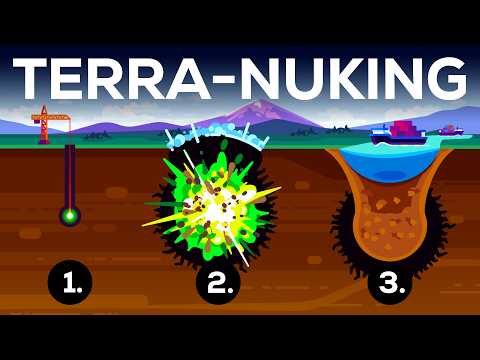
In the 1960s, the US embarked on Project Plowshare, a two-decade endeavor to use nuclear explosions for peaceful engineering, driven by physicist Edward Teller. Teller, a key figure in the Manhattan Project, envisioned using thermonuclear bombs, which he helped develop, not just for destruction but for construction projects like excavating canals, carving out harbors, and tapping oil and gas. This initiative, costing hundreds of millions of dollars and involving dozens of nuclear tests, occurred during the Cold War when the threat of nuclear war loomed large. Teller's initial work focused on developing thermonuclear bombs, which were thousands of times more powerful than the atomic bombs used on Hiroshima and Nagasaki. He believed that if these H-bombs could destroy the planet, they could also reshape it, offering a much more enthusiastic and cost-effective alternative to traditional explosives for large-scale earthmoving. The concept of "nukes for peace" also served a convenient purpose: it allowed for continued nuclear weapons testing under the guise of peaceful applications, at a time when public opinion was increasingly opposed to the arms race.
Read AI summary
YouTube
Kurzgesagt has introduced a new channel titled “Nightshift - Kurzgesagt After Dark,” dedicated to the darker stories of history. The debut video centers on a brutal event in 1809 in the Pearl River Delta. Pirates attacked the fishing village of Sanshan after residents failed to pay protection money. Despite the villagers’ attempts to defend themselves with a wooden palisade and armed men, their efforts failed catastrophically when their only cannon exploded. The resulting massacre left two thousand dead, and the pirates displayed eighty severed heads as a grim warning to others. This incident raises a significant question: how could the Chinese Empire, the wealthiest state on Earth, fail to protect its people? At the turn of the 19th century, China was home to nearly a third of the world's population and possessed the largest economy. Having functioned under a consistent operating system for two millennia, the "Middle Kingdom" saw itself as the pinnacle of civilization, responsible for revolutionary inventions like gunpowder, paper money, and the compass.
Read AI summary
YouTube
The universe is not a uniform spread of stars and gas; instead, it is defined by its absences. The vast majority of the cosmos consists of voids—gargantuan, unfathomably large bubbles of empty nothingness stretching hundreds of millions of light-years. These are the loneliest places in existence, almost entirely devoid of galaxies, stars, or light. Scientists have already identified over 8,000 of these voids and supervoids, revealing that they are not just "empty space" but dynamic structures that grow, collide, and merge, ultimately sculpting the fate of the entire universe. To grasp the scale of these voids, one must look far beyond our solar neighborhood. While our Milky Way and the neighboring Andromeda galaxy are part of a "Local Group" of about 50 galaxies, they are just a small pocket within the Virgo Supercluster—a wall of 2,000 galaxies. Beyond this lies the "cosmic cliff," where the Local Void begins. This empty bubble is 200 million light-years across; if it were visible to the naked eye, it would fill 40% of the night sky. Even more staggering is the Boötes Supervoid, a "cosmic desert" 300 million light-years wide. In a space that should contain thousands of galaxies, there is instead a darkness so absolute that it offers no sense of motion or orientation.
Read AI summary
YouTube