Let’s Travel to the Scariest Place in The Universe
AI Summary
The universe is not a uniform spread of stars and gas; instead, it is defined by its absences. The vast majority of the cosmos consists of voids—gargantuan, unfathomably large bubbles of empty nothingness stretching hundreds of millions of light-years. These are the loneliest places in existence, almost entirely devoid of galaxies, stars, or light. Scientists have already identified over 8,000 of these voids and supervoids, revealing that they are not just "empty space" but dynamic structures that grow, collide, and merge, ultimately sculpting the fate of the entire universe.
To grasp the scale of these voids, one must look far beyond our solar neighborhood. While our Milky Way and the neighboring Andromeda galaxy are part of a "Local Group" of about 50 galaxies, they are just a small pocket within the Virgo Supercluster—a wall of 2,000 galaxies. Beyond this lies the "cosmic cliff," where the Local Void begins. This empty bubble is 200 million light-years across; if it were visible to the naked eye, it would fill 40% of the night sky. Even more staggering is the Boötes Supervoid, a "cosmic desert" 300 million light-years wide. In a space that should contain thousands of galaxies, there is instead a darkness so absolute that it offers no sense of motion or orientation.
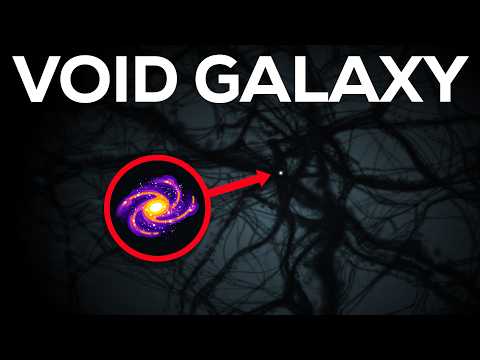
Despite their emptiness, voids contain mysterious features. Faint tendrils of dark matter, resembling "cosmic lichen," reach into the darkness. At the tips of these filaments sit "void galaxies"—the rarest and most isolated galaxies known. Because these galaxies are far from the gravitational tugging and merging of crowded clusters, they evolve in "slow motion." They tend to be smaller, bluer, and birth stars at a much calmer pace. Because of this stability, void galaxies may become the last habitable refuges in a dying universe, hosting the final stars ever to be born.
The macro-structure of the universe resembles a cosmic web or a collection of soap bubbles, where galaxies and dark matter cling to the rims of these massive empty gaps. This arrangement is maintained by a strange gravitational tug-of-war. Gravity attracts mass to mass; because there is almost no mass inside a void, the dense galaxy clusters on the edges pull material outward. This makes it naturally difficult for galaxies to enter a void, as they are effectively "spit out" toward the edges. Over time, this process makes voids even emptier and the surrounding walls of galaxies denser.
Ultimately, voids are the primary stage for dark energy, the force responsible for the accelerating expansion of the universe. While gravity wins the battle in crowded regions, dark energy dominates within voids, blowing these bubbles of nothingness larger and larger. As voids expand, they thinned out the filaments of the cosmic web and rip apart the structures of the universe. In the far future, these supervoids will merge and take over, eventually turning the entire observable universe into a singular, inescapable void of nothingness.