When the US Tried to Build Megastructures...With Nukes
AI Summary
In the 1960s, the US embarked on Project Plowshare, a two-decade endeavor to use nuclear explosions for peaceful engineering, driven by physicist Edward Teller. Teller, a key figure in the Manhattan Project, envisioned using thermonuclear bombs, which he helped develop, not just for destruction but for construction projects like excavating canals, carving out harbors, and tapping oil and gas. This initiative, costing hundreds of millions of dollars and involving dozens of nuclear tests, occurred during the Cold War when the threat of nuclear war loomed large.
Teller's initial work focused on developing thermonuclear bombs, which were thousands of times more powerful than the atomic bombs used on Hiroshima and Nagasaki. He believed that if these H-bombs could destroy the planet, they could also reshape it, offering a much more enthusiastic and cost-effective alternative to traditional explosives for large-scale earthmoving. The concept of "nukes for peace" also served a convenient purpose: it allowed for continued nuclear weapons testing under the guise of peaceful applications, at a time when public opinion was increasingly opposed to the arms race.
In 1957, Project Plowshare was officially launched with Teller at the helm. One of the earliest proposals was to blast open a new canal through the Israeli desert, following Egypt's nationalization of the Suez Canal in 1956. Another major project considered was an upgrade to the Panama Canal, which would require moving 1.2 billion cubic meters of earth. While traditional methods would cost $6 billion, nuclear excavation was estimated at $3.1 billion.
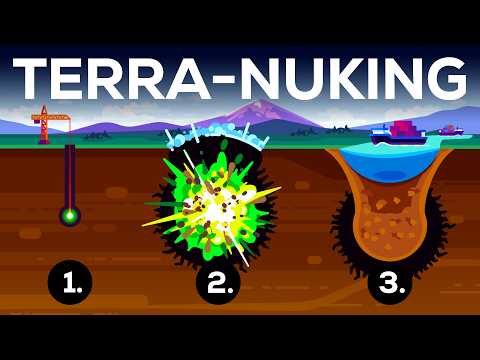
Before tackling continental canals, Teller proposed starting small with a new harbor in Alaska. The plan involved detonating five nukes, equivalent to 170 Hiroshima bombs, to create a 500-by-200-meter trench. Despite local communities' concerns about radioactive contamination, Teller insisted the dangers were "greatly exaggerated." His solution for managing radioactivity involved burying bombs hundreds of meters deep. The explosion would create a cavern, melting rock into magma that would pool at the bottom. As the ceiling collapsed, a crater would form on the surface, with radioactive debris sealed beneath tons of rock.
The first test of Project Plowshare occurred in 1961 in the New Mexico desert. A nuke, buried 360 meters deep in a salt deposit, was intended to melt the salt into a hot liquid to generate electricity. However, the salt contained more water than anticipated, which turned into superheated steam, amplifying the blast. The hole designed to seal itself failed, and a plume of radioactive steam erupted, causing damage and exposing observers to radiation. Despite government attempts to downplay the incident, public concern about radioactive fallout grew.
Undeterred, Teller scheduled another test in July 1962 in the Nevada desert, aiming to test nuclear excavation and crater size. A thermonuclear bomb, equivalent to seven Hiroshima nukes, created a massive crater 100 meters deep and 400 meters across, the largest artificial crater in US history. However, a miscalculation in depth led to another radioactive plume, with fallout detected as far as South Dakota and Illinois, and radioactive iodine found in milk in Utah. This became one of the "dirtiest tests" on US soil.
In the following years, more peaceful explosions and fallout occurred, and Teller's proposals became increasingly ambitious, including liquefying tar sands in Canada, blasting a highway through the Sierra Nevada, and connecting rivers in Mississippi, all with nukes. The Pan-Atomic Canal remained the "crown jewel" of these dreams. Plans progressed disturbingly far, with one route in Panama requiring 250 bombs, equivalent to 8,000 Hiroshimas, and the evacuation of 43,000 people. Shockwaves were expected to shatter windows in neighboring countries.
A hypothetical scenario of the Pan-Atomic Canal project depicted initial success with rainforest obliteration, followed by a cloud of fallout catching Pacific winds, leading to radiation spikes over the Caribbean and radioactive contamination in ocean food chains. Subsequent blasts in the central Chucunaque River valley encountered unexpected clay, resulting in landslides that clogged the new craters during the rainy season. This presented a choice: leave a "mud-choked, glowing blister" or undertake a "colossal engineering nightmare" to prevent further landslides, alongside an "ecological apocalypse" and a significant propaganda victory for Cuba and the USSR.
Fortunately, in our timeline, the US halted these plans. In 1970, a final report canceled the Pan-Atomic Canal and all nuclear excavation projects. Teller, however, refused to give up, turning to nuclear fracking to keep Plowshare alive. But after several explosions, the resulting gas was ultra-expensive and radioactive, making it impossible to sell. In 1977, after 20 years and dozens of nuclear tests across the US, Project Plowshare was finally canceled without achieving any of its goals. No canal, harbor, or tunnel was ever built. While the idea seems "insane" in hindsight, in an era where World War III felt imminent and atomic toys were common, using nukes to build a better future likely seemed like a viable solution.