Secret Travel Routes
AI Audio Summaries
3 videos summarized
1 follower on BriefTube
Last summary: Apr 18, 2026
Distrubing Realities About Life In North Korea Today
North Korea is portrayed as a nation completely isolated from the rest of the world, where 25 million people live under the absolute control of the Kim family dynasty. This control extends to every aspect of life, including employment, residence, thoughts, and relationships. The country, roughly the size of England, is sealed off with no internet, foreign news, or contact with the outside world, leading most citizens to be unaware of the true extent of their hardship. Following World War II, Korea was divided, with the Soviet Union backing the North and America supporting the South. This division led to the bloody Korean War in 1950, which ended in 1953 with a ceasefire but no peace treaty, leaving the two Koreas more separated than ever. From this conflict, Kim Il-sung rose to power, establishing an ideology called Juche, a distorted form of self-reliance that elevated the state and its leader to sacred status while demonizing the outside world. His image and quotes were ubiquitous. Upon his death in 1994, power transitioned to his son, Kim Jong-il, and then to his grandson, Kim Jong-un, in 2011, establishing the world's only communist dynasty, akin to a cult with nuclear weapons. In February 2026, Kim Jong-un was reelected as general secretary and formally designated South Korea as the DPRK's primary enemy, abandoning the goal of Korean reunification.
Read AI summary
YouTube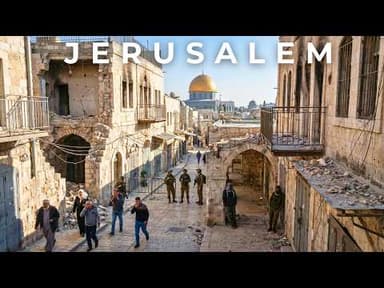
JERUSALEM: The Holiest Place On Earth That Refuses to Die | 4K Travel Documentary
For millennia, the Holy Land has been perceived as a place existing outside of time, where history paused and meaning began. Every stone, hill, and step is imbued with ancient significance, deemed sacred, chosen, and eternal. However, this land is not static; it is alive and constantly contested, not just by armies or politics, but by belief itself. Most visitors arrive seeking confirmation of existing narratives, whether for God, history, or personal truths. Few are prepared to ask the more challenging question: what happens when everyone believes a place belongs to them? The Holy Land is often presented as a pilgrimage destination, a map of holy sites. Yet, it functions as a complex system built on faith, maintained by ritual, protected by power, and inhabited by ordinary people who navigate its holiness daily. These individuals wake, work, raise families, and live within a place the world struggles to view as normal. While appearing timeless from a distance, the land feels heavy on the ground because belief here is not abstract; it is physical. It dictates where one can walk, pray, live, and even where one is forbidden to go. This land has been conquered, divided, and reclaimed countless times, but the certainty of those who believe they are right remains constant. Every faith tells a story about this place, each claiming ancient truth, leaving little room for those caught in between. The Holy Land is sacred not only for past events but for what quietly unfolds daily behind walls, beyond cameras, and beneath rituals. Tourists are invited to witness, but rarely to understand. This is a story about holiness becoming geography, and geography becoming destiny, urging listeners to look past monuments, prayers, and slogans, and instead listen to the silence that often carries more truth than words.
Get automatic AI summaries for all your channels
BriefTube monitors your YouTube channels, generates AI-powered audio summaries, and delivers them wherever you listen. Telegram, Discord, Slack, or your podcast app. Fully automated.
Start free trial