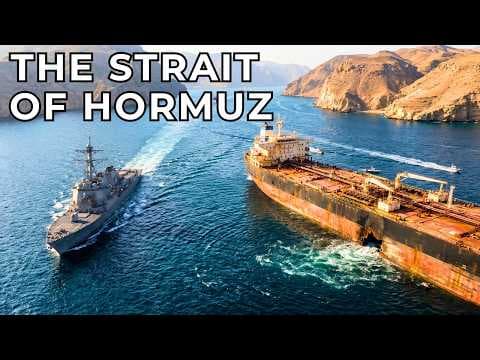
STRAIT OF HORMUZ: The World’s Most Dangerous 33km | Why It Controls Your Life! | 4k Documentary
AI Summary
The Strait of Hormuz, a narrow corridor of water only 33 kilometers wide at its narrowest point, is a critical global chokepoint, controlling one-third of the world's energy supply. Each day, 20 million barrels of oil pass through this strait, which connects the Persian Gulf to the Gulf of Oman and the open Arabian Sea. This oil is fundamental to global energy, powering electricity, fueling vehicles, and forming the plastic in countless devices. A significant portion of the world's crude oil travels through this single channel between Iran and Oman. Experts predict that if the strait were to close, oil prices would spike within hours, gas stations would run dry within weeks, factories would halt, power grids would strain, and electricity and fuel costs would rise dramatically, with governments unable to respond quickly enough. This makes the Strait of Hormuz the most fragile piece of global infrastructure.
Over 70% of the oil transiting this corridor is destined for Asia, specifically China, Japan, India, and South Korea. This means the economies that produce most of the world's goods are directly dependent on the uninterrupted passage of ships through this waterway. The strait is the sole exit route for all countries bordering the Persian Gulf, including Kuwait, Iraq, Saudi Arabia, Qatar, and Bahrain, with no alternative available.
From above, the strait appears calm, but a closer look reveals its militarized surroundings. Iran has strategically developed its northern shoreline, deploying hundreds of fast attack craft designed for swarm tactics to overwhelm larger vessels. Coastal missile batteries are embedded in hillsides and islands, with anti-ship missiles capable of reaching virtually any point in the strait from Iranian territory. Naval mines, inexpensive yet highly disruptive, have been previously deployed, capable of causing a crisis by making insurers nervous and halting shipping. Iran also operates surveillance and strike-capable military drones along this corridor, ensuring constant aerial monitoring.
On the southern side, Oman plays a crucial role in intelligence. A radar station high on the Musandam Peninsula, over 2,000 meters above sea level, continuously manages the traffic separation scheme, ensuring tankers avoid collisions in these tight waters. This radar also tracks potential threats. Western naval forces, including the multinational Combined Maritime Forces coalition, maintain a constant presence, conducting escort missions, surveillance flights, and warship patrols due to the high stakes involved. There have been instances where American warships and Iranian patrol boats came so close that personnel on both sides could see each other's faces.
Kish Island, the largest island in the Persian Gulf, lies parallel to the strait along Iran's southern coast. Its strategic location allows for intimate observation of shipping lanes, meaning any disruption originating here would rapidly impact the global oil market. Despite its militarized landscape of radar installations and naval infrastructure, Kish Island also hosts the ancient port town of Laft, characterized by coral stone houses, winding alleyways, and traditional wind towers (badgirs) that act as natural air conditioners. Fishermen still operate from the harbor, and massive wooden dhows are built using centuries-old techniques, a craft recognized on UNESCO's intangible cultural heritage list. This ancient maritime culture predates the oil age by over a thousand years.
Hormuz Island, which shares its name with the strait, is a small, volcanic island with unique visual characteristics. Its beaches are a deep, genuine red due to iron oxide in the soil, creating a striking scene where the ocean appears to bleed into the land. Inland, Rainbow Valley showcases a collision of vivid colors: crimson slopes, bright gold and sulfurous yellow ridges, dark volcanic rock, and turquoise mineral deposits. These colors are not superficial but are inherent to the rock itself, formed by iron oxide, sulfur compounds, hematite, and manganese over millions of years, with every rainfall and season reshaping the landscape. Beneath this colorful surface lies a vast salt dome, pushed up by tectonic pressure, containing cool, silent caves of white and amber crystal where mineral water trickles and walls glow in low light. This "Hormuz salt cave" is a luminous underground world built in darkness over eons.
Crossing to the southern side, Oman's Musandam Peninsula presents a landscape of towering limestone cliffs plunging into fjord-like inlets of extraordinary depth and color, resembling a misplaced piece of Norway. Traditional wooden boats navigate these channels, some almost hidden from the open sea. This strategic landscape allows Oman to monitor the waterway, with high ridges providing natural observation points and hidden inlets sheltering patrol craft. The Jabel Harim radar station, perched on the highest peak, continuously tracks every vessel in the strait, day and night. From this 2,000-meter-high ancient limestone mountain, containing fossilized coral from a time it was submerged, the entire maritime corridor is visible.
Tucked within the folds of the Musandam Peninsula is the isolated village of Kumzar, accessible mainly by boat. Life here revolves around fishing, weather, and tradition. The most remarkable aspect of Kumzar is its unique language, Kumzari, a blend of Persian, Arabic, and older regional dialects, a linguistic fossil formed by centuries of maritime contact and trade through these waters before the oil age. While Gulf cities modernized, Kumzar maintained its distinct language and way of life.
Before modern navies and global oil markets, a Portuguese fortress stood on Hormuz Island in the early 16th century. Built to control maritime trade routes between India, Persia, and Arabia, it taxed spices, silk, pearls, and silver. The fort, made of red earth and coral stone, still stands, its thick walls once deflecting cannon fire. Its existence underscores the enduring strategic importance of controlling this threshold.
Kish Island is also the Middle East's first UNESCO Global Geopark. Its landscape features narrow canyons carved by ancient water, salt domes pushing through the surface, and folded sedimentary hills revealing geological layers. In the tidal shallows, mangrove forests thrive, their tangled roots reaching for the sea. This landscape vividly displays the planet's history written in stone.
The Strait of Hormuz remains unchanged in its physical dimensions and the shipping lanes it facilitates. Mountains continue to watch from both sides, and the oil, essential to global machinery and daily life, continues its daily passage through this improbable corridor. The ongoing geopolitical tension surrounding the strait has persisted for decades, with no clear resolution in sight. Yet, amidst this strategic importance, the region harbors quietly beautiful places: the red sands of Hormuz, the rainbow hills, the glowing salt caves, the ancient fort, and the unique language of Kumzar. This paradox of a highly militarized waterway being one of the world's most beautiful places persists, much like the mountains watching the water move.