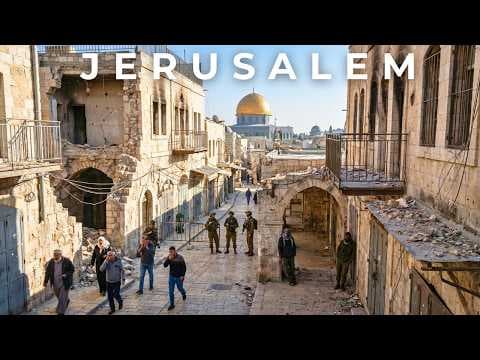
JERUSALEM: The Holiest Place On Earth That Refuses to Die | 4K Travel Documentary
AI Summary
For millennia, the Holy Land has been perceived as a place existing outside of time, where history paused and meaning began. Every stone, hill, and step is imbued with ancient significance, deemed sacred, chosen, and eternal. However, this land is not static; it is alive and constantly contested, not just by armies or politics, but by belief itself. Most visitors arrive seeking confirmation of existing narratives, whether for God, history, or personal truths. Few are prepared to ask the more challenging question: what happens when everyone believes a place belongs to them?
The Holy Land is often presented as a pilgrimage destination, a map of holy sites. Yet, it functions as a complex system built on faith, maintained by ritual, protected by power, and inhabited by ordinary people who navigate its holiness daily. These individuals wake, work, raise families, and live within a place the world struggles to view as normal. While appearing timeless from a distance, the land feels heavy on the ground because belief here is not abstract; it is physical. It dictates where one can walk, pray, live, and even where one is forbidden to go. This land has been conquered, divided, and reclaimed countless times, but the certainty of those who believe they are right remains constant. Every faith tells a story about this place, each claiming ancient truth, leaving little room for those caught in between. The Holy Land is sacred not only for past events but for what quietly unfolds daily behind walls, beyond cameras, and beneath rituals. Tourists are invited to witness, but rarely to understand. This is a story about holiness becoming geography, and geography becoming destiny, urging listeners to look past monuments, prayers, and slogans, and instead listen to the silence that often carries more truth than words.
In the Holy Land, holiness is a continuous, practical experience that shapes daily life. Belief isn't confined to prayer or ceremony; it manifests in schedules, routes, permissions, and timing. The sacred is not merely visited but navigated. Each day begins with invisible boundaries, some codified in law, others in tradition, and some in habits so ingrained they no longer feel chosen. These dictate movement, waiting times, entry, and exit, not through constant surveillance, but because the system has been internalized. Holiness, over time, becomes procedural. From the outside, sacred sites seem calm and timeless, with ancient paths polished smooth by centuries of feet. Internally, they operate as carefully regulated spaces, managing flows, containing crowds, and prioritizing hours over intention. Devotion is scheduled, not spontaneous, and when millions believe a place holds eternal meaning, even silence must be organized.
Faith in the Holy Land feels heavy, not because belief is stronger, but because its consequences are ever-present. Prayer impacts traffic, ritual affects access, and sacred time interrupts ordinary time. Daily life is constantly reshaped by something older than its inhabitants. For residents, holiness is tangible; it determines school routes, safe streets, avoided paths, and when work pauses or voices lower, driven by expectation rather than force. Generations develop a unique awareness, learning to read the land like weather. A change in rhythm signals a shift in mood; a quiet morning carries different meaning than a loud one; a blocked passage isn't always an obstacle, but simply how things are. Adaptation becomes a form of survival.
The world often imagines the Holy Land as a place of spiritual clarity, but clarity is rare. Instead, there is constant adjustment. Beliefs overlap, traditions press against routines, and sacred intentions collide with daily necessities. Life continues in the narrow spaces between them, an experience most visitors miss. They witness moments of arrival, prayer, and photographs, but don't stay long enough to feel how holiness shapes the hours that follow. Faith here doesn't ask permission to enter daily life; it's already integrated into street layouts, conversation pace, and seemingly ordinary decisions that are, in fact, profound. By adulthood, residents no longer question it; holiness isn't something they believe in, but something they live around. Once holiness becomes infrastructure, leaving it behind is no longer simple.
In the Holy Land, faith is not just practiced; it's depended upon. Pilgrimage is continuous, a steady stream of people carrying hope, obligation, longing, and fear. Where people gather in the name of meaning, an economy quietly forms around sacred sites. Daily life reorganizes itself: shops open early, rooms are rented nightly, languages shift with new arrivals. Work follows belief; when belief rises, income follows; when it pauses, everything slows. For many, faith is a profession of necessity. Guides learn expected stories, vendors identify relevant symbols, and families adjust routines to waves of visitors. What's sold isn't belief itself, but access to it: a candle, a relic, a path, a moment. Over time, the sacred becomes standardized. Rituals repeat on schedule, experiences are shortened for itineraries, and silence is timed between crowds. This isn't because faith has lost meaning, but because meaning has learned to survive within high volume. A delicate balance emerges: holiness must remain authentic enough to be believed, yet organized enough to function. Too much structure feels staged, too little leads to collapse. Faith adapts quietly, reluctantly, continuously, creating a subtle tension for residents. The same prayer sustaining tradition might pay rent; the same story told for centuries might be repeated dozens of times daily. The line between devotion and performance blurs. This isn't simple exploitation but participation; people respond to demand. The world asks for meaning, and the land organizes itself to deliver. Yet, when belief becomes livelihood, silence becomes valuable, access limited, and sacredness measured in time slots. The deeper meaning, though present, becomes harder to protect from repetition. Visitors leave feeling fulfilled, having prayed and seen what they came for. Residents remain, adjusting to the next arrival. Faith here is never finished; it must be maintained daily, seasonally, generationally. For those whose lives are built around it, holiness is not only spiritual but practical, economic, and fragile.
The Holy Land exists for most as an idea, imagined through scripture, history, headlines, and inherited belief—a symbol shaped long before current residents were born. For those living there, this symbolism is constant, following them into ordinary moments. Growing up means learning that the place belongs not only to them but to memory, interpretation, and people who have never stood there. Every street carries meaning assigned elsewhere; every neighborhood is explained by outsiders who see it as destiny rather than daily life. Identity becomes external. Children learn their home is constantly described by pilgrims, historians, commentators, and believers who view it symbolically. What feels normal to them feels symbolic to the world: a school becomes a headline, a routine a statement, a daily habit a distant debate. This creates a strange awareness; people see themselves as part of a narrative they didn't write, constantly watched, interpreted, and spoken for by louder voices. Living inside a symbol means even neutrality is noticed, silence interpreted, stillness questioned. Ordinary life becomes difficult to keep ordinary, with little room to simply exist without meaning being attached. This produces a quiet tension: personal identity must negotiate with collective expectation; choices are never just personal; actions echo further than intended; and the smallest detail can be absorbed into a larger story. Many adapt by narrowing their world, focusing on family and routine, not out of indifference, but because living entirely within the larger meaning would be exhausting. Others internalize the symbolism, becoming comfortable as representatives rather than individuals, learning safe words, expected explanations, and wise silences. Identity becomes layered: private, public, and what the world believes one must be. What outsiders mistake for certainty is often protection; conviction may be endurance. When home carries the weight of history, carrying oneself lightly is difficult. To live in the Holy Land is to understand that meaning is never neutral; it presses inward, shaping tone, posture, and caution. Even in calm moments, there's an awareness that this place is never just itself. For residents, the land is not a metaphor but where life happens, and life lived inside a symbol must find quiet ways to remain human.
In the Holy Land, silence is learned, not empty. Certain things are unspoken, not because they are unknown, but because naming them carries weight. Words don't disappear; they remain, travel, and attach to places, families, and futures. So, people choose them carefully. Silence becomes a form of fluency: knowing when not to speak, when to listen, when to let something pass without response. These are not signs of avoidance but understanding. Where meaning multiplies quickly, restraint is protection. Absence is also visible: quiet streets, unused buildings, unexplained routine changes. Life adjusts around these gaps as if they were part of the landscape, unquestioned, unexplained, absorbed. This shapes communication: conversations circle subjects, stories are told through implication, truth carried in tone. To outsiders, this can seem evasive; to residents, it's necessary. Children learn not to ask certain questions loudly; histories are known but not recited; boundaries exist without signs. Silence becomes a shared language, passed quietly from generation to generation. This doesn't mean unawareness, but that awareness coexists with caution where every statement can be interpreted. Not speaking can be an act of precision. Even faith participates: certain interpretations remain private, doubts held inward, tensions acknowledged indirectly. Belief here is rarely loud; it's measured, controlled, careful. Visitors often mistake this quietness for certainty, assuming confidence without friction. But silence doesn't mean ease; it means wait. It means knowing that speaking freely isn't always being understood. Absence leaves traces; what isn't said shapes behavior as strongly as what is repeated. In that space, between words and explanations, life continues cautiously, deliberately intact.
In most places, time moves forward, leaving things behind, replacing old routines, and making the past distant. In the Holy Land, time layers. The past isn't remembered; it's encountered. Ancient stories coexist with modern routines without fading. Old meanings remain active, shaping present decisions. History doesn't conclude; it repeats quietly under different names. What happened centuries ago isn't settled; it's referenced, revisited, reinterpreted as instruction. This creates a unique relationship with time. Progress doesn't feel linear; resolution doesn't feel permanent. Each generation inherits land, belief, and unresolved meaning. Change feels slower, not because people resist it, but because it must negotiate with everything that came before. New ideas carry old consequences; modern life unfolds within ancient frameworks; nothing begins on empty ground. The weight of this continuity is subtle; it accumulates in habits, caution, and the sense that today's events will matter tomorrow and long after. Many grow tired of history without escaping it, not denying it, but surrounded by it. Time here doesn't grant distance; it grants responsibility, leading to a particular fatigue: the exhaustion of always being part of something larger, the pressure of never being allowed to forget. Visitors often find timelessness beautiful, but it also means repetition, patterns resisting closure, cycles renewing quietly, and lives lived knowing endings are rare. The future doesn't arrive cleanly; it arrives layered, carrying echoes, expectations, and unresolved questions. Learning to move through time here means learning to live without resolution.
Few places are watched as closely as the Holy Land. It exists not just as land, but as image, symbol, argument, proof. Billions hold an idea of this place without ever standing in it. From afar, it becomes a mirror, reflecting projected meaning: belief, fear, hope, certainty. For many outsiders, it's interpreted through texts, tradition, and stories passed down rather than lived. These stories arrive fully formed, seeking confirmation. This attention never fades; it renews with each generation, retelling, and new lens. The Holy Land becomes less a place and more a reference point for debates far beyond its borders. For residents, this creates a quiet imbalance. Their home is constantly spoken about but rarely listened to; their daily life absorbed into narratives written elsewhere. They are expected to represent something simply by existing. Global attention subtly reshapes reality: moments are documented, spaces framed for meaning rather than use, ordinary life becomes symbolic by default. The land is never allowed to rest. This projection isn't always hostile; often, it's reverent, curious, well-intentioned. But even reverence carries pressure. When a place is endlessly observed, it begins to perform itself. Visitors seek significance, media clarity, belief affirmation. What remains is a population learning to live under constant interpretation. Over time, this creates emotional distance between how the land is lived and how it is imagined, between reality and expectation. Misunderstanding becomes inevitable, not because truth is hidden, but because meaning is crowded. Too many stories compete for ownership, too many interpretations seek dominance. Yet, life continues. People wake, work, children grow, routines persist—not in defiance, but beneath the world's gaze. The Holy Land doesn't exist to resolve belief; it absorbs it, carrying the weight of everyone who looks toward it without living inside it.
In the Holy Land, endings are rare. Stories don't close cleanly; they pause, carry on quietly, and wait. What appears unresolved from the outside is often simply ongoing from within. This land has learned to exist without final answers, not because answers are impossible, but because certainty has never belonged to just one voice. Meaning doesn't settle; it circulates through prayer, memory, silence, and daily life. Visitors often leave searching for clarity; residents learn to live without it. They understand that permanence comes not from resolution but from adaptation, finding ordinary life within extraordinary weight. The Holy Land is not only shaped by belief; it shapes belief in return, testing, complicating, and refusing to simplify it. Perhaps that is why it endures. To stand here is to realize that sacredness doesn't remove conflict; it concentrates it, turning land into language, history into presence, faith into responsibility. This place doesn't ask to be understood; it continues regardless, holding the past beside the present, carrying expectation without relief, allowing life to persist without permission. The Holy Land is not frozen in time; it is suspended within it. For those who live here, the most meaningful act is not explanation, but continuation. Some places teach you what to believe; others teach you what belief costs.