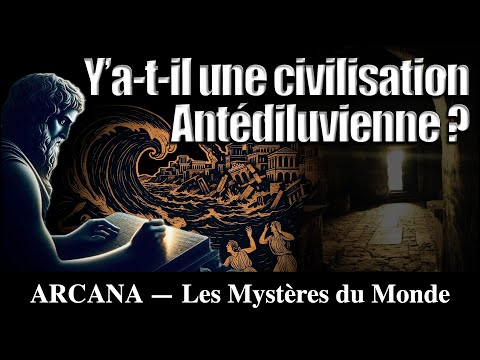
Y’a-t-il une civilisation antédiluvienne ? - Du Mythe à la Réalité
AI Summary
This video explores the hypothesis of a pre-diluvian civilization, examining the concept from historical, mythological, and archaeological perspectives. The presenter emphasizes a rigorous, evidence-based approach to avoid confirmation bias and unfounded speculation.
**Part 1: Contextualization**
The term "antéluvien" refers to events or existence before a great flood, often referencing the biblical deluge but extending to any cataclysmic event involving rising waters. Historically, it denoted a period before known civilizations like ancient Egypt or Sumer. The definition of "civilization" itself is crucial: it's defined as a complex society with common characteristics like language, culture, religion, art, politics, science, and technology. A distinction is made between "culture" and "civilization," with civilization implying a broader, more organized, and interconnected societal structure. A chronological overview of known civilizations highlights Sumer (4th millennium BCE), Egypt (around 3200 BCE), the Indus Valley (around 3200 BCE), Minoan (Crete, pre-palatial period), China (around 1500 BCE), and the Olmec in America (around 1200 BCE). The importance of a scientific method, using reliable sources and consistent analysis, is stressed to avoid falling into cognitive traps.
**Part 2: Mythological Approaches**
This section delves into prominent myths that fuel the idea of pre-diluvian civilizations.
* **The Deluge Myth:** The earliest textual occurrences are the Atrahasis Epic (c. 2000-2300 BCE) and the Epic of Gilgamesh (c. 1900 BCE, with a later version from the 7th century BCE). These Mesopotamian myths describe a divine flood meant to eradicate humanity, with survivors guided by gods to build an ark. Later versions appear in Greek mythology (Deucalion, c. 8th century BCE), biblical texts (Noah, Genesis, c. 5th century BCE), and Hindu traditions (Manu, c. 3rd-4th century BCE). The presenter notes the widespread nature of flood myths globally, but emphasizes the chronological and geographical context of the earliest written accounts, originating in Mesopotamia.
* **The Myth of Atlantis:** Attributed to Plato (c. 360 BCE) in his dialogues "Timaeus" and "Critias," the legend describes a powerful island civilization that existed 9,000 years before his time. Importantly, Plato's Atlantis was technologically advanced for its era but not depicted as having capabilities beyond ancient Greek knowledge, contradicting later, more fantastical interpretations. While Aristotle considered it a literary allegory, others like Diodorus of Sicily attempted to locate it in the Western Mediterranean. The myth saw a resurgence during the Renaissance and was heavily transformed in the 19th century into a technologically superior, almost alien civilization.
* **The Myth of Hyperborea:** Originating in Greek texts (Hecataeus of Miletus, Herodotus, c. 6th-7th century BCE), Hyperborea was envisioned as a mythical land beyond the north wind, often associated with gods. Ancient Greek geographical knowledge was limited, so "beyond" represented the unknown. Later, the myth of Hyperborea became conflated with the discovery of Thule by Pytheas of Massalia (c. 4th century BCE), a northern land described as inhabited by people with social behaviors akin to Celtic cultures. The 19th century saw a fusion of these myths, placing Hyperborea in the Arctic and associating it with Nordic and Germanic cultures, often as a lost paradise.
* **The Myth of Mu:** This concept, popularized in the 19th and 20th centuries by figures like Augustus Le Plongeon, Helena Blavatsky, and Colonel James Churchward, posits a lost continent in the Pacific Ocean submerged by a flood. Crucially, Mu is not an ancient myth but a modern construct, essentially an Atlantean legend transposed to the Pacific, drawing on existing flood narratives and indigenous oral traditions (like those of the Maori regarding a lost land called "Hiva").
* **The Theory of Ancient Astronauts:** Also termed "neo-evhemerism," this modern theory, gaining traction from the 19th century onwards, suggests that extraterrestrial beings or advanced beings from elsewhere influenced early human civilizations, potentially through genetic manipulation or interbreeding. This theory often reinterprets ancient myths of gods and celestial chariots as evidence of alien technology. The Roswell incident in 1947 and subsequent popularization by authors like Jacques Bergier, Louis Powell, and Zecharia Sitchin (who linked Sumerian texts to Anunnaki aliens) have fueled this narrative.
The presenter critiques how these myths are often conflated and misinterpreted. For example, underwater sites like Yonaguni are linked to Atlantis without considering their actual geological or archaeological context and dating. Similarly, the search for Hyperborea is often projected onto the Arctic based on limited ancient knowledge, and Mu and Lemuria are seen as modern interpretations of lost continents. Ancient astronaut theories often misinterpret ancient texts and artifacts, projecting modern scientific concepts onto ancient narratives.
**Part 3: Archaeological and Historical Approaches**
This section outlines the methodological tools for investigating such claims:
* **Chronological Methods:** The division of time into Prehistory, Protohistory, and History is discussed, noting its geographical variability. Prehistory (from human origin to c. 10,000 BCE) covers hunter-gatherer societies. Protohistory (c. 10,000 - 3500 BCE) marks the transition to settled life, agriculture, and the development of complex cultures. History begins with the invention of writing (c. 3500 BCE in Mesopotamia). The Ages of Stone, Copper, Bronze, and Iron provide further chronological markers, highlighting that technological advancements did not occur uniformly across the globe. For instance, copper metallurgy appeared in Anatolia and the Balkans around 7000 BCE, while it was much later in other regions.
* **Protocivilizations:** Examples like Çatalhöyük (c. 7000 BCE) and Amoukar (c. 5th millennium BCE) are presented as "protocivilizations" – complex cultures that didn't quite reach the scale or interconnectedness of a full civilization. Sumer is considered the first true civilization due to the presence of multiple interconnected city-states with shared language, writing, religion, and political structures.
* **Dating Methods:** Various dating techniques (Carbon-14, thermoluminescence, stratigraphy) are crucial for establishing chronologies. It's emphasized that these methods need to be used in conjunction and cross-referenced.
* **Technological Chronology:** Examining the timeline of key inventions like rope-making (c. 50,000 BCE), the bow (c. 12,000 BCE), the wheel (c. 4th millennium BCE), the inclined plane (c. 3rd millennium BCE in Egypt), the pulley (c. 870 BCE in Assyria), and the compass (c. 4th century BCE in China) helps contextualize potential pre-diluvian capabilities. The Antikythera mechanism (c. 2nd-1st century BCE) is discussed as an example of complex ancient technology, but its existence doesn't necessarily point to a lost advanced civilization, but rather to the ingenuity of its time.
* **Anomalies:** The presenter clarifies that "anomalies" are not evidence of lost civilizations but rather phenomena that are currently difficult to explain within existing knowledge. Examples like the Piri Reis map, Puma Punku, and the Yonaguni Monument are analyzed. The Piri Reis map's inaccuracies are attributed to cartographical errors and translation issues, not ancient advanced knowledge. Puma Punku's construction, while impressive, is dated to around 1000 BCE with evidence of human occupation, ruling out a much earlier origin. Yonaguni remains debated between natural formation and human modification, with its dating uncertain, making it a point of inquiry rather than definitive proof of a pre-diluvian civilization.
**Part 4: The Protean Hypothesis**
This section critiques the "protean hypothesis," which combines various myths, archaeological findings, and artifacts to construct a narrative of a lost, advanced civilization. The presenter argues that this approach often suffers from a "syncretism of sources," where unrelated elements are forced together, ignoring their individual contexts, authors, and timelines. The myths of Atlantis, Hyperborea, Mu, and flood narratives are analyzed for their origins and transformations. The presenter emphasizes that each myth and artifact must be studied independently before any attempt at synthesis. The "who, what, when, how, and why" of each source are crucial for proper contextualization.
**Part 5: Conclusion and Perspectives**
The presenter concludes that while the idea of a technologically advanced, lost pre-diluvian civilization is unlikely based on current archaeological evidence, the concept itself is deeply rooted in the human need for an "eternal return" – a yearning for a lost golden age. This desire, amplified by the cyclical view of time prevalent in ancient cultures and the rise of esoteric thought, has led to the modern interpretations of Atlantis, Mu, and Hyperborea as utopian ideals. The presenter distinguishes between historical and allegorical interpretations of the deluge, suggesting that if the deluge was a historical event (like the Younger Dryas or the Black Sea flood), any pre-diluvian civilization would have existed in the Neolithic or Chalcolithic periods, possessing technologies consistent with those eras. The idea of a global, technologically advanced civilization before the deluge is deemed improbable due to the lack of supporting archaeological evidence. The presenter advocates for critical analysis of myths and artifacts, emphasizing that fiction can inspire theories, but theories should not be built upon fiction without rigorous evidence. Ultimately, the search for a lost golden age reflects a desire for an idealized past that informs our aspirations for the future, rather than a verifiable historical reality of a highly advanced pre-diluvian civilization.