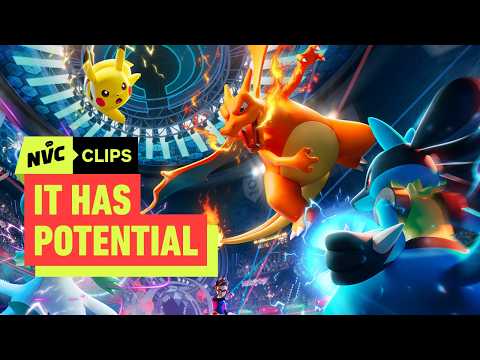
Pokemon Champions Has Potential After A Disappointing Start - NVC Clips
Audio Summary
AI Summary
Pokemon Champions has launched to a mixed reception, with many expressing unhappiness over missing features such as the absence of local wireless, no compatibility with the Switch friends list, a lack of standard 6v6 battles, and a very small Pokedex. Despite these criticisms, one player described the game as "aggressively fine," particularly for those familiar with Pokemon Stadium's competitive battling. The game is set up as a "games as a service" model, incorporating battle passes, daily unlocks, and daily challenges. Players can recruit one free Pokemon daily from the farm or speed up the clock using tickets or currency. The game is envisioned as a way to connect all Pokemon games, serving as an extra component alongside Pokemon Home. The ability to transfer Pokemon from games like Scarlet Violet, Sword Shield, and Arceus into Champions and utilize them is highlighted as a positive aspect.
However, a significant concern is the game's poor performance, with frame rate issues even during idle animations, not just during attacks. The graphics for background elements like people in the stands are described as "wobbly and weird looking," appearing lower quality than recent Pokemon games. This visual downgrade is partially attributed to the game's future mobile release, suggesting a design choice to maintain a consistent, albeit less graphically intensive, experience across platforms.
On the positive side, matchmaking has been quick, and the user interface for selecting Pokemon, assigning items, picking moves, and viewing opponent's team information is praised. A notable UI feature allows players to see the effectiveness of a chosen move against all Pokemon in the opponent's party, aiding strategic swaps. Despite these quality-of-life improvements, the game is considered a "very rough package" at launch, expected to improve over several 30-day seasons.
A perplexing design choice was noted during the tutorial, where players receive a free Pokemon recruit, only for the first in-game event to offer the exact same Pokemon as a reward for playing three battles. This raises concerns about limited box space, as players can only hold a certain number of Pokemon without purchasing additional storage or a starter pack, hinting at potential microtransaction issues in the long term. Despite the shortcomings and limitations, the core Pokemon battles are still enjoyable, offering extensive options for updating stats, training, switching abilities, changing nature, and modifying move sets.
The current state of Pokemon Champions has been criticized for being incomplete, especially considering its role as the new format for official competitive play. The competitive community has temporarily lost access to a wide range of Pokemon and held items that were crucial to established meta-strategies. There are also reports of bugs, such as Pokemon disappearing when transferred from Pokemon Home. The timing of the release is questioned, with suggestions that it should have remained in development longer or been released as an early access title, with a full competitive launch slated for a later date. The game is perceived as rushed and not well thought out, particularly regarding its timing.
The game's strong reliance on microtransactions and its mobile game aesthetic are seen as significant disappointments, especially given the initial excitement surrounding the concept of a dedicated competitive Pokemon platform. The limited Pokedex at launch (around 180 Pokemon) and the "characterless menus" for training Pokemon contribute to the perception that it feels more like a "mobile app store microtransaction shop with Pokemon pasted over it" rather than a modern RPG experience with engaging animations.
Despite these criticisms, the fundamental appeal of Pokemon battling remains strong. The core system of creatures fighting each other, with well-balanced numbers and matchups, is praised as "freaking great." This inherent quality of Pokemon is acknowledged as the primary factor carrying the franchise, even when individual games have technical issues or design flaws. The question arises whether this fundamental strength can continue to carry the franchise indefinitely, or if a "breaking point" will eventually be reached where consumers demand better surrounding elements. The possibility of a true competitor emerging in the monster-collecting genre is seen as a potential catalyst for innovation within the Pokemon franchise, as competition often drives growth and improvement.
The ongoing technical issues even in older games like Scarlet and Violet are highlighted, with examples such as invisible picnic tables and ingredients falling through the ground during picnics. This reinforces the idea that the underlying game development often struggles, with the enduring popularity of Pokemon itself, particularly iconic creatures like Pikachu, being the main draw. The sentiment is that when the only truly good aspect of a product is its core gameplay mechanic—Pokemon battling—which has been consistently good across all games and wasn't newly introduced or significantly innovated upon here, then the product's value proposition, especially with its emphasis on microtransactions, becomes questionable. Ultimately, there's hope that Pokemon Champions will evolve into a better product, but for now, it's seen as a rough, microtransaction-heavy offering on Switch, with a planned mobile release.