Vacances XXL : ils s'offrent le plus grand camping de France
Audio Summary
AI Summary
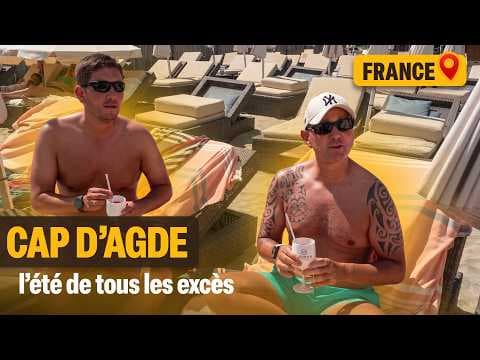
The Cap d'Agde, a popular family resort between Sète and Béziers, boasts 300 days of sunshine annually, 14 km of beaches, and one of Europe's largest naturist villages. This paradise for vacationers emerged from the ground 60 years ago. In the late 1960s, General de Gaulle initiated the creation of six seaside resorts from scratch, investing 700 million francs to transform the Cap d'Agde marshes into a "French Florida," featuring 25 nightclubs clustered together. Today, Cap d'Agde hosts 300,000 residents each summer, ten times its winter population. This report follows both vacationers and professionals whose livelihoods depend on these few weeks.
One major attraction is Aqualand, the largest water park in the south of France, drawing hundreds of visitors daily with its waves and 15 aquatic attractions, including nine dizzying slides. For 36 euros a day, guests like Baptiste, a 24-year-old car body painter, and his friends from Fouquières-lès-Béthune, enjoy thrills such as the 18-meter-high boomerang slide, equivalent to a five-story building. The park, open only in summer, can accommodate up to 6,000 people daily, attracting half a million vacationers in two and a half months.
To house the influx of tourists, Cap d'Agde offers 29 campsites, each striving for uniqueness. Caroline, an aeronautical engineer, and her sister Camille, from Savoie, booked a mobile home in one of the 11 four-star campsites. Their mobile home, with three bedrooms, a kitchen, and a small living room, costs 3,400 euros per week, a price that includes a private jacuzzi. The campsite itself features 880 mobile homes across 11 hectares, with prices starting at 200 euros per night in high season. Caroline chose this campsite for the second consecutive year primarily for its private 10,000 m² pirate-themed water park. Despite the 22-degree water, a bit chilly for the adults, the children enjoy the river. The campsite also offers a wide range of activities, with a 17-person team providing entertainment throughout the day, including swimming with a mermaid, pirate dances, and dinner shows.
Behind this tourism hub is the Poujol family, descendants of Pierre Pougol, who foresaw the potential of Cap d'Agde in 1967. Originally a winegrower, Pierre convinced his parents to convert their vineyards into a campsite, a radical idea at the time, as it meant uprooting generations of vines. The initial campsite featured dry toilets and tents, which gradually gave way to more lucrative mobile homes as Pierre acquired surrounding land. In May, a fire destroyed 200 mobile homes, 20% of the camping, just weeks before peak season. Despite the setback, Paul Henri, Pierre's son, remains optimistic, noting the palm trees regenerating from their ashes. Last year, he invested 2.5 million euros in a five-star pirate-themed hotel within the campsite, featuring 5,000 antique and internet-sourced objects. A night here costs between 700 and 1,000 euros. The hotel offers a 24-hour pirate experience, including a surprising welcome from actors portraying Jack Sparrow and a kraken. These actors, Vincent and Vincent, a mason and a children's entertainer in real life, reinforce the animation team on weekends in July, with Vincent having meticulously crafted all the costumes, including the kraken costume costing over 3,000 euros.
While everything is designed to keep vacationers within the campsite, Camille and Caroline ventured out for a unique experience: the barbecue boat. Mathieu and Jeff, two Cap d'Agde entrepreneurs, introduced this concept after discovering it in Guadeloupe. They offer nine permit-free boats equipped with gas barbecues. For 135 euros for three hours, plus food and wine, guests can navigate the port's ten basins. The inverted steering system requires a quick 10-minute lesson. This allows families, like Aurélie and Jonathan from Narbonne, to enjoy a barbecue on the water, a welcome alternative to the camping's barbecue restrictions due to fire risks. Launched five years ago, the barbecue boats are now fully booked.
However, not all tourism professionals are having an easy time. On a day when the tramontana wind blows at 50 km/h, Anaïs, the manager of Manovi, the largest of eight beach restaurants, faces challenges. Manovi generates 40% of its revenue from mid-June to mid-September. On this windy morning, two-thirds of the sunbeds are empty, and the restaurant is only at 40% capacity, compared to a full house last year. Cancellations due to the wind are frequent. The chefs, having just bought fresh Mediterranean red tuna from a local fisherman, must sell it all within 24 hours, preparing carpaccio, steaks, and poke bowls. Anaïs, a former CPE from Brittany who changed careers four years ago, manages a team of 24. Despite the challenges, the red tuna carpaccio proves popular. She notes a 30% drop in July's attendance compared to last year, attributing it to the weather and reduced purchasing power.
On the beach, other professionals face different struggles. Paul, a 19-year-old plumbing apprentice, sells churros and ice cream in July and August to fund his studies. He is one of about ten vendors working eight hours a day. However, the Agde municipality recently banned street vending on beaches during peak hours (2 PM to 6 PM), citing concerns about food preservation and persistent vendors. Paul and his colleague, Ashraf, have been fined 135 euros for illegal occupation of public land. The company employing them is appealing the fines, arguing for freedom of commerce.
That evening, Anaïs's restaurant is full for a "white party," thanks to two local stars: Doris and her daughter Maëlys, along with François, Doris's husband, a professional saxophonist. The trio, "Ladies and Sax," are a major draw, with fans driving an hour to see them. For two and a half hours, they perform American and French classics, creating a lively atmosphere. The event cost Anaïs 1,400 euros but generated 250 covers, quickly recouping the investment and providing good publicity. Doris and Maëlys, who perform about 40 shows in July and August, are natives of the region. Maëlys, whose parents met in a local orchestra, began performing at age two and a half. Despite a scientific baccalaureate and a dietetics BTS, she joined her parents, becoming a self-taught singer. Their family bond and coordinated stage outfits, costing around 5,000 euros annually, are key to their success. They emphasize elegance, carefully adjusting their dresses to avoid vulgarity.
Beyond the music, another spectacle draws crowds to the Languedoc coast each summer: nautical jousting. This 17th-century tradition involves two teams, with the first jouster to fall into the water losing. It's a sport requiring balance, strength, and agility, with a national federation, weight categories, and official competitions. Jimmy, 34, a municipal employee, trains weekly on a simulator built by his father 30 years ago. He is one of 80 licensed jousters in Agde, a town with two clubs. Jousting is a family passion, with Jimmy's father and uncle having been players, and his great-grandfather a champion. Jimmy, who started jousting at age 10, carries the pressure of four generations and the entire town. Today, he competes 20 km away in Sète, the historical birthplace of the sport, likening it to challenging the All Blacks in rugby. In the league championship, nine towns compete. Jimmy, wearing the traditional immaculate white jousting outfit, has his rituals, like never using a towel, a sign of impending defeat. He faces Valentin Fabre, a top-15 French player. Jimmy is eliminated in his first attempt, but accepts the defeat gracefully, acknowledging his opponent's skill.
Away from the crowds, 4 km from the beaches and campsites, lies Agde's historic town center with its volcanic stone cathedral, usually deserted by tourists in summer. However, on this day, it's bustling. The city organized a free concert on a floating stage to attract visitors. Two thousand people gather on the banks of the Hérault river to see MC Solaar, a pioneer of French rap. Sylvie, from the city's entertainment department, prepares his lodge, an old libertarian club under the cathedral, ensuring he has everything he needs, from Perrier to ginger and dried fruits. MC Solaar, on tour all summer, expresses his appreciation for the free concert, seeing it as an opportunity for new generations to discover his music and for everyone to experience a memorable summer celebration. The 56-year-old rapper performs for 1.5 hours. The show, costing the city nearly 50,000 euros, is one of four free concerts held that summer, each attracting 5,000 spectators.