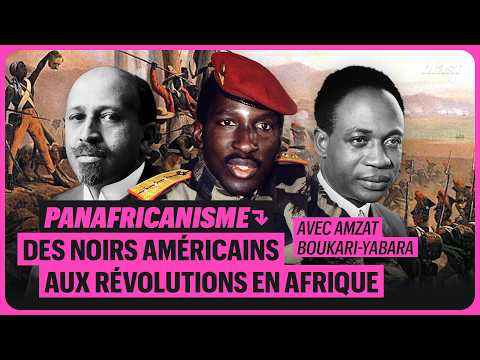
PANAFRICANISME : DES NOIRS AMÉRICAINS AUX RÉVOLUTIONS EN AFRIQUE
AI Summary
In this interview, historian Hamza Boukari-Yabara, author of *Africa Unite*, explores the complex history, evolution, and current state of Pan-Africanism. He describes the movement as an "historical enigma"—an international phenomenon born not in a single location, but among the African diaspora in the Americas during the 16th-century transatlantic slave trade.
**The Foundations of Pan-Africanism**
Boukari-Yabara identifies the Haitian Revolution of 1804 as the movement's foundational political moment. It was the first successful revolution by enslaved people, the first decolonization in French history, and a catalyst that forced European powers to rethink their strategies. Following Haiti’s victory over the Spanish, British, and French, these colonial powers realized that internal divisions made them vulnerable. Consequently, they developed a form of "collective imperialism" to maintain global control. Throughout the 19th century, Haiti served as a symbol of liberation, supporting figures like Simón Bolívar and working to revalue the African identity in a world dominated by both the abolition of slavery and the onset of new colonial expansions.
By the late 19th century, the Berlin Conference saw Africa divided into European spheres of influence. In response, members of the diaspora in the United States, Jamaica, and England realized their status as Black people globally was tied to the fate of the African continent. This led to the 1900 Pan-African Conference in London, which formally named the movement and set an agenda to combat capitalism, colonialism, racism, and imperialism.
**Ideological Divergence: Du Bois vs. Garvey**
The movement has historically been shaped by two competing yet complementary visions. W.E.B. Du Bois, a Harvard-educated intellectual, represented an elitist, reformist approach. He focused on political emancipation and the integration of Black people into American society, famously theorizing the "double consciousness" of being both Black and American. He proposed the "Talented Tenth" theory, suggesting that a small intellectual elite would lead the masses toward progress.
In contrast, Marcus Garvey championed a radical, popular Pan-Africanism. He focused on mass mobilization, racial pride, and the "Back to Africa" movement. Garvey argued that the diaspora should return to the continent to aid its development, famously declaring "Africa for the Africans." While these two figures are often polarized in history books to highlight division, Boukari-Yabara argues they were complementary. Figures like Kwame Nkrumah, Ghana's first leader, eventually merged these intellectual and popular currents.
**The Structural Impact of Slavery and Capitalism**
Boukari-Yabara makes a critical distinction between different slave trades. While the Arab-Muslim trade existed for centuries, it did not halt the internal development of African empires. However, the transatlantic trade was inextricably linked to the birth of Western capitalism. It "extraverted" Africa, dragging the continent into a global system against its will and turning it into a source of raw labor. This caused a massive demographic collapse—estimated at five to six times the number of those who survived the crossing—and dismantled African social and political structures. This "wild capitalism" persists today through multinational corporations that continue a legacy of predation.
**Decolonization and the "Balkanization" of Africa**
During the mid-20th century, Pan-Africanism became a tool for independence. However, colonial powers, particularly France, used "balkanization" to weaken the continent. By breaking up large administrative blocs like French West Africa into a dozen smaller, fragile states, they made African unity significantly harder to achieve.
Boukari-Yabara distinguishes between "African Unity"—a bureaucratic effort by established states (like the African Union)—and "Pan-Africanism," which remains a grassroots, internationalist struggle led by the diaspora. He argues that the official narrative, which claims Pan-Africanism achieved its goals with the end of Apartheid in 1994, is false. Direct colonialism still exists in territories like Kanaky, Guadeloupe, Martinique, and Mayotte. Furthermore, "coloniality" persists through economic structures like the CFA Franc and the influence of the IMF and World Bank.
**New Imperialism and the Logic of Force**
The historian warns of a "new imperialism" characterized by advanced technology, such as drones and AI, which allow for remote warfare. This era is also defined by the "tracking of the internal enemy." He cites French immigration policies as an example: by halting immigration for several years, the state focuses on purging "undesirables" within its borders, a tactic he describes as having "genocidal ideological dimensions."
While the West remains largely unified by a shared history of supremacy, the "Global South" is currently fragmented. Some African nations remain aligned with former colonial masters, while others, like South Africa, attempt to assert a sovereign moral line by defending causes like the Palestinian struggle. Boukari-Yabara criticizes the "messiah complex" or the cult of the individual leader, such as the popular image of Ibrahim Traoré in Burkina Faso. Instead, he advocates for horizontal resistance and a shift toward federalist, parliamentary models that move away from the "republican monarchism" inherited from colonial rule.
**Conclusion: The End of a Cycle**
As an historian, Boukari-Yabara views the current Western hegemony as a cycle that will inevitably end. Just as the Soviet Union collapsed, he believes the current imperial structures—including French control over overseas territories—will eventually vanish. The challenge for the future is ensuring that the coming independence of these territories is "revolutionary" rather than a "settler's independence" that preserves capitalist interests. Pan-Africanism, therefore, remains a vital repertoire of strategies for collective dignity and the decolonization of international law.