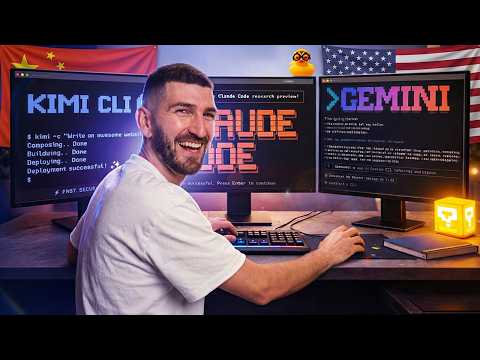
Quelle IA code le mieux des landing page ?
AI Summary
In this video, Benjamin Code puts four of the most powerful current AI models to the test: Claude, Gemini, Codex, and the newcomer from China, Kimi. The objective is to see which one can best execute a professional brief for a real-world project: creating a landing page for his new service, "Small Players."
### The Project: Small Players
The service being used for this test is a new offering on the "Meet Sponsor" platform. For years, the creator helped YouTubers find sponsors; now, he is flipping the script to help small software-as-a-service (SAS) creators and entrepreneurs find visibility. "Small Players" guides these creators through the process of finding micro-influencers, estimating costs, drafting effective outreach emails, and understanding the workflow of a YouTube collaboration, complete with contract templates.
### The Challenge and Scoring
Each AI received the exact same "ultra-square" brief originally intended for a human designer. The requirements included a creative hero banner, high-conversion copywriting, and a structure that encourages users to sign up. The AIs were free to choose their technology stack. Benjamin established a scoring system out of 20 points, divided into four categories:
1. **Hero "Wow" Effect (5 points):** Visual impact upon arrival.
2. **Global Design & Aesthetics (5 points):** Overall look and feel.
3. **Copywriting (5 points):** How well the brief was translated into persuasive text.
4. **Code & Deployability (5 points):** Technical quality and ease of launch.
---
### Contestant 1: Claude (Anthropic)
Claude is Benjamin’s daily driver, and it set a high bar. For the "Hero Twist," Claude proposed a "matchmaking constellation" where the product is at the center, surrounded by orbiting creator avatars.
**Results:** Claude produced a single `index.html` file with no dependencies, making it instantly deployable. The hero banner featured an impressive interactive canvas with floating bubbles that reacted to the mouse.
* **Strengths:** The hero banner was high quality with a direct call-to-action (CTA) allowing users to enter their product URL immediately. The layout was clean, and the responsive design was flawless.
* **Weaknesses:** The fonts and colors were a bit generic. The copy was slightly too "wordy" in some sections and missed a key product detail regarding "pay-per-view" metrics.
* **Score:** 13/20. (Hero: 4, Design: 3, Copy: 3, Code: 3).
### Contestant 2: Gemini (Google)
Despite the hype surrounding Google’s AI, Benjamin found the experience deeply disappointing. Gemini initially produced a very "sad" and "poor" iteration of a hero banner.
**Results:** Even after being pushed to use its "thinking" mode and being asked to create a "scanner dashboard" effect, the result remained underwhelming.
* **Strengths:** It attempted a scanner interface that showed "54 matching creators," which aligned with the actual product's functionality.
* **Weaknesses:** The design was described as "nightmarish" and "childish." Despite installing React and various libraries, it did nothing creative with them. The spacing was off, and the overall aesthetic was barely functional.
* **Score:** 9.5/20. (Hero: 2, Design: 2.5, Copy: 2, Code: 3).
### Contestant 3: Codex (GPT-based)
Benjamin tested Codex using both "Medium" and "Extra High" thinking settings. He was curious to see if the model could rival Claude’s logic.
**Results:** The output was cluttered and "bavard" (talkative). The design felt dense and lacked the necessary breathing room for a modern landing page.
* **Strengths:** It achieved excellent Lighthouse performance scores because it didn't use heavy canvas animations. The code was clean and easy to deploy.
* **Weaknesses:** The hero banner lacked a "wow" factor. The CTA was buried under too much text, and the responsive design was "broken." Benjamin noted it looked more like an insurance website than a startup landing page.
* **Score:** 11/20. (Hero: 2.5, Design: 2.5, Copy: 2.5, Code: 3.5).
### Contestant 4: Kimi (Moonshot AI)
Kimi, a Chinese model known for its long-context reasoning and coding capabilities, was the final contender.
**Results:** Kimi attempted a unique 3D rotation effect on the Z-axis for the hero banner.
* **Strengths:** It included a clever feature highlighting the email generation tool, showing a "live-typing" email effect. It showed more effort in the hero section than Gemini or Codex.
* **Weaknesses:** The 3D effect was glitchy and didn't quite work. The blocks of text were too long and failed to be punchy. Like the others, it struggled to balance creativity with a clean UI.
* **Score:** 11.5/20. (Hero: 3.5, Design: 2.5, Copy: 2.5, Code: 3).
---
### Conclusion and Final Thoughts
Claude emerged as the clear winner of the battle. While none of the AIs produced a "perfect" page on the first try, Benjamin noted that obtaining these results in just five minutes is revolutionary. He ultimately used Claude’s version as a foundation, iterating on it to create the final, live landing page for "Small Players."
The experiment demonstrates that while AI can handle the heavy lifting of coding and basic layout, the human element—iterating on ideas and refining the "wow" factor—remains essential. Benjamin concludes that for developers and entrepreneurs, these tools are best used as high-speed starting points rather than total replacements for design sensibility.