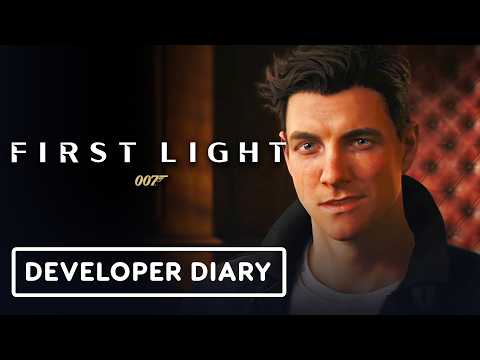
007 First Light - Official 'Story Dev Diary' Beyond the Light Episode 3
Audio Summary
AI Summary
Welcome to Beyond the Light, episode 3, featuring Mikuel F., the lead writer for 007 First Light. Mikuel, who has been with IO for 14 years, discusses the crafting of the game's story.
The project's vision always centered on Bond's origin. Meeting Bond as a young man meant the story and tone needed to reflect a youthful perspective. Unlike a dark and gritty spy narrative, this world is dangerous but also fun, inviting, adventurous, and ultimately hopeful. Bond isn't jaded yet; he's experiencing the exciting world of espionage for the first time with a sense of bright-eyed wonder. While many heroes walk away from explosions because they've seen so many, a 26-year-old Bond, on his first outing, would likely turn and watch.
Many familiar James Bond qualities are present as innate traits: he's charming, charismatic, audacious, cool under pressure, incredibly capable, resourceful, and ruthless when necessary. However, he also exhibits emotional distance or a reluctance to deal with emotions. He's not yet the suave connoisseur of champagne, wine, and fancy cars; that will come with age. As a young man, he possesses traits not often seen before: innocence, trust, earnestness, and idealism—qualities that may not survive long in his line of work.
Belonging is a key theme. Bond is a young man searching for his place and purpose. The story explores what it means to be a 00 agent in the current age, questioning if the world still needs them and if intuition matters when technology can do everything better. This youthful take also influenced gameplay choices, such as a bluff mechanic that allows Bond to escape tight spots, reflecting the actions of a young, impulsive James Bond, unlike Agent 47, who plans meticulously.
Game writing involves two toolboxes. The first is classic screenwriting craft: structuring plots, creating character arcs, and developing resonant themes. This forms the initial, elastic story outline, similar to a feature film, but designed with a flexible second act to accommodate a longer campaign while maintaining tension. Once this outline is complete, the second toolbox—game writing craft—comes into play. This involves translating the outline into an interactive experience, working closely with level designers to craft the moment-to-moment story gameplay flow. This process is far more demanding than simply writing an outline, taking significantly longer.
For writers trained in classic storytelling, a linear, story-driven action-adventure like First Light is closer to their comfort zone than a sprawling, non-linear, gameplay-driven title like Hitman. The main challenge was to create a forward-momentum game while retaining the core elements that define an IOI game. The story focuses on Bond's journey to becoming a 00 agent, placing him on a trajectory without fully resolving his character. Bond is seen as someone who grows and evolves but doesn't fundamentally change; instead, his innate qualities make him an agent of change, constantly altering the world around him. He possesses inherent "Bond qualities" from the outset. The story explores his maturation and how he, in turn, changes MI6 and the characters around him. Bond's heart, tenacity, and willingness to take risks influence MI6's operations in an otherwise risk-averse, data-driven era.
This Bond also leans more on other people than typically seen, partly because he's a less seasoned agent still learning, and partly because games, unlike films, often involve players spending long periods alone. A strong supporting cast is essential for communicating the story. Bond develops strong relationships throughout the campaign, some with familiar characters and some with new ones, each affecting his character development.
Player agency is crucial, especially for IOI players. While players are given as much agency as possible, they must always feel like Bond. Unlike Hitman, where players can act spectacularly out of character, this feels wrong for the established Bond. Therefore, choice is approached not through branching narratives but through improvisation. Players can choose to be a brawler, use clever dialogue, or utilize gadgets, all valid choices that allow players to feel clever and think like a proper 00 agent without breaking character. Dialogue trees are used for world-building, with usually one mandatory option and others for exploring the world and characters. Eavesdropping, similar to Hitman, is also a creative approach, allowing players to gather hints and unlock opportunities.
A good villain is thematically opposed to the main character, often encompassing multiple individuals who challenge different aspects of the hero's character. Sometimes, a villain is a dark mirror image of the hero, but thematic opposition—diametrically opposed values and ideas—is most impactful. A character like Bobma, for example, is a study in contrasts: volatile and ruthless yet thoughtful and eloquent, a "philosopher king" who built something from nothing, earning a certain respect even in a harsh environment.
The game features great actors and a fantastic ensemble cast. While the story is clever and intriguing, it's the characters that ultimately drive engagement, much like in TV series. If you missed the first two episodes of Beyond the Light, they are available on the channel. Don't forget to pre-order 007 First Light, releasing on May 27th, for a free deluxe upgrade.