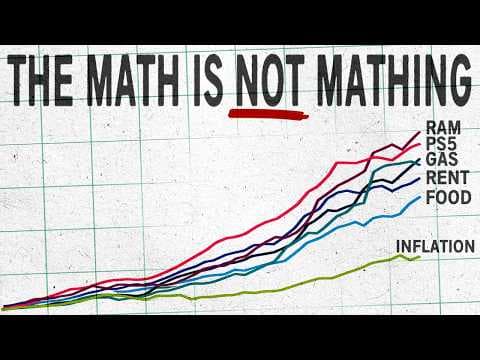
How Is Everything Outpacing Inflation At The Same Time?
AI Summary
The perception that the price of everything is outpacing inflation is a common sentiment, despite official economic measurements suggesting otherwise. Economics 101 teaches that inflation is measured by tracking the weighted cost of a basket of goods and services, known as the Consumer Price Index (CPI). The Bureau of Labor Statistics (BLS) indicates that since mid-2023, the measured inflation rate has been around 3% annually, trending downwards to about 2.5% today. However, this figure often feels disconnected from daily experience, as many consumers struggle to find items that have only increased by 10% over three years.
Historically, essentials like healthcare, housing, and education have outpaced inflation, with their impact on the average offset by cheaper non-essentials such as cell phones, software, and televisions. Today, even these non-essentials are becoming more expensive. Computer hardware is now a strategic investment, PlayStations have seen significant price hikes, new cars average close to $50,000, and software has largely shifted to expensive subscriptions. Fast food, once a cheap convenience, is now a costly treat, and energy bills are soaring. Housing, healthcare, and education continue to be problematic. Furthermore, tariff discussions are causing even generic consumer goods to become more expensive. This raises questions about whether anything is still offsetting these rising costs or if there are issues with the statistical methods used to measure inflation.
The skepticism about official inflation figures, which suggest low single-digit annual increases, is not unfounded. While it's unlikely the government is intentionally manipulating data, there are significant problems with how this data is processed, leading to a skewed understanding of actual costs.
One major challenge is controlling for quality in official inflation rates. Surprisingly, this includes instances where products improve. For example, a new iPhone performs the same basic function as its predecessor from 20 years ago, but its maximum capabilities are vastly superior. Statisticians face a dilemma: if prices remain similar over time, consumers are technically getting more phone for less money due to improved capabilities. Similarly, if prices rise but capabilities increase much faster, it's argued that purchasing power can be maintained by buying a lower-end phone that still outperforms a high-end product from earlier years.
The BLS addresses this by adjusting prices downwards for quality improvements. If a phone becomes more expensive but features a higher pixel count, a better processor, or an improved camera, its price is adjusted to compensate for these enhancements. This adjusted, lower price is what's counted in the CPI basket, even if it's not the actual price consumers pay. Similar adjustments are made for items like televisions. While not inherently unfair, these adjustments can strain budgets for consumers who don't necessarily benefit from or need these advanced features. Many users, for instance, only require basic phone functions that could be performed by much older devices, yet they pay higher prices for features they don't utilize. The statisticians might suggest using older or lower-tier phones, but this often isn't feasible due to issues like poor repairability and software updates rendering older hardware unusable.
However, these tech products, despite their theoretical price reductions, constitute a relatively small portion of overall spending. To understand the broader picture, it's necessary to look at bigger ticket items.
Not all items in the CPI basket are weighted equally; some have a larger share of household budgets. For instance, a doubling of movie ticket prices would have less impact on an average person's budget than an increase in insurance premiums. Consequently, entertainment items are weighted much lower than insurance when calculating the CPI. The largest category in the basket is housing, but its measurement is complex and unintuitive. Housing is both an essential consumer good and a speculative asset. The BLS aims to separate the speculative aspect, focusing on housing as a consumed good, like food or water.
Therefore, actual house prices are not directly measured in the CPI. Instead, the BLS surveys homeowners and rental listings to estimate how much a home could be rented for, a metric called "owner's equivalent rent." The idea is that renting represents pure consumption of shelter, not an investment. While this theory makes sense, it means that the biggest purchase most people make in their lifetime isn't directly counted in inflation. This indirect measurement through rental equivalents creates three main problems:
1. **Lagging data:** Rental agreements are long-term, causing this data to lag behind the true housing market by several months.
2. **Inconsistent rent:** Rent can vary significantly between properties, with some including utilities and maintenance, while others are very basic.
3. **Ignored costs for homeowners:** For homeowners or aspiring homeowners, this method ignores crucial costs like maintenance, property taxes, HOA fees, improvements, insurance, and, most importantly, mortgage interest, which can vary widely based on purchase timing.
The BLS acknowledges these issues, but this doesn't alleviate the financial burden on consumers or bridge the gap between reported inflation and felt reality.
The final major reason for the perception of faster-than-inflation price increases is the declining quality of many goods and services. This phenomenon, often called "shrinkflation" or "shitification," involves companies maintaining prices year-to-year but cutting costs by reducing build quality, materials, or ingredients. This allows them to claim stable prices while consumers receive inferior products. The inability to use older phones, for instance, is partly due to poor repairability and software updates that render older hardware obsolete. This widespread decline in quality is evident in both data and personal experience.
Another subtle but significant issue is the increasing number of hurdles consumers face to access reasonable prices. Dynamic pricing has become common for everyday purchases like groceries, insurance, and travel. Companies build profiles on consumers to individually set prices, aiming to extract the maximum possible amount from each person. For example, a busy professional might pay more for groceries than a retiree shopping during off-peak hours. This practice makes it nearly impossible to accurately assess what the "average" consumer pays for their statistical basket of goods, as prices fluctuate based on an algorithm's assessment of their perceived wealth and willingness to pay. Similar hurdles exist elsewhere; to get a good deal at a fast-food chain, one might need to use an app, check daily rewards, and navigate complex bundle offers. Those unwilling to do so end up paying significantly more.
In summary, the feeling that everything is outpacing inflation stems from a combination of statistical nuances: the challenge of accounting for expensive and increasingly essential new technology, the peculiar way housing is measured, and corporate cost-cutting leading to declining quality and dynamic pricing.
While these are important statistical considerations, they don't change basic arithmetic. It's worth noting which categories have actually fallen below the overall inflation rate. The good news is that one key category, gasoline and other fuels, has seen falling prices, which has a tangible ripple effect throughout the economy. The bad news is that this trend is unlikely to continue.
Understanding these complexities in government statistical collection is crucial because the inflation figure underpins many financial decisions, from pay raises to savings interest rates. For younger, early-career professionals, in particular, the true cost of living is likely rising much faster than the single headline inflation measurement suggests.