Forza Horizon Recap - Yes, Seriously...
Audio Summary
AI Summary
The Forza Horizon series, often perceived as a simple racing game, actually boasts a rich narrative, presenting a clash between two competing visions for civilization. This epic story, rendered in chrome and destructible fence posts, has spanned multiple installments and holds significant implications for the upcoming Forza Horizon 6.
The narrative begins in Colorado in 2012 with the inaugural Horizon Festival, a gathering of car enthusiasts drawn to the thrill of speed. The first game, Forza Horizon, chronicles the quintessential American hero's journey of a young driver, the player, rising through the ranks to challenge established champions like Darius Flint. Beyond individual races, the festival established the car's dominance over other forms of transport. This was epitomized by showcase events, like the iconic race between a 1970 Ford Mustang Boss 429 and a P-51 Mustang fighter plane, symbolizing America's core identity and air superiority. These events demonstrated that the Horizon Festival was more than just a race; it was a spiritual celebration of the automobile's power and freedom. The series continued to push this theme, with cars racing against planes, helicopters, and even hot air balloons, asserting the car's supremacy on America's open roads.
Forza Horizon 2 shifted the festival to the car-loving nations of France and Italy in 2014. This installment embraced the idea of a grand, sprawling festival with multiple locations, incorporating elements of the Grand Tour and road trips. Showcase events returned, featuring a race between an Italian Air Force team and a Ferrari, and a bizarre rematch against numerous hot air balloons. The game also introduced a new adversary for the car: the train. This rivalry, framed as a battle between freedom (cars) and socialism (trains), culminated in a close race between a steam-powered locomotive and a 1968 Lancia, highlighting the train's speed and the car's narrow victory. The festival continued with a Jaguar SQRS racing a cargo plane, inspired by the Riviera's beauty.
Australia hosted Forza Horizon 3, setting a new standard for spectacle with its diverse landscapes. The festival innovated by tying showcase events to social media followers, increasing fan engagement. While cars still raced against aircraft, a shift occurred with a buggy facing off against an airship, signaling a more friendly banter between land and sky. The series also explored competition between different vehicle types, with a Toyota Baja truck racing powerboats. However, the road versus rail feud remained central, featuring a freight train versus a 2015 Chevrolet Camaro.
The United Kingdom became the backdrop for Forza Horizon 4 in 2018, a nation with a rich motoring heritage and the birthplace of the railway. The festival featured a heritage race between a Vulcan bomber and an Aston Martin Vulcan, and a hovercraft versus a Toyota Baja truck, challenging the automobile's dominance. The Flying Scotsman represented rail against a rocket-powered shopping trolley, with the car ultimately winning, though the game noted the contrast with Britain's more understated car culture.
Forza Horizon 5 returned to Mexico in 2021, offering a vibrant, coast-to-coast road trip experience. Showcase events became more involved with expeditions, highlighting the land itself. The ultimate showcase was a final grudge match between a freight train and the iconic Lamborghini Countach in Mexico's Copper Canyon. Despite the Countach’s size limitations, the car emerged victorious, further solidifying its supremacy.
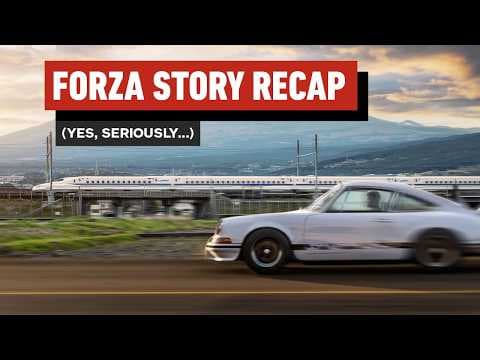
The upcoming Forza Horizon 6 is set in Tokyo, Japan, a global capital of street racing and home to a strong automotive industry. However, this is also the territory of the Shinkansen, Japan's iconic bullet train, representing a formidable challenge. The Shinkansen embodies collectivism, a stark contrast to the car's individualism, posing an existential threat to the cult of the motor car. This sets the stage for the ultimate showdown between personal freedom and societal progress.